

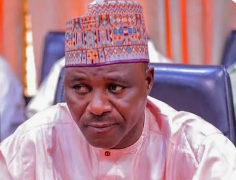
By Luminous Jannamike
ABUJA — “Those who follow us will enjoy the honey; if you refuse, then you’ll be flogged.”
Those were the words from Borno State Commissioner for Youth and Sports Development, Sainna Buba, as he addressed supporters of Tinubu’s City Boy Movement in Maiduguri ahead of the 2027 presidential election.
He also spoke of breaking fingers. He later retracted the remarks and described them as figurative, but by then the words had travelled.
Buba’s comments matter not simply because one commissioner made an inflammatory statement, but because they fit a growing pattern of political language in which disagreement is answered not with persuasion, but with warnings, exclusion and the language of punishment.
A Vote Should Not Come with a Threat
Buba’s outburst would be easier to dismiss if it stood alone.
Recently, in Kuje Area Council of the Federal Capital Territory, the chairman, Samuel Danjuma Shekwolo reportedly told residents to either support APC or leave the council.
His Chief Protocol Officer, Stephen Tumaka, similarly warned that Kuje was not for residents who would not vote for President Bola Tinubu and APC in 2027.
In Osun, Senator Francis Fadahunsi, representing Osun East, was captured appearing to call for Accord Party members to be killed. He later explained that he meant defeating the party with votes.
Then, in Yobe, APC State Chairman, Alhaji Muhammad Gadaka, reportedly told women: “If your husband won’t allow you to vote for the APC, stand up to him and seek a divorce. If you leave the marriage, I will pay your dowry and marry you.”
Put together, the language follows an uncomfortable progression: vote for us; vote for us or leave; oppose us and you will be punished.
It is not proof that the APC has adopted intimidation as official policy. It is evidence of a political culture in which some public figures speak about electoral competition as though political choices carry consequences beyond the ballot box.
When ‘Figurative’ Still Frightens
Borno Commissioner, Sainna Buba has since apologised and withdrawn the remarks, saying they did not represent APC ideals or Governor Babagana Zulum’s administration. He also said his words were figurative and directed at APC members accused of disloyalty.
Political words do not exist only in the minds of those who utter them. They are heard by ordinary citizens, opponents and undecided voters.
When words such as ‘flogged’, ‘break fingers’, ‘leave’ and ‘kill’ enter political speech, the intended meaning may differ from the effect.
Shekwolo’s comments have been placed in the context of development under the Tinubu administration. Fadahunsi said ‘kill’ meant defeating Accord at the polls. But when violent or coercive metaphors become recurring features of mobilisation, dismissing each one separately misses the pattern.
Remember 2015?
ADC National Publicity Secretary, Bolaji Abdullahi, sees the irony.
“APC needs to call their members to order,” he told Saturday Vanguard.
His point was straightforward: the party that defeated PDP in 2015 did so because Nigerians had the freedom to reject the government then in power.
“If PDP had behaved this way, they would not have come to power in 2015,” Abdullahi said.
Political parties cannot celebrate democracy when it delivers victory and become impatient with voters choosing someone else.
Abdullahi called on security agencies to act against intimidation, urging them to make an example of what he described as “rascals masquerading as public servants.”
PDP National Publicity Secretary Jungudo Haruna Mohammed was equally blunt.
“This statement is unfortunate,” he also told Saturday Vanguard, describing the commissioner’s conduct as unbecoming of someone who occupies such a position and sits on the State Executive Council.
“If he (Borno Commissioner) feels he is doing any good for his party, he is not. Such threats and barbaric behaviour will only turn the people against the APC,” Jungudo added.
Borno cannot afford careless words
Borno makes the issue more sensitive. The state has endured years of insurgency and insecurity. Its political leaders therefore carry a special responsibility to avoid language that can deepen fear.
There is no evidence that Buba’s remarks caused violence. But there is little wisdom in treating threats of punishment as harmless campaign theatre in a place where citizens have experienced instability.
The Nigeria Police Force has reportedly opened an investigation into alleged inciting comments involving Buba, Shekwolo and Fadahunsi. Yet there has been no publicly announced disciplinary action or prosecution by the government.
The opposition camps are asking: if the commissioner’s words did not represent the government or APC, what action will make that distinction clear?
The Voter is Not the Enemy
The test of 2027 will not only be who wins. It will be whether Nigerians can make that choice without fear.
Politicians can campaign aggressively. They can attack policies, expose failures and ask voters to reject rival parties. What they cannot safely normalise is the idea that political disagreement deserves punishment.
The ballot is how citizens reward performance and reject failure. A government can be voted out. An opposition can be voted in. That is not betrayal. That is democracy.
When politicians treat dissent as disloyalty, they invert the relationship. The citizen stops being the person who gives power and starts looking like someone expected to obey it.
That is why these remarks deserve more than outrage for a few news cycles. They deserve scrutiny, accountability and a political response.
Right now, every party is asking Nigerians for their votes ahead of the 2027 general elections. The crucial question is whether voters will feel free to give them or withhold their votes.
An election is not an obedience test. It is a contest for consent. The citizen owns the choice. They should be persuaded, not threatened; won over, not intimidated.
The post ‘You’ll be flogged’: Threats against opponents cast shadow over 2027 appeared first on Vanguard News.