

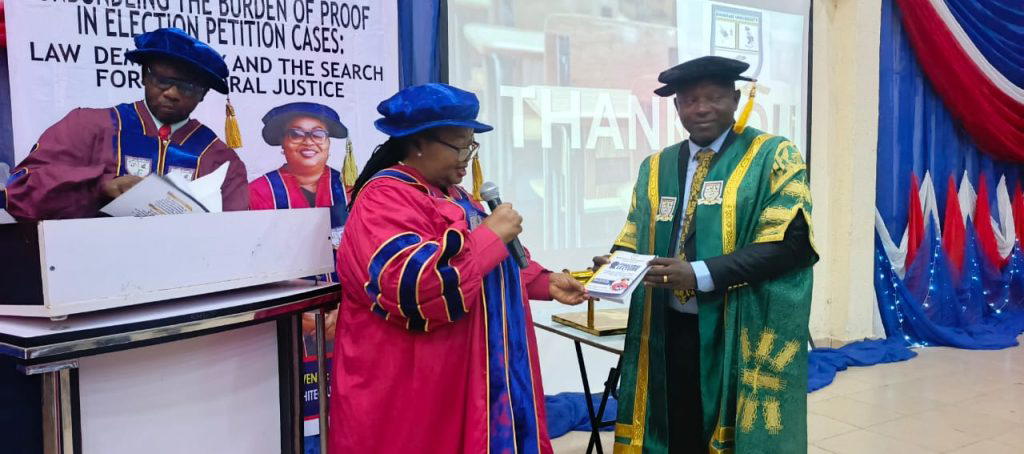
…seeks major reforms in election petition cases, burden of proof framework
…delays, ambiguities, procedural hurdles in election litigation pose serious challenges to public confidence in the electoral process – VC Ayuba
By Joseph Erunke, Abuja
With Nigeria preparing for the 2027 general elections, a leading constitutional law scholar has raised serious concerns over what she described as deep-rooted flaws in the country’s electoral justice system, warning that the current burden of proof requirements in election petition cases could continue to deny citizens meaningful access to justice and undermine confidence in democracy.
The warning came on Thursday at Bingham University’s 13th Inaugural Lecture, delivered by Professor Magdalyne Mbadzendan Dura, Dean of the Faculty of Law and Professor of Constitutional Law and Jurisprudence.
In a lecture titled “Unbundling the Burden of Proof in Election Petition Cases: Law, Democracy and the Search for Electoral Justice in Nigeria,” Professor Dura mounted a robust critique of Nigeria’s electoral adjudication framework, arguing that existing legal and procedural barriers have made it exceedingly difficult for aggrieved candidates and voters to successfully challenge disputed election outcomes.
She called for sweeping reforms involving the judiciary, legal practitioners, the National Assembly and the Independent National Electoral Commission, INEC, insisting that electoral justice cannot be achieved unless all stakeholders embrace a new approach to the handling of election petitions.
According to her, the current system often compels petitioners to prove electoral malpractices under practically impossible conditions, especially within the limited timeframe provided by law.
“The great questions of electoral law do not originate in courtrooms or legislative chambers; they originate in the lived democratic experiences of citizens who participate in elections and seek justice when they believe that process has been compromised,” she said.
Prof. Dura argued that the burden of proof in election petitions has become one of the greatest obstacles to electoral accountability, often preventing courts from examining the substantive merits of complaints.
She maintained that many petitions fail not necessarily because allegations are untrue but because evidentiary rules are structured against petitioners.
In one of the most far-reaching recommendations of the lecture, she urged the Supreme Court to reconsider long-standing judicial precedents governing election disputes and adopt a more balanced evidentiary standard in cases involving allegations of corrupt electoral practices.
She also called on the apex court to compel greater transparency from INEC by imposing a positive obligation on the electoral body to proactively disclose election materials relevant to disputes before tribunals and courts.
According to her, electoral justice requires that institutions in possession of critical evidence should not be allowed to frustrate access to such materials.
The law scholar further urged the National Assembly to use the newly enacted Electoral Act 2026 as an opportunity to address persistent deficiencies in the electoral legal framework.
She argued that although previous reforms introduced important innovations, gaps remain that continue to hinder effective adjudication of election disputes.
For INEC, Prof. Dura prescribed extensive institutional reforms, including the preservation of electoral records, establishment of clear disclosure protocols, strengthening of compliance mechanisms for tribunal directives and the creation of a robust technological accountability framework for electronic electoral systems such as BVAS and IReV.
She stressed that the credibility of electoral technology depends not merely on deployment but on the ability of citizens and courts to independently verify and authenticate the records generated by such systems.
Drawing heavily from the recommendations of the Justice Mohammed Uwais Electoral Reform Committee, she lamented that many proposals aimed at strengthening electoral accountability and institutional independence remain unimplemented nearly two decades after they were made.
“The Bar must litigate differently. The Bench must reason differently. The Legislature must legislate differently. INEC must administer differently,” she declared.
Prof. Dura described electoral justice as the cornerstone of democratic legitimacy, warning that every election cycle in which genuine complaints are blocked by procedural obstacles weakens public trust in democratic institutions.
“The Constitution makes a covenant with every citizen who casts a vote,that the vote will count, that the declared result will reflect that vote, and that where it does not, the courts will hear and correct. The burden of proof is either the operational expression of that covenant or its operational betrayal,” she stated.
Earlier, the Vice-Chancellor of Bingham University, Prof. Haruna Kuje Ayuba, said the theme of the lecture was particularly significant as Nigeria moves closer to the 2027 elections.
He noted that questions surrounding the burden of proof in election petitions have increasingly become central to debates about electoral legitimacy, transparency and democratic governance.
According to him, delays, ambiguities, and procedural hurdles in election litigation continue to pose serious challenges to public confidence in the electoral process.
“This discourse is both urgent and essential. It supports Nigeria’s democratic trajectory and ensures that the voices of Nigerians are genuinely heard and respected in the 2027 elections and beyond,” Ayuba said.
The Vice-Chancellor also congratulated Prof. Dura for becoming the university’s 13th inaugural lecturer and the first professor from the Faculty of Law to deliver an inaugural lecture at the institution.
He described the event as a milestone for the faculty and a demonstration of Bingham University’s commitment to fostering rigorous intellectual engagement on critical national issues.
The lecture attracted academics, legal practitioners, students, university officials, and policy stakeholders among others.
Former governor of Benue State, Chief Samuel Ortom; former Senate President, Dr. Iyorchia Ayu and a constitutional lawyer, Dr. James Onoja, SAN, in their various goodwill messages at the event, hailed the presentation as a timely intervention in Nigeria’s ongoing quest for credible elections and democratic accountability.
The post 2027: Bingham varsity don calls for electoral justice overhaul appeared first on Vanguard News.

 Daily Post
 The Leadership
 Vanguard Nigeria