

…Stakeholders advocate renaming LASU after Lateef Jakande
By Olasunkanmi Akoni and Juliet Umeh
A professor of Political Science at Lagos State University (LASU), Sylvester Akhaine, and the Nigerian Guild of Editors (NGE) have stressed the need for a responsible media, transparent electoral commission and informed electorate to guarantee credible elections in Nigeria.
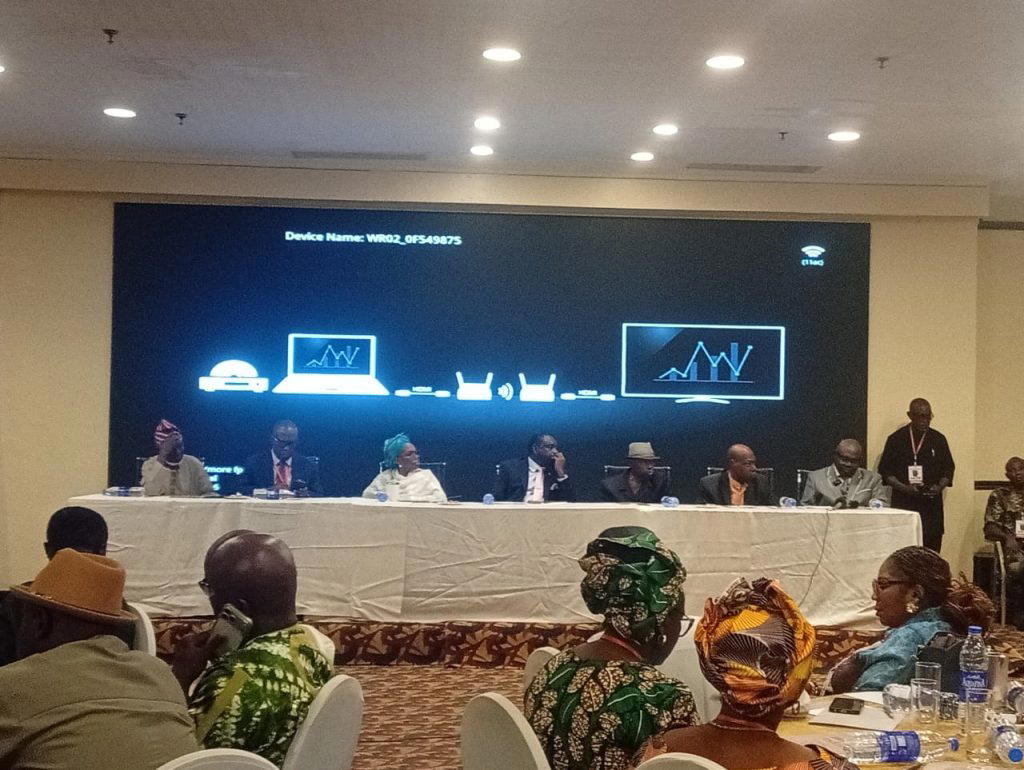
They made the call at the Fourth Lateef Jakande Memorial Lecture organised by the NGE on Thursday in Ikeja, Lagos, with the theme: “The Media, INEC, Voters and the Path to Credible Elections.”
The annual lecture is organised in honour of the late Alhaji Lateef Jakande, former Lagos State Governor, journalist and former President of the NGE.
The event was attended by NGE members led by its President and Editor of Vanguard Media, Mr Eze Anaba; Vanguard Publisher, Uncle Sam Amuka; veteran journalist and co-founder of Newswatch, Mr Ray Ekpu; members of the Jakande family, including his widow, Alhaja Sikirat Jakande; academics, media executives, public officials, civil society representatives and students from LASU, Yaba College of Technology and other institutions.
Delivering the keynote address, Akhaine said the role of the media, the Independent National Electoral Commission (INEC) and voters would be critical to the success of the 2027 general elections.
Referencing the ideals of the Jakande administration during the Second Republic, Akhaine described the theme of the lecture as timely, given the country’s preparations for another electoral cycle.
“For credible elections to take place in our country, the media, INEC and voters have a role to play,” he said.
Akhaine described Nigeria’s democratic experience as facing challenges of state capture and weakened sovereignty, where institutional balance is affected and non-state actors exert influence in some areas.
He said such challenges had contributed to insecurity and increased reliance on community-based security arrangements alongside conventional security agencies.
The political scientist also criticised Nigeria’s political culture, citing monetised politics, poor leadership recruitment and a trust deficit that has reduced citizens’ active participation in governance.
He described the media as a key institution for information dissemination, public education and shaping opinion, noting its historical role in Nigeria’s democratic development.
On electoral management, Akhaine traced the evolution of Nigeria’s election bodies from the Electoral Commission of Nigeria (ECN) established in 1959 to the present INEC, established in 1998.
He said while election management bodies expanded globally following the third wave of democratisation, many in Africa still face challenges relating to independence.
Akhaine described voters as the “transmission belt for consent” in democracy, stressing that citizens remain central to any electoral process.
According to him, credible elections are best identified by the absence of practices such as ballot stuffing, vote-buying, gerrymandering and intimidation.
He referenced international frameworks, including the International Covenant on Civil and Political Rights (ICCPR), the African Charter on Human and Peoples’ Rights, the ECOWAS Protocol and SADC Guidelines, which promote free, fair and transparent elections.
Reviewing Nigeria’s electoral history, Akhaine said none of the seven general elections conducted since 1999 could be regarded as completely free and fair.
He cited previous electoral controversies, including the 1964/1965 elections, the 1979 “two-thirds” controversy, the annulment of the June 12, 1993 presidential election and the 2007 elections, which the Commonwealth Observer Group said fell short of acceptable standards.
He also identified emerging challenges facing the media, including misinformation, fake news and post-truth politics driven by digital platforms, bots and online manipulation.
Call for collaboration
Akhaine urged the media, INEC and voters to work together to strengthen Nigeria’s democracy.
He said the media must uphold the provisions of Sections 22 and 39 of the 1999 Constitution, which empower the press to hold government accountable and guarantee freedom of expression.
He urged INEC to maximise technological reforms and financial autonomy to improve electoral credibility.
Akhaine also supported recommendations of the Uwais Electoral Reform Panel, including the proposal to remove the appointment of INEC officials from the exclusive control of the executive arm.
He called for continuous voter education to help citizens make informed choices and resist electoral inducements.
“If these critical stakeholders play their role, it is my conviction that Nigeria’s democratic train would be steered on the right course,” he said.
Earlier, NGE President Eze Anaba said the choice of theme was informed by the country’s approach to another electoral cycle and the need to strengthen democratic institutions.
He said the credibility of elections remained the foundation of legitimate governance, warning that doubts over electoral integrity could erode public confidence in democratic institutions.
Anaba urged the media to remain professional, accurate and fair in election coverage, while calling on INEC to continue to discharge its responsibilities with transparency, competence and impartiality.
He explained that the memorial lecture, instituted in 2023, was designed to preserve the legacy of Jakande, whose career as a journalist, administrator and public servant represented service, integrity and good governance.
The Chairman of the occasion, Prof. Lai Olorode, described Jakande as a leader committed to public welfare and urged political leaders to emulate his values.
He said credible elections remained essential to ensuring that the will of the people is reflected in governance.
Lagos State Governor Babajide Sanwo-Olu, represented by the Commissioner for Information and Strategy, Mr Gbenga Omotoso, described Jakande as an outstanding journalist and administrator whose contributions continue to inspire generations.
Sanwo-Olu warned against the spread of fake news and misinformation, urging media practitioners to uphold accuracy, credibility and ethical standards.
He also welcomed efforts by the Federal Government to address challenges facing media organisations, particularly the relationship between traditional media and global digital platforms.
Meanwhile, stakeholders at the event advocated the renaming of Lagos State University (LASU) after Lateef Jakande, describing the proposal as a fitting recognition of his contributions to education, journalism and public service.
The post 2027: Credible polls require responsible media, transparent INEC, informed voters — Akhaine, Editors appeared first on Vanguard News.

 Premium TImes
 Punch Nigeria
 Daily Post
 Arise TV
 Vanguard Nigeria
 The Leadership
 Modern Ghana
 Channels TV
 This Day