

…Stakeholders advocate renaming LASU after Lateef Jakande
By Olasunkanmi Akoni
Media practitioners, the Independent National Electoral Commission (INEC) and Nigerian voters have a shared responsibility to ensure credible elections in 2027, a professor of Political Science at Lagos State University (LASU), Sylvester Akhaine, has said.
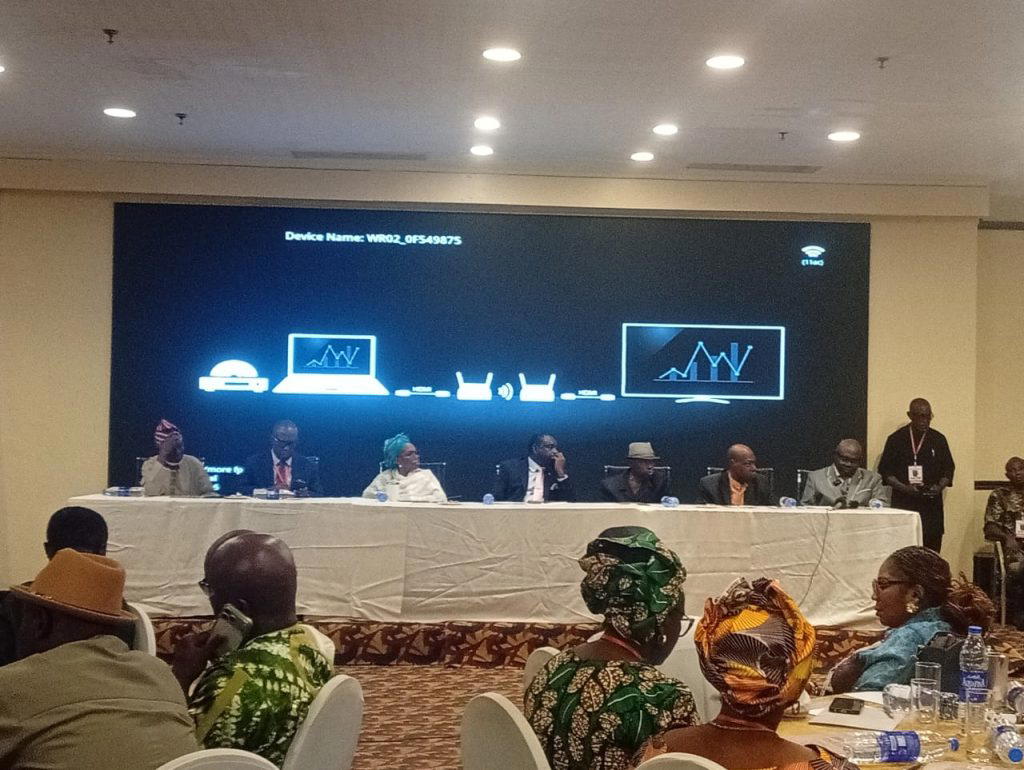
Akhaine made the assertion while delivering the keynote address at the 4th Annual Lateef Jakande Memorial Lecture organised by the Nigerian Guild of Editors (NGE) on Wednesday in Ikeja, Lagos.
The lecture, themed “Media, INEC, Voters and the Path to Credible Elections,” is held annually in honour of the late Alhaji Lateef Jakande, former Governor of Lagos State and veteran journalist.
Drawing lessons from the Jakande era during the Second Republic, Akhaine described the lecture theme as timely in view of preparations for the 2027 general elections.
“For credible elections to take place in our country, the media, INEC and voters all have important roles to play,” he said.
He described Nigeria’s democratic landscape as one characterised by “state capture” and “negative sovereignty,” where the executive dominates other arms of government while non-state actors exercise control over parts of the country, worsening insecurity and increasing dependence on local vigilante groups alongside conventional security agencies.
Akhaine also criticised the country’s political culture, citing monetised politics, mediocrity in leadership recruitment and a widening trust deficit that has left many citizens disengaged from the democratic process.
According to him, the media remain vital to democracy through information dissemination, public education and opinion shaping, noting that Nigeria’s press has historically maintained a strong libertarian tradition dating back to the colonial era.
On electoral administration, he traced the evolution of Nigeria’s election management bodies from the Electoral Commission of Nigeria (ECN) to the present-day INEC, established in 1998. He observed that although election management bodies expanded globally following the third wave of democratisation, many across Africa, including Nigeria’s, still lack full institutional independence.
Describing voters as the “transmission belt for consent,” Akhaine said they remain central to any democratic process.
He noted that while credible elections are defined in different ways, they are most easily recognised by the absence of electoral malpractice such as ballot stuffing, vote-buying, gerrymandering and voter intimidation.
Akhaine cited international instruments, including the International Covenant on Civil and Political Rights (ICCPR), the African Charter on Human and Peoples’ Rights, the ECOWAS Protocol and the SADC Principles and Guidelines Governing Democratic Elections, all of which promote free, fair and transparent elections.
Reviewing Nigeria’s electoral history, he argued that none of the seven general elections conducted since 1999 could be regarded as completely free and fair. He referenced the disputed 1964/1965 elections, the “two-thirds” constitutional controversy of 1979, the annulled June 12, 1993 presidential election and the 2007 general election, which the Commonwealth Observer Group said fell below acceptable standards.
He also warned that the media now faces fresh challenges from digital technology, misinformation and post-truth politics, where bots and coordinated online campaigns increasingly undermine factual reporting.
Calls for collaboration
Akhaine urged greater collaboration among the media, INEC and the electorate to strengthen Nigeria’s democracy.
He said the media must remain committed to truth and continue to uphold Sections 22 and 39 of the 1999 Constitution, which empower the press to hold government accountable and guarantee freedom of expression.
He urged INEC to maximise its technological reforms and financial autonomy to conduct credible elections, while also supporting the recommendations of the Justice Mohammed Uwais Electoral Reform Committee, particularly the proposal to remove the President’s power to appoint INEC leadership and transfer it to the legislature.
He also called for sustained voter education to help citizens resist financial inducements and make informed electoral choices.
“If these critical stakeholders play their respective roles, it is my conviction that Nigeria’s democratic journey will be steered in the right direction,” Akhaine said.
At the event, stakeholders also advocated renaming Lagos State University after the late Lateef Jakande in recognition of his contributions to education and the establishment of the institution.
The post Media, INEC, voters hold key to credible 2027 elections — Prof. Akhaine appeared first on Vanguard News.

 Vanguard Nigeria
 Business Day
 Daily Post