

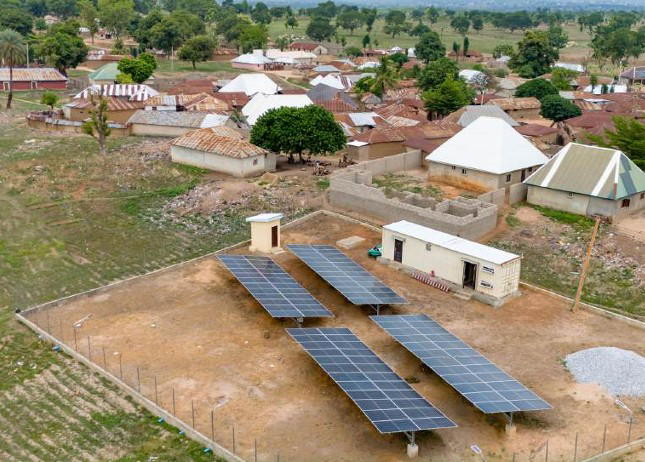
By sunset, Ajuye used to disappear.Nestled along a dusty farming corridor in North Central Nigeria, the community of Ajuye was a place that fell still after sunset. Once darkness settled over its market stalls and clay walled compounds, businesses closed early, generators sputtered to a halt and much of the town retreated indoors.
Traders rationed fuel carefully. Welders shut down their equipment before nightfall. Families relied on torchlights and battery lamps.
In the health centre, emergency cases were sometimes handled under dim improvised lighting. For generations, this was simply how life in Ajuye worked.
Today, the town glows.
From a distance, the light is the first thing visitors notice. “People coming from Abuja at night can now see the village shining brightly from afar,” says Yakubu Ahmed Maidoji, the Sarkin Ajuye, seated beneath a slowly rotating ceiling fan inside his palace. Around him, the town hums with an energy that residents say would have been difficult to imagine only a few years ago.
For many residents, it is the first time in the community’s history that homes and businesses have experienced stable electricity. Generations lived without power, relying on improvised lighting for everyday life.
Ajuye, a farming and trading settlement in Nasarawa State, is among a growing number of rural communities benefiting from Nigeria’s expanding renewable energy transition through off-grid electrification projects. The community’s 120kW solar hybrid mini-grid was developed under the Rural Electrification Agency’s Nigeria Electrification Programme (NEP), as part of interventions advancing under the World Bank-supported Distributed Access through Renewable Energy Scale-up (DARES) initiative. The project was developed by Husk Power Systems and became operational in January, 2025.
For residents here, however, the transformation is measured less in megawatts or policy language than in the ordinary routines of daily life.
Cold drinks are now sold deep into the evening. Welding machines run late into the night. Charging shops remain open past midnight. Tailors sew without interruption. Mothers freeze food at home. Children sleep under fans instead of waving away heat with hand-held paper paddles.
“We used to spend most of our earnings buying fuel,” says Bulus Yusuf, a welder whose workshop sits near the market road. “Sometimes you make money all day, and almost everything goes back into the generator.”
Before the mini grid Yusuf spent estimated ₦60,000 to ₦70,000 a month on generator fuel alone, a cost that consumed most of his margins. Now his electricity bill is a fraction of that between ₦10,00 to ₦20,000, while his working hours have stretched to cover more jobs per day and he has added two machines to his workshop. He speaks openly about hiring an apprentice.
Around the market square, small businesses have quietly reorganised themselves around the assumption that electricity will remain available. Phone charging hubs, once entirely dependent on noisy petrol generators, now operate with little interruption.
“My business now runs 24 hours,” says Abdulazeez Zakaria, who manages one of several charging points serving both Ajuye and surrounding villages still without electricity. “Before, you worried about fuel, repairs or whether the generator would stop. Now you recharge the electricity and continue working.”
The shift is not only economic. Residents repeatedly describe electricity as changing the emotional atmosphere of the town itself.
There are more people outside after dark. Shops remain open later. Streets feel safer. In conversations across Ajuye, the language of development appears less abstract and more immediate: comfort, movement, business, visibility.
At the central mosque, evening religious lessons now take place under electric lighting and fans. In homes, women use refrigerators to sell cold drinks and frozen food. Some residents say tensions caused by heat and darkness inside households have eased.
Anthony Sakuya Abednego, a community health worker at Kyuni Clinic, a community health center, remembers arriving in Ajuye in 2019 when electricity barely existed. The facility serves Ajuye and surrounding settlements and for years its staff managed night-time emergencies under conditions that made the work far harder than it needed to be.
“If you needed light during labour cases or accident emergencies, you depended on generators,” he says.
Since the mini-grid became operational, the facility now runs a vaccine refrigerator continuously, deliveries and emergency procedures are handled under consistent electric lighting. Staff report being able to attend to patients at any hour of the night without contingency planning for power failure.
“Now I can work effectively at any time of the night.” The generator, he says, now sits mostly unused.
Across the town, there is a noticeable pattern in how residents speak about the future. The conversation is no longer centered purely on access to electricity. Instead, people speak about what electricity allows them to attempt.
Fatima Abdullahi, a resident and mother of four says electricity has improved home life and reduced heat-related stress. “We now sleep comfortably with fans and children can study at night,” she says. She added that daily routines have become easier, especially during hot nights. Her husband, she notes, has also committed to buying a television for the household, a step she says was not previously possible without reliable electricity.
Muhammad Shafi’u Yunusa, a fashion designer who has operated a tailoring business in Ajuye plans to open a second shop. His tailoring shop now runs industrial sewing machines without interruption. One of the clearest signs of what that stability has made possible is Aisha Jibrin, who works alongside him as an apprentice.
Aisha started her apprenticeship under Muhammad before the mini-grid arrived. “Progress was slow and work stopped when fuel ran out or daylight faded” she said.
“When the electricity came, everything changed. I was able to learn industrial sewing properly because the machines could run consistently and I had more time to practise after normal working hours.” She now works full-time in the shop, skilled on both manual and industrial machines. “Without steady electricity, I don’t think I would have progressed this fast.”
The Sarkin Ajuye says nearby villages regularly approach him for help securing connections. “People continue begging me to help them get this electricity,” he says.
That demand reflects a wider reality across rural Nigeria, where millions still live beyond the reach of stable grid electricity. While large urban centres remain connected, many rural communities continue to rely on expensive generators, diesel, kerosene and improvised energy systems that limit business activity and public services.
In Ajuye, residents insist the difference lies not simply in having electricity but in having electricity that works consistently.
Several compare the solar system favourably with Nigeria’s notoriously unreliable grid supply. “Sometimes regular electricity disappears for two or three days,” says Muhammad Shafi’u Yunusa. “But here, we have power almost all the time.”
There are still gaps. Not every household is connected. Some outskirts of the community remain unserved. Residents continue pushing for expansion into nearby settlements. But even with those limitations, the presence of stable electricity has already altered the town’s trajectory.
What is striking in Ajuye is that people rarely describe electricity as infrastructure alone. They describe it as an arrival of hope and change.
For decades, the community watched electricity poles erected elsewhere while remaining largely excluded from modern energy access. Now, the glow visible from the roadside after sunset has become, for many residents, proof that the town is no longer being left behind.
The post Ajuye after dark: How solar power is reshaping life in a forgotten Nigerian town appeared first on Vanguard News.

 This Day
 Daily Post
 Vanguard Nigeria
 Channels TV
 Punch Nigeria
 The Guardian Football
 Mwananchi