

….FG committed to removing bottlenecks, improving ease of doing business
….NECA to upgrade Employers’ Summit into international event in 2027
By Johnbosco Agbakwuru
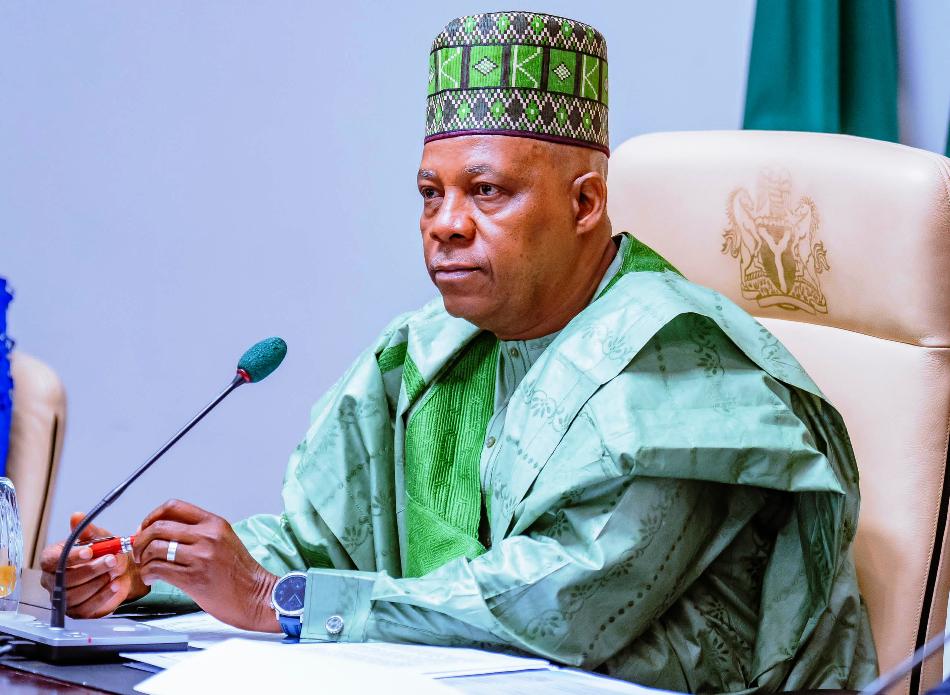
ABUJA — Vice President Kashim Shettima has said no government can fully understand the economy without maintaining regular engagement with employers and the private sector.
He also reaffirmed the Federal Government’s commitment to removing bureaucratic bottlenecks and digitising government processes to improve the ease of doing business across the country.
Shettima spoke on Monday at the 5th Nigerian Employers’ Summit in Abuja. He was represented by a former Minister of the Federal Capital Territory (FCT) and Special Adviser to the President on General Duties, Dr. Aliyu Modibbo Umar.
The Vice President described the summit as timely, saying Nigeria is at a decisive moment that requires honest conversations about economic reforms.
“It is honest because reform demands difficult conversations about production costs, access to credit, exchange rates, taxation and investment.
“It is necessary because the private sector cannot compete on sentiment. It competes on functional infrastructure, predictable policies, fair taxation and reliable energy,” he said.
Commending President Bola Tinubu for taking difficult but necessary decisions, Shettima said prosperous nations achieved success through visionary leadership backed by the courage to implement reforms.
“Foresight without courage produces fine speeches and empty outcomes. Courage without foresight produces motion without progress. What a nation requires is the marriage of both: the vision to see what must change and the resolve to change it, even when the path is steep.
“That is the burden of responsible leadership,” he said.
The Vice President praised the Nigeria Employers’ Consultative Association (NECA) for sustaining a credible platform for dialogue among government, labour, development partners and the organised private sector.
“For nearly seven decades, NECA has remained a credible voice of employers, building bridges between government, labour, development partners and the business community. I commend NECA for sustaining this important tradition,” he said.
According to Shettima, the Tinubu administration inherited an economy burdened by structural challenges, including an unsustainable fuel subsidy regime, a fragmented foreign exchange market, weak government revenue and declining investor confidence.
He said the administration chose to confront these challenges rather than postpone difficult decisions.
“The Renewed Hope Agenda was designed to address these realities. We cannot build prosperity on distortions, attract investment when foreign exchange remains uncertain, or create jobs when enterprises are suffocated by multiple taxation, poor logistics and insecurity.
“The reforms have been difficult, but their purpose is to correct the foundations so that growth becomes real, durable and inclusive,” he stated.
Shettima said restoring macroeconomic stability was the government’s first priority because businesses require confidence to plan and invest.
“This is why removing the fuel subsidy and reforming the foreign exchange market remain central to our reforms. The subsidy crowded out investment while encouraging inefficiency and rent-seeking. The foreign exchange reforms are delivering a more transparent and market-reflective system,” he said.
He added that the administration’s fiscal and tax reforms are aimed at reducing the burden on businesses by harmonising taxes, simplifying administration, protecting vulnerable groups, supporting small businesses and encouraging compliance.
“Businesses do not reject taxation. They reject multiple taxation, harassment and systems that punish compliance while rewarding informality,” he said.
The Vice President stressed that government remains committed to improving the business environment.
“The private sector asks only that government should not make doing business unnecessarily difficult. Every delayed approval and every unclear regulation imposes additional costs on enterprise.
“That is why we remain committed to reducing bottlenecks and digitising government processes so that reforms announced in Abuja are experienced by businesses in Lagos, Kano, Aba and every part of the country without delay,” he added.
Earlier, the Director-General of NECA, Mr. Adewale Oyerinde, said the summit had, over the past five years, consistently produced practical policy recommendations that have shaped national economic discourse and strengthened collaboration between government and the organised private sector.
“Our responsibility is to ensure that government understands where businesses are experiencing challenges and what policy adjustments are required to improve enterprise competitiveness. This summit provides that platform and ensures that the voice of employers is heard,” he said.
Oyerinde also announced that beginning in 2027, the Nigerian Employers’ Summit will be expanded into an International Employers’ Summit.
“By the grace of God and with the support of our partners across Africa and the world, I am pleased to announce that beginning in 2027, the Nigerian Employers’ Summit will transition into the International Employers’ Summit,” he said.
The post Any government that ignores employers can’t fully understand economy — Shettima appeared first on Vanguard News.

 Business Day
 Premium TImes
 Punch Nigeria
 This Day
 Vanguard Nigeria
 Daily Post
 Capital Ethopia
 The Standard Kenyan
 The Guardian Football