

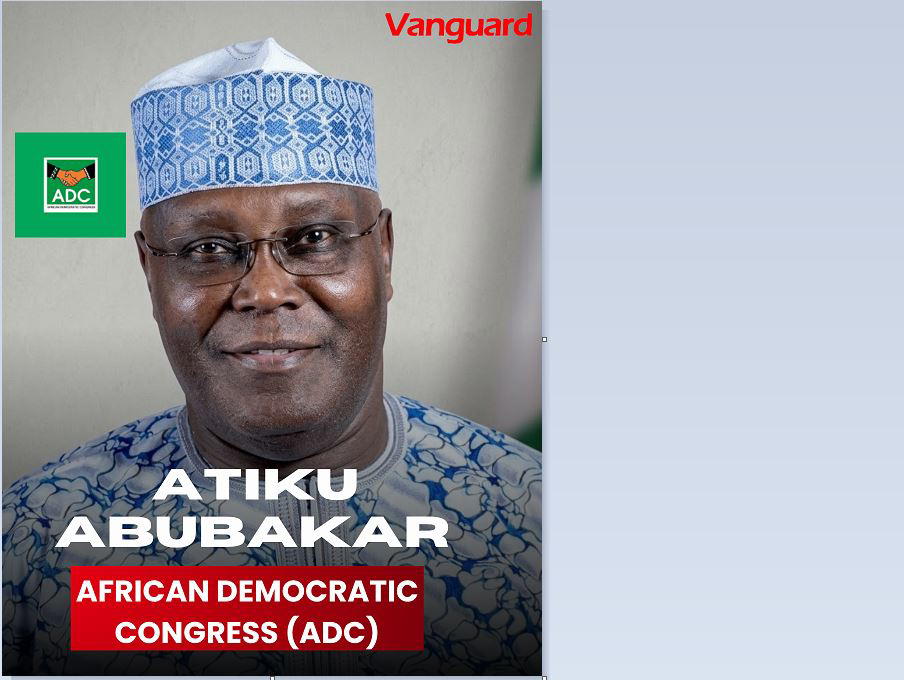
At 79, Atiku Abubakar is no longer trying to prove that he can survive Nigeria’s politics. He has already done that. His significance in the 2027 presidential contest lies elsewhere.
Read Also: 2027 Presidential Election: Meet Sandy Onor, scholar carrying PDP’s broken burden
After decades of moving through virtually every important corridor of federal politics, the former vice president has arrived at the African Democratic Congress, ADC, as the opposition party’s presidential candidate, carrying with him experience, networks, old alliances, old battles and the burden of an ambition that has refused to disappear.
The ADC has formally submitted Atiku’s name, alongside Rotimi Amaechi’s as running mate, to the Independent National Electoral Commission, INEC. INEC subsequently published the particulars of the presidential candidates and their running mates for the 2027 election.
That makes the 2027 contest another chapter in a political story that began long before Atiku occupied the Vice Presidential Lodge.
It is a story of movement: from the Nigerian Customs Service to business, from state politics to the presidency’s inner circle; from an alliance with Olusegun Obasanjo to a bitter rupture, and from the PDP to a succession of opposition platforms before his latest home in the ADC.
From Jada to Customs
Atiku was born on November 25, 1946, in Jada, Adamawa State. The biographical record supplied for his INEC nomination places his formal qualifications at First School Leaving Certificate, West African School Certificate and a Master of Arts in International Relations obtained in 2020.
His first professional world, however, was not politics. It was the Nigerian Customs Service.
He joined the service in 1969 and spent about two decades there, eventually rising to the rank of deputy director before voluntarily retiring in 1989. His years in Customs gave him something that would later prove useful in politics: an understanding of government machinery, commerce, borders and the workings of a large federal institution.
Business followed, but politics was never far away.
Atiku had already begun building political relationships while still a Customs officer. By the early 1990s, he was no longer simply a businessman with political interests. He was becoming one of the northern politicians whose ambitions could not easily be ignored.
In 1991, he contested the governorship of the old Gongola State. Two years later, he sought the presidential ticket of the Social Democratic Party, SDP. He did not win it. The experience, however, established an enduring pattern: Atiku would repeatedly come close to the centre of presidential power, fall short, regroup and return.
The Obasanjo years
His defining breakthrough came in 1998. Atiku was elected governor of Adamawa State but never occupied the office for which he had won the election. Instead, Olusegun Obasanjo, the PDP presidential candidate, selected him as running mate.
The ticket won the 1999 election, making Atiku vice president from May 29, 1999. He and Obasanjo were re-elected in 2003 and remained in office until 2007.
Those eight years established Atiku as a national political heavyweight.
As vice president, he chaired the National Council on Privatisation and became associated with some of the administration’s economic reforms and privatisation efforts. But the Obasanjo years also revealed another side of Atiku’s politics: his capacity for independent power-building.
The relationship between the president and vice president eventually deteriorated. Their disagreement became particularly consequential when the question of a third term for Obasanjo emerged. Atiku opposed the move, and the political partnership that had taken both men to Aso Rock eventually collapsed.
For Atiku, the break was more than a personal political disagreement. It marked his emergence as an independent presidential force.
The presidency that kept moving away
Atiku contested the 2007 presidential election on the Action Congress platform after leaving the PDP. He returned to the PDP and sought its presidential nomination ahead of the 2011 election, but the party nominated Goodluck Jonathan.
He later joined the APC during the opposition realignment that preceded the 2015 election, but his presidential ambition again survived the political rearrangement.
By 2019, he was back in the presidential contest as the PDP candidate, with Peter Obi as his running mate. He lost to Muhammadu Buhari.
Four years later, Atiku again carried the PDP flag, this time against Bola Tinubu of the APC and Peter Obi of the Labour Party. Again, he finished short of the presidency.
The defeats matter because they form part of the political calculation surrounding his 2027 bid. Atiku is not an unknown quantity entering his first national contest. Nigerians have seen him campaign, negotiate, build alliances and contest presidential elections. His supporters can point to persistence and experience. His critics can point to the repeated failure to cross the final electoral barrier. That tension is central to understanding his candidacy.
From PDP to ADC
The move to ADC represents another major political transition.
Atiku is now seeking the presidency on a platform that is being positioned as a vehicle for a wider opposition coalition against the ruling APC. The ADC has become a meeting point for politicians from different political backgrounds, making Atiku’s candidacy less about the traditional identity of one established party and more about whether disparate opposition interests can remain together long enough to mount a serious national challenge. That is the opportunity.
The danger is equally obvious. Opposition politics in Nigeria has repeatedly been weakened by competing ambitions. Atiku himself understands that reality. His running mate, Amaechi, acknowledged at the Nigerian Bar Association conference in Port Harcourt that coalition building remained difficult because political leaders were reluctant to surrender their individual ambitions.
That admission gives the Atiku candidacy an important context. The ADC may have assembled experienced politicians, but experience alone does not produce electoral unity.
What Atiku brings — and what follows him
Atiku’s strongest political asset is familiarity with power. He understands presidential politics from inside the executive branch. He knows party organisation, federal institutions, campaign structures and the bargaining that often determines who gets what in Nigerian politics. He also brings a national political network accumulated over decades.
His business background adds another layer to that profile. But experience can also become baggage.
Atiku’s long political record means that almost every argument for him comes with a counterargument. His persistence can be read as political resilience or an unwillingness to surrender a long-held ambition. His experience can be presented as tested capacity, but it also means that voters can judge him against a record stretching across several decades.
That is what makes the 2027 contest different. This time, Atiku is not returning to the PDP, the party that carried him through much of his political life. He is leading an opposition platform whose central proposition is that Nigeria needs an alternative to the APC.
The post Atiku Abubakar’s long road to one more presidential fight appeared first on Vanguard News.