

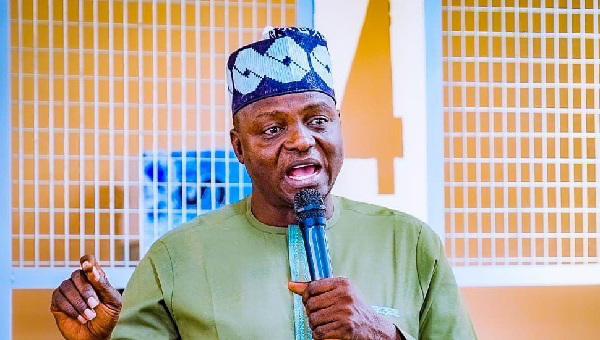
The National Chairman of the All Progressives Congress (APC), Prof. Nentawe Yilwatda, has warned that former Vice-President Atiku Abubakar’s proposal to restore fuel subsidy could worsen Nigeria’s fiscal pressures and reverse gains recorded under the ongoing economic reforms.
Yilwatda alleged that a return to the subsidy regime could lead to fuel queues, undermine the payment of the new minimum wage and affect government funding for education and other social services.
He spoke in Abuja while receiving a delegation of economic stakeholders who visited him to discuss the state of the Nigerian economy, ongoing reforms and prospects for sustainable growth.
The APC chairman said the fuel subsidy debate should not be reduced to political rhetoric but assessed against the country’s experience with the policy, particularly its impact on government revenue and funding for salaries, pensions, education and infrastructure.
According to him, Atiku’s proposal raises questions about how the subsidy would be financed and sustained without recreating the fiscal pressures associated with the previous regime.
“Subsidy may appear attractive because it promises cheaper petrol, but Nigerians must also ask the bigger question: who pays for the subsidy and what happens to the resources that government must divert to finance it?
“A policy cannot be judged only by its immediate benefit at the pump. We must examine its impact on government revenues, salaries, pensions, education, healthcare, infrastructure and the overall capacity of government to meet its obligations to citizens,” he said.
Yilwatda said several state governments struggled to meet salary obligations before the current administration, with some unable to pay workers regularly and others resorting to partial payments.
He argued that the removal of fuel subsidy and increased federal allocations to states had improved the fiscal position of many sub-national governments, enabling them to meet salary and pension obligations and undertake development projects.
He therefore urged caution over any proposal to reintroduce subsidy, saying its economic implications should be thoroughly evaluated.
The APC chairman also raised concerns about the potential impact of fiscal pressures on education, recalling disruptions to academic activities in Nigerian universities under the previous administration.
He said policies that could weaken the ability of governments to finance education and other essential public services should be carefully scrutinised.
“A return to a fiscally unsustainable subsidy regime could have consequences far beyond the price of petrol. When government revenue is squeezed, the first victims are often the critical sectors that directly affect the welfare and future of our people,” he said.
On the new minimum wage, Yilwatda said the sustainability of higher wages depended on the ability of federal and state governments to meet their recurrent obligations.
He said wage increases must be accompanied by stronger government revenues to ensure that improved salaries could be sustained without undermining spending on infrastructure, healthcare, education and other essential services.
Yilwatda also said ongoing reforms were creating opportunities in areas previously constrained by weaknesses in Nigeria’s foreign exchange and payment systems.
He cited the growing ability of Nigerians to use locally issued bank cards for legitimate international transactions and the expansion of digital payment opportunities as developments that could strengthen the country’s participation in the global digital economy.
“Our young people are no longer limited by geographical boundaries. A Nigerian content creator, software developer, consultant or freelancer can provide services to clients anywhere in the world. But that opportunity requires a financial and payment system capable of supporting the global digital economy,” he said.
The APC chairman further highlighted the Nigeria Education Loan Fund (NELFUND), describing it as an important intervention that has expanded access to tertiary education financing and reduced the financial burden on families.
He said sustainable education financing was necessary to ensure that young Nigerians were not forced to abandon their studies because their families could not afford tuition and other educational expenses.
Yilwatda acknowledged the hardship Nigerians experienced following the removal of fuel subsidy, saying the government must continue to strengthen measures aimed at cushioning the impact of the reforms on vulnerable citizens.
“The hardship Nigerians have experienced is real, and government must continue to respond to it. But the answer cannot simply be to return to a system whose long-term fiscal implications created serious distortions in our economy,” he said.
He urged political leaders advocating a return to subsidy to explain the cost, funding mechanism, duration and sustainability of the proposed policy.
“Whenever anybody proposes a return to subsidy, Nigerians should ask: how much will it cost? Where will the money come from? What programmes will be sacrificed to finance it? And for how long can the government sustain it?” he asked.
Yilwatda said the APC-led Federal Government remained committed to reforms aimed at building a productive, competitive and sustainable economy.
He urged economic stakeholders, professional bodies, labour organisations, businesses and citizens to continue engaging the government on ways to improve the reforms and ensure their benefits were more widely shared.
He added that Nigeria’s economic future should be shaped by policies capable of delivering sustainable growth, employment, investment and improved living standards rather than short-term political considerations.
The post Atiku’s subsidy proposal will reverse economic gains, APC chair warns appeared first on Vanguard News.