

KAMPALA — Uganda’s media landscape was thrown into an unprecedented crisis on Sunday morning, June 28, 2026, after heavily armed security forces executed an overnight raid on the Nation Media Group (NMG) Uganda headquarters, forcing major television and radio stations off the air and halting newspaper production.
The coordinated military operation, which commenced shortly after midnight, targeted NMG’s main premises in Namuwongo, Kampala, and its primary transmission hubs. By dawn, viewers tuning into NTV Uganda and Spark TV were met with blank screens displaying “video unavailable” alerts. Sister radio stations 93.3 KFM and 90.4 Dembe FM were similarly silenced, while the production of Monday’s print editions for the Daily Monitor and The EastAfrican was brought to a dead stop. Staff inside the building during the shift were confined to the premises, with soldiers blocking all entry and exit points.
‘I Do Not Believe in a Free Press’
The sudden military clampdown follows a barrage of provocative midnight posts on X (formerly Twitter) by the Chief of Defence Forces (CDF) and First Son, General Muhoozi Kainerugaba, who openly proudly took ownership of the media blackout.
“Mzee [President Museveni] has approved my plan to close both NTV and Monitor. We are moving immediately!” Muhoozi posted.
The army chief, known for his volatile online presence, made no secret of his motives, citing “bad stories” targeting Uganda’s political and security establishment as the trigger.
“From now on, ALL bad stories about Uganda have to be cleared by my office! In Uganda, I DO NOT believe in a free press! The press should be guided by cadres of the revolution,” Muhoozi added, explicitly decreeing that the sealed stations will not reopen without his personal authorization.
Despite the scale of the operation, no statutory regulator—including the Uganda Communications Commission (UCC) or the Ministry of ICT—has issued a formal legal notice or regulatory directive providing a constitutional basis for the military siege.
NAB Scrambles for Diplomatic Lifeline
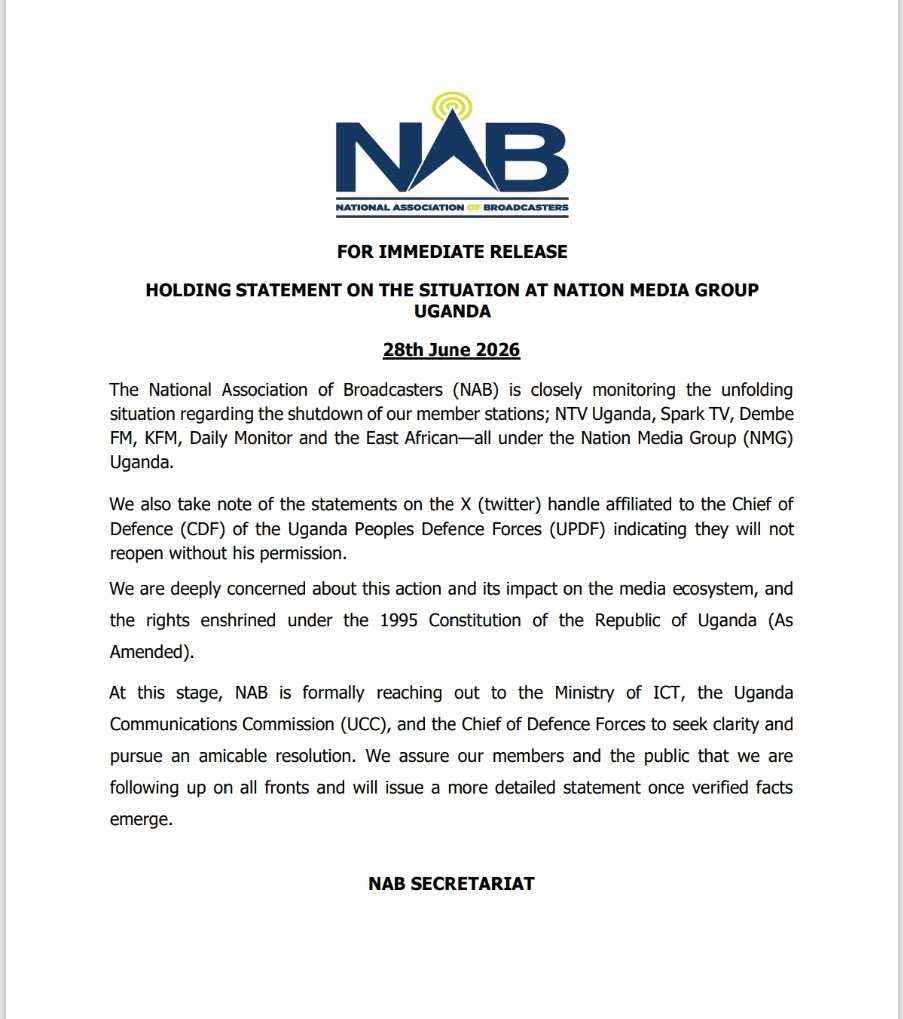
As news of the blackouts sent shockwaves through the regional media industry, the National Association of Broadcasters (NAB) executive body rushed into emergency sessions to formulate a response to the direct military overreach.
In an official statement, NAB confirmed it is closely monitoring the abrupt closures and expressed profound concern over the CDF’s public statements conditioning the outlets’ operational future on personal military clearance. The body noted that the sudden shutdown poses a severe threat to constitutional media rights, corporate investments, and free expression in Uganda.
Rather than issuing a retaliatory ultimatum, NAB has opted for a cautious, behind-the-scenes diplomatic strategy. The association announced it is aggressively engaging the Ministry of ICT, the regulatory UCC, and the Office of the Chief of Defence Forces to seek a negotiated administrative resolution.
Factions, Frustration, and Public Backlash
NAB’s measured, bureaucratic approach has done little to satisfy an outraged public and media fraternity. On social media, Ugandan journalists, civil society actors, and independent netizens sharply criticized the broadcasters’ association, calling its response “too passive” and weak in the face of an existential threat to independent journalism.
Prominent local media practitioners are calling for total media solidarity, urging competing private networks to stage a joint broadcasting strike or news blackout until NMG’s platforms are restored.
The crisis has also quickly taken on a distinct political dimension. Opposition leader Bobi Wine swiftly condemned the raid, accusing General Muhoozi of utilizing state power to completely choke out the country’s remaining independent voices as part of an aggressive campaign to control the narrative surrounding the state’s ongoing political transition.
The current siege mirrors the infamous May 2013 military lockdown of the Daily Monitor and its sister radio stations, which lasted eleven days after the paper published details regarding the controversial “Muhoozi Project.” Thirteen years later, with Muhoozi now firmly at the helm of the national army, media analysts warn that the lines between legal state regulation and absolute military decree have been entirely erased.
Watchdog Uganda is tracking this developing story. Updates will follow as negotiations between NAB leadership, the UCC, and the military command unfold.
The post Broadcasters Scramble for Response As Gen. Muhoozi’s Military Raid Forces Sweeping Nation Media Blackout in Kampala appeared first on Watchdog Uganda.

 Mwananchi
 Punch Nigeria
 Watchdog Uganda