

Corruption or Political Management? Muhoozi and Mwenda Clash Over Anita Among
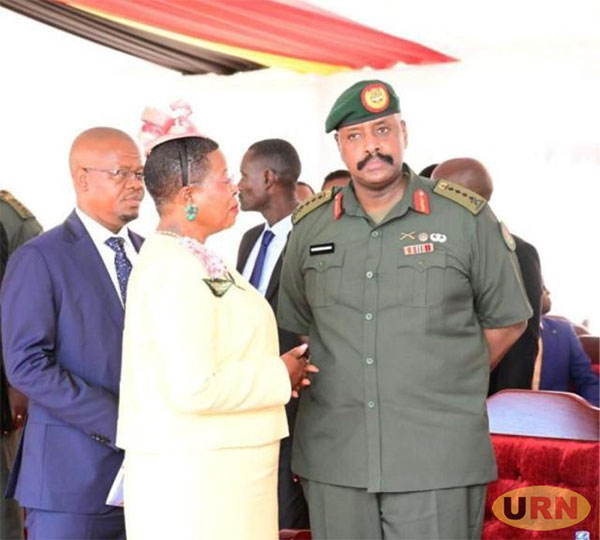
The dramatic political fallout surrounding former Speaker of Parliament Anita Annet Among has exposed a rare but revealing disagreement between Gen. Muhoozi Kainerugaba and political commentator Andrew Mwenda, two influential figures operating within the broader Patriotic League of Uganda (PLU) orbit.
At the heart of the disagreement lies one critical question: Was Anita Among guilty of personal greed and corruption, or was she simply operating within Uganda’s deeply entrenched system of political patronage and power management?
For Muhoozi, the answer appears straightforward.
The First Son and PLU leader has publicly condemned what he views as extravagance, corruption, and misuse of public office. His criticism intensified after reports linked Among to luxurious spending and ownership of high-end assets, including a Rolls-Royce Cullinan reportedly worth billions of shillings.
Muhoozi openly distanced himself from Among and withdrew political support for her re-election bid as Speaker, arguing that public leaders must exercise restraint at a time when millions of Ugandans are battling poverty, unemployment, and rising living costs.
“We cannot support a corrupt and luxurious Speaker,” Muhoozi declared in one of his strongest public statements on the controversy.
To Muhoozi and his supporters, the issue is moral as much as political. They see Among’s alleged conduct as symbolic of a political culture that has alienated ordinary citizens through excess, impunity, and abuse of public trust.
His camp has framed the crackdown on Among as part of a broader effort to restore discipline, accountability, and credibility within government institutions. The subsequent raids on properties linked to Among, seizure of luxury vehicles, and investigations into alleged illicit enrichment only reinforced the perception that powerful forces had turned against the once untouchable Speaker.
But Andrew Mwenda views the saga differently.
While acknowledging allegations of corruption, Mwenda argues that Anita Among cannot be judged outside the political realities that have shaped Uganda’s governance system for decades.
According to Mwenda, powerful political actors are often expected to mobilize resources, build networks, sustain patronage systems, and maintain loyalty structures that strengthen the ruling establishment.
In his interpretation, Among was not merely spending public money for personal luxury; she was also using resources to consolidate political support and strengthen networks aligned to President Yoweri Museveni and the ruling order.
“Anita Among’s use of parliamentary money was actually to build Museveni’s political base,” Mwenda argued, suggesting personal gain was only one aspect of a much larger political system.
Mwenda’s argument essentially reframes the controversy. Rather than portraying Among as a rogue individual acting alone, he presents her as a product of Uganda’s patronage politics — a system where political survival often depends on distributing resources, rewarding loyalty, and maintaining influence.
In that context, Among’s downfall may not simply be about corruption, but about power.
Mwenda suggests that the former Speaker may have accumulated too much political influence and built networks that eventually made sections of the establishment uncomfortable. In other words, her “sins” became intolerable not necessarily because they were unique, but because her growing power became politically risky.
That is where the disagreement between Muhoozi and Mwenda becomes most significant.
Muhoozi frames the issue as a matter of morality, accountability, and leadership discipline. Mwenda frames it as a political struggle rooted in the realities of state power and patronage.
The clash exposes two competing visions within Uganda’s ruling circles.
One seeks to project a new image of discipline, anti-corruption, and intolerance for elite excess. The other acknowledges that Uganda’s political system has historically relied on patronage, compromise, and resource distribution to maintain stability and loyalty.
For many Ugandans, the disagreement says more about the future of power in Uganda than about Anita Among herself.
Is the system genuinely reforming?
Or is the political establishment merely reorganizing itself while preserving the same underlying methods of control?
As investigations continue and political alignments shift ahead of the 12th Parliament, the Anita Among saga has evolved beyond a corruption scandal. It has become a revealing window into the ideological tensions, succession debates, and internal contradictions shaping Uganda’s political future.
The post Corruption or Political Management? Muhoozi and Mwenda Clash Over Anita Among appeared first on Watchdog Uganda.

 This Day
 Punch Nigeria
 Daily Post
 Vanguard Nigeria
 Mwananchi