

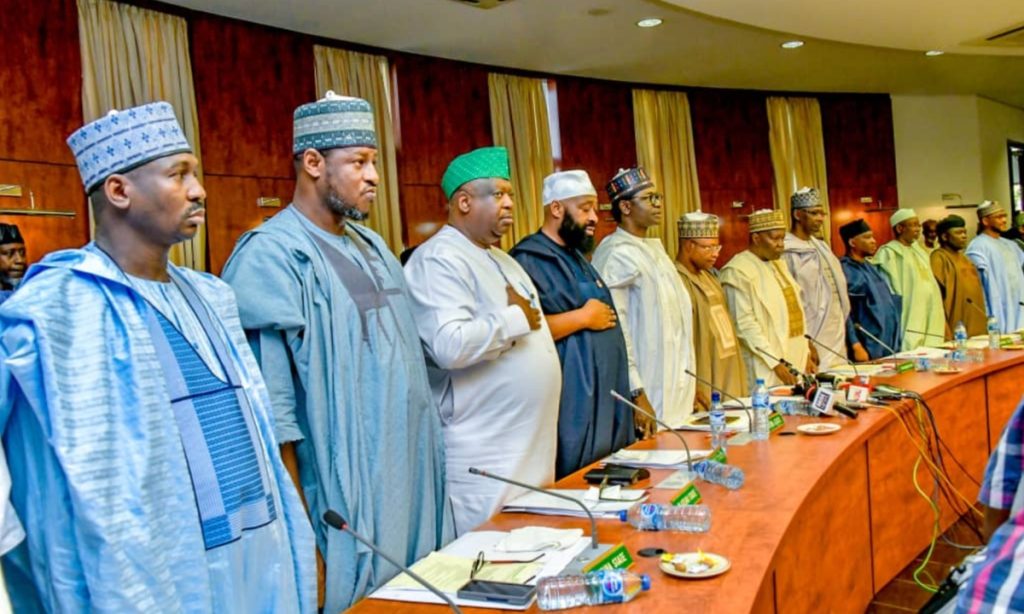
I have been much surprised that the Northern Nigeria Security Trust Fund (NNSTF), established last month by the Northern States Governors’ Forum (NSGF), has not generated as much public interest and debate as one would have expected for such a consequential policy. I think it should. First of all, the very idea of establishing a security fund represents a good example of responsive governance.
Of course, it is belated: such a policy should have come sooner. For more than two decades now, Northern Nigeria has been the hotbed of perhaps 70% of all insecurity in the country, several dimensions of which directly threaten the very existence of the Nigerian state. From religious insurgency and terrorism in the northeast, banditry in the northwest, to frequent farmer-herder and indigene-settler communal clashes in the north-central, the North — and Nigeria — has scarcely known any quiet since the early 2000s.
All of these have decimated lives, limbs, and livelihoods across nearly every state in the region. No doubt, then, that Northern governors should have established such a security fund much earlier than now. Still, it is better late than never. The establishment of the NNSTF is therefore an important first step as it suggests that the northern governors are now responding to public concerns with a policy initiative rather than more talk. After all, public policy is the surest mechanism by which governments work to resolve collective problems. This is commendable, and should elicit interest, debate and the involvement of all stakeholders, including citizens. Secondly, the initiative is responsive to the need for collective action for addressing peculiar but collective northern problems, a point I have argued repeatedly in this column, and it is refreshing to see policymakers finally walking in this direction.
The various forms of security challenges northern Nigeria faces are conducted by the same set of actors, but their activities are not limited to any one state. This is as true of Boko Haram attacks as it is of banditry or farmer-herder and indigene-settler conflicts, all of which cut across multiple states. Communal conflicts in one state often trigger reprisals in another or other states. Such a problem therefore calls for regional leadership and governance, since no individual state can adequately deal with any of these alone. Yet, insecurity is not the only peculiar but collective challenge northern Nigeria faces today. The statistics are now befuddled, but there is no question that the vast majority of Nigeria’s out-of-school children are in the northern states. The almajiri phenomenon, which is the biggest driver of the numbers for out-of-school children in the country, is entirely a northern factor that cuts across all 19 states to some degree. We certainly have the least private-sector investment and development in the country, along with several other unpleasant development indices.
The Northern Nigeria Security Trust Fund (NNSTF) is therefore a model of collective leadership that can be transferred to other areas of regional governance and development, since several policy challenges not only cut across 19 northern states, but also defy the capacity of any individual state to tackle alone. The model can be used, for example, to address out-of-school children or develop a regional public transport network. Establishing an airline by any state is scarcely a development priority in my view, but states like Kano and Sokoto that are reportedly considering doing so could instead pool resources together to establish a single multi-state-owned airline strong enough for both domestic and international operations. The collective regional leadership that the NNSTF demonstrates is also in keeping with the political and constitutional transformations underway by the President Bola Ahmed Tinubu administration. As I argued recently in these pages, President Tinubu’s political reforms are based on a return to the old federal model of strong regions rather than our current weak states. I don’t know if this is a good or a bad thing, but rather than political resistance or noisy complaints, the North can respond positively by putting its house in order, and by demonstrating some measure of self-reliance within the framework of the Nigerian federation. Northern Nigeria simply cannot continue to be defined as the only problem with the country.
For example, the Northern Nigeria Security Trust Fund speaks directly to the idea of state police currently being pushed by the Tinubu administration. I do not believe there is any state in northern Nigeria that can adequately fund a genuinely functional police organization. Moreover, real security challenges in the North are Boko Haram insurgency, banditry, cattle rustling, farmer-herder clashes, and religious-cum-communal clashes. I sincerely doubt that the establishment of a state police by any state in the region can help much with all these. That does not mean the idea of state police should be discarded outright, however. Instead, it is a question of which internal security outfit is functionally and constitutionally best suited to address the specific security challenges in the region. Rather than state police for its own sake, I suggest a regional outfit that combines both policing and military functions enough to deal with counter-insurgency, anti-banditry, rapid response against kidnapping, riots, farmer-herder clashes, rural policing, forest guarding, etc. The current federal Nigeria Police can then do much of the everyday crime fighting across all the states in keeping with the changing realities.
The scale of the NNSTF is also notable. As reported in the news, each of the 19 northern states will be committing N1bn monthly, deducted at source. This equals N19bn monthly or about N228bn per year for regional security. These are the exact figures I have once suggested in this column, and it not only demonstrates a strong commitment from the governors, but also gives them significant leverage to attract more funding from the federal government or other sources. Still, contribution by state governments would not be enough. Since security is everybody’s business, we must find a way to get everyone to contribute. The three zonal development commissions should also be contributing a monthly sum. Rural farmers, herders, and all businesses located across all 19 states, from telecoms companies and banks to the average akara seller and every adult resident across the region must also contribute to the security pool, however small. Security is a collective responsibility, and its costs must be shared by all.
Finally, I have a few concerns about the NNSTF. First, the 21-member Board of Trustees leans too heavily on retired military or police officers (about 70%). This suggests a narrow understanding of insecurity as armed conflict. But several of the security challenges in the North are deeply rooted in social, political and economic phenomena and impact all sectors of society. So, you need a much more diversified membership than currently obtains. It is also not clear how the fund would be utilized. Will the NNSTF be used to finance military or intelligence operations or to buy security equipment? Would it be used to establish a new security organization or to support existing federal agencies? What about conflict prevention, peacebuilding, victim support, and reconstruction? All of these are not yet clear, and exemplify why there is a need for more sustained stakeholder and public engagement on this issue.
I also frankly do not see the need for co-chairmanship of the board by former Minister of Defence and Head of the Civil Service, Alhaji Yayale Ahmed, and former Chief of Defence Staff, General Martin Luther Agwai. Either man is more than qualified for the job, and the sharing of responsibility is both functionally and symbolically unnecessary. After all, we do not have a co-chairmanship of the Northern Governors Forum and it has never been a problem. In this sense, a rotational or chairman/deputy-chairman with real strategic functions is better. We must resist the attempt to treat a serious policy initiative as just another idle community or inter-faith dialogue session. Overall, however, this is a good step in the right direction.
Suleiman, a public affairs analyst, writes from Abuja
The post Credit to northern governors for NNSTF, by Suleiman A. Suleiman appeared first on Vanguard News.