

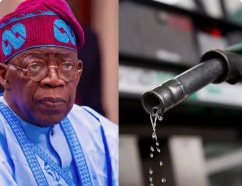
•Dele Oye: Trillions recorded by NNPCL is subsidy in disguise
By Nnamdi Ojiego
When President Bola Tinubu declared on May 29, 2023 that “fuel subsidy is gone,” it marked what many believed was the end of one of Nigeria’s most expensive and controversial fiscal policies.
The announcement triggered an immediate rise in petrol prices, sparked nationwide protests, and was defended by the government as a painful but necessary reform to free up public funds for infrastructure, education, healthcare and other critical sectors.
More than three years later, however, a fresh debate has emerged over whether the subsidy actually disappeared or merely changed form.
That debate was reignited after Chairman of the Alliance for Economic Research and Ethics Ltd/GTE and former National President of the Nigerian Association of Chambers of Commerce, Industry, Mines and Agriculture, NACCIMA, Mr. Dele Oye, alleged that the Federal Government’s N17.5 trillion receivable recorded by the Nigerian National Petroleum Company Limited, NNPCL, amounted to “fuel subsidy in disguise.”
His assertion, first made in a public statement, generated widespread interest and raised fundamental questions.
If subsidy had indeed been removed, why had such a huge liability accumulated? Was the entire N17.5 trillion truly subsidy? Was NNPCL simply recovering legitimate operational costs under the Petroleum Industry Act, PIA, or was the government quietly financing petrol price support through another route?
To answer those questions, Sunday Vanguard sought further clarification from Oye.
In an extensive evidence-based response supported by NNPCL’s 2024 audited financial statements, provisions of the Petroleum Industry Act, PIA, relevant sections of the Constitution and findings by the World Bank, he offered a more nuanced explanation of his earlier claim.
Implicit subsidy
His position is that while the entire N17.512 trillion should not be described as fuel subsidy, a substantial portion of it represents what economists would recognise as an implicit subsidy because government, rather than consumers, absorbed part of the cost of imported petrol.
One of the first clarifications Oye made was that many people had misunderstood his earlier statement.
According to him, the N17.512 trillion recorded by NNPCL as receivables from the Federation consists of two separate components.
The first is N8.672 trillion classified as “energy security costs,” while the second is N8.840 trillion listed as other receivables from the Federation, including advances and expenditure incurred on behalf of government.
He explained that the N7.131 trillion frequently cited in public discussions represents energy security costs incurred during 2024 and is already reflected in the movement that produced the N8.672 trillion closing balance.
“Adding the N 7.131 trillion to the N17.512 trillion would amount to double counting,” he said.
Oye therefore stressed that the N17.512 trillion should be regarded as NNPCL’s recorded receivable or claim against the Federation rather than an automatically admitted Federal Government debt.
Audited financial statements
For Oye, the real issue is not the accounting terminology but the economics behind the transaction. He pointed to NNPCL’s audited financial statements, which showed that approximately N7.131 trillion in energy security costs was recorded during 2024, compared with about N4.844 trillion in 2023.
According to him, the company explained that these costs arose largely from exchange rate differences between the rate used in determining the ex-coastal price of imported Premium Motor Spirit, PMS, and the exchange rate prevailing when payments for imported fuel were eventually settled.
Oye argued that although the government publicly announced the removal of subsidy, NNPCL continued importing petrol under a pricing arrangement that prevented consumers from bearing the immediate full cost of imported fuel.
Instead, he said, the resulting losses were transferred to the Federation through energy security costs and deductions from revenues that would otherwise have been remitted to government.
“The arrangement had the economic characteristics of a subsidy because consumers did not immediately bear the full cost of imported petrol, while the difference was transferred to the Federation through NNPC’s receivables and remittance arrangements,” he said.
He noted that this interpretation is not his alone. According to Oye, the World Bank similarly described the arrangement as an implicit PMS subsidy and reported that it effectively ended in October 2024 when NNPCL began applying the official exchange rate for fiscal revenues and stopped recording foreign exchange differential losses.
Legal grey areas
Beyond the financial implications, Oye believes the arrangement raises important legal questions. He acknowledged that NNPCL relied on Section 64(m) of the Petroleum Industry Act, which empowers the company to act as supplier of last resort for energy security purposes, with the associated costs borne by the Federation.
However, he pointed out that the same legislation also contains Section 317(6), a transitional provision which authorised government to request NNPCL to ensure adequate supply and distribution of petrol for a period not exceeding six months from the commencement of the Act.
According to him, this raises legitimate questions about whether the continued recovery of PMS-related costs after that transitional period was specifically authorised through executive directives, legislative appropriation or another lawful fiscal arrangement.
He also drew attention to Sections 80, 81 and 162 of the Constitution, which govern the collection, custody, appropriation and distribution of public revenue.
“The available materials establish the statutory basis relied upon by NNPC but do not conclusively determine the legality of every deduction,” he explained.
“A definitive conclusion would require examination of government directives, approvals, reconciliation records and appropriation documents.”
Impact on FAAC, public finances
Oye argued that the deductions have implications extending far beyond the oil industry. He said every deduction made before NNPCL remits revenue reduces the amount eventually shared by the federal, states and local governments through the Federation Accounts Allocation Committee, FAAC.
Citing World Bank data, he noted that although gross FAAC revenue rose significantly in 2024, petroleum revenues remitted by NNPCL actually declined because substantial deductions continued to be made before remittances.
According to him, this means less money is ultimately available for roads, hospitals, schools, security and other public services. He also warned that the receivable treatment makes it difficult for Nigerians to determine the country’s true petroleum earnings, NNPCL’s legitimate recoverable costs, government’s actual fiscal obligations and the real amount available for budget implementation.
While acknowledging that the arrangement may have moderated the immediate impact of higher petrol prices on consumers, he argued that the financial burden was merely transferred to public finances through lower government revenues and accumulated obligations.
Dangote refinery
The former NACCIMA president also questioned why Nigeria continues to incur significant energy security costs despite the commissioning of the Dangote Petroleum Refinery. According to him, increased domestic refining should ordinarily reduce dependence on imported petrol and the foreign exchange exposure associated with imports.
Oye, however, noted that inadequate domestic crude supply has constrained local refining capacity and forced continued reliance on imported products. He urged government to fully implement the domestic crude supply obligation contained in Section 109 of the PIA to ensure local refineries receive predictable crude supplies on commercially negotiated terms.
Forensic audit
To restore confidence in Nigeria’s petroleum revenue management, Oye called for a comprehensive independent forensic audit of all energy security costs and Federation receivables.
According to him, the Federal Ministry of Finance, the Office of the Accountant-General of the Federation and NNPCL should jointly reconcile all energy security costs, other Federation receivables, deductions from remittances, arrears claimed by NNPCL, disputed balances and the legal authority for every deduction.
He said the findings should be independently verified and made public. He also recommended that monthly petroleum revenue reports should disclose gross revenue, deductions, remittances, federation liabilities, disputed balances and actual FAAC distributions to improve transparency.
Explicit legislative appropriation
In addition, Oye urged government to ensure direct remittance of petroleum revenues into constitutionally recognised accounts and to subject any future price-support intervention to explicit legislative appropriation rather than allowing it to operate through off-budget arrangements.
He further called for a clear framework defining when NNPCL may act as supplier of last resort, the approvals required, the methodology for calculating associated costs and the duration of any intervention.
According to him, such reforms would prevent temporary energy security measures from evolving into indefinite fiscal obligations beyond public scrutiny.
“The outstanding questions,” Oye said, “are whether the costs were properly calculated, whether every deduction was validly authorised and whether the Federation’s liability has been independently confirmed.
“Forensic audit, complete reconciliation, direct remittance of petroleum revenues and transparent appropriation of any future price-support intervention are necessary to resolve those questions and restore confidence in Nigeria’s petroleum revenue management.”
The post Did FG pay N17.5trn in subsidy despite removal? appeared first on Vanguard News.

 Vanguard Nigeria
 Punch Nigeria
 Daily Post
 Channels TV
 Business Day
 Premium TImes