

…Most patients arrive when kidneys have failed — NMADU
…OYEWALE: Painkillers, herbal mixtures silently destroy organs
…Water contains harmful heavy metals — YEMITAN
…ODUBANJO: Education, early screening remain best defense
By Chioma Obinna
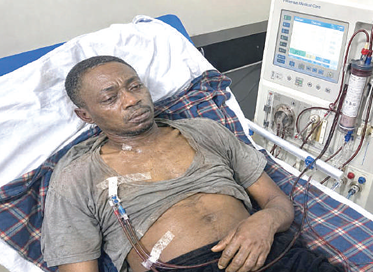
Three mornings every week, Uche Oke left home before dawn, clutching a small bag that had become as familiar to him as his own shadow.
Inside were a bottle of water, a few personal belongings and the hope that another four-hour dialysis session would buy him a little more time.
At just 32, a trader and father of one should have been expanding his business and raising his young family. Instead, his life had become a cycle of hospital appointments, mounting medical bills and desperate prayers for a kidney transplant that remained painfully out of reach.
A few years earlier, headaches were nothing unusual. Like millions of Nigerians, he simply bought painkillers from the neighbourhood pharmacy. Fever meant swallowing herbal mixtures recommended by friends with drinking water from the family’s borehole. Routine medical check-ups never crossed his mind because he believed he was healthy. Then came persistent stomach pain.
Doctors initially treated him for Helicobacter pylori ulcer. But instead of improving, his condition deteriorated dramatically. He became unusually weak. His legs swelled. Painful mouth sores made eating difficult. He vomited repeatedly, lost weight and eventually stopped passing urine.
Alarmed, his family rushed him to hospital, where doctors delivered devastating news, both kidneys had failed. The diagnosis changed everything. Doctors said he required an urgent kidney transplant. The procedure would cost about ¦ 18 million, while securing a compatible donor would require another ¦ 25 million, an impossible amount for his family.
Dialysis becomes lifeline
Three times every week, Uche spent hours connected to a dialysis machine while his family appealed for financial assistance. But the money never came. He died waiting.
His death left behind a grieving wife, a young child, and a question that echoes in hospitals across Nigeria, how many more lives will be lost before kidney disease receives the attention it deserves?
Sadly, nephrologists say Uche’s story is no longer unusual.
Across Nigeria, dialysis centres are receiving increasing numbers of patients whose kidneys have already suffered irreversible damage before they ever see a specialist. Many are young adults in the prime of their lives. Others are breadwinners whose illness plunges entire families into poverty.
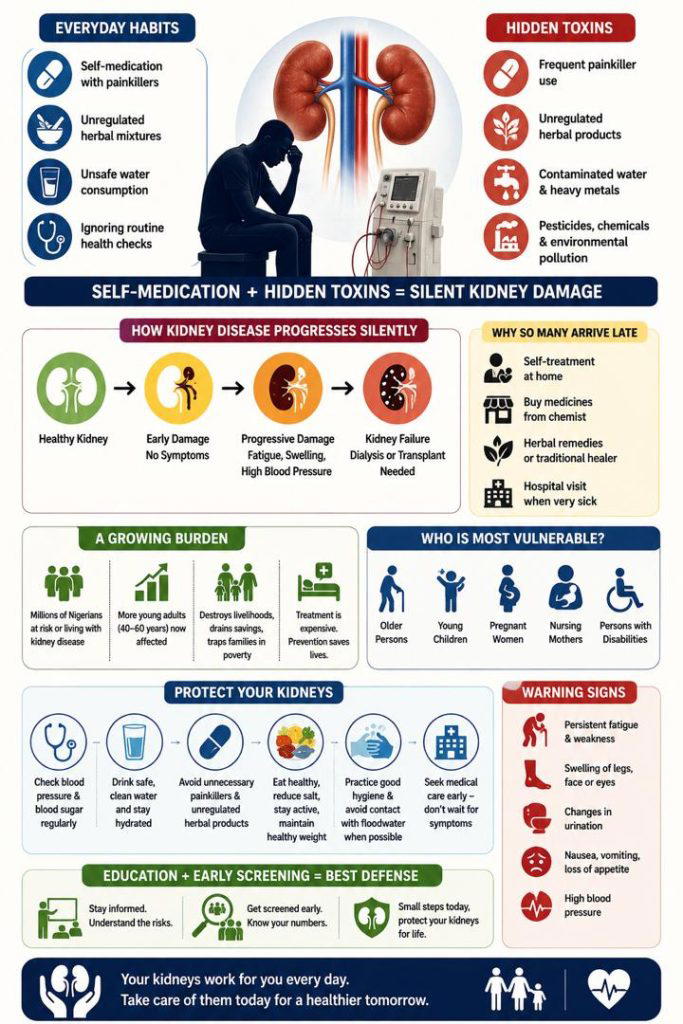
Behind the rising burden lies a dangerous mix of undiagnosed hypertension and diabetes, indiscriminate use of painkillers, widespread reliance on unregulated herbal remedies, environmental toxins, poor health-seeking behaviour and a healthcare system that many patients simply cannot afford.
Silent epidemic
Unlike infectious disease outbreaks that trigger emergency responses, chronic kidney disease progresses quietly.
The kidneys can lose much of their function without causing obvious symptoms, allowing damage to accumulate silently over several years.
Consultant Nephrologist at the Federal Medical Centre (FMC), Ebute Metta, Dr. Danladi Nmadu, says that is precisely why so many Nigerians arrive at hospital when very little can still be done.
“The kidneys are very resilient organs. You can remove one kidney completely and a person can still live normally”, Mmadu said.
“Even when kidney function has dropped significantly, many people still feel well.
“By the time symptoms become obvious, the kidneys have often almost completely shut down.
“The result is devastating. Patients who could have been treated early instead require lifelong dialysis or kidney transplantation. What worries specialists even more is, who is becoming ill?
“In developed countries, kidney disease usually affects older people in their sixties and above.
“But here in Nigeria, many of the patients requiring dialysis are between 40 and 60 years old, and we are increasingly seeing younger adults.
“These are people in their most productive years, the people raising families, running businesses and contributing to the economy.”
Consequences far beyond hospital
When a family’s breadwinner develops kidney failure, incomes disappear almost overnight while medical expenses multiply. Savings vanish. Businesses collapse. Children leave school. Entire households become trapped in poverty.
Growing burden hiding in plain sight
Although chronic kidney disease has long existed in Nigeria, health experts say it is becoming an increasingly important public health challenge.
Available studies estimate that millions of Nigerians are living with varying degrees of kidney disease, many without knowing it.
One reason is that kidney disease rarely causes pain in its early stages. Another is that routine health screening remains uncommon. Many Nigerians still wear their avoidance of hospitals as a badge of honour: “I don’t fall sick. I’ve never been admitted. I don’t like hospitals.”
According to Nmadu, these familiar expressions often conceal dangerous realities.
“One of the biggest problems we have is that young people believe they are healthy simply because they feel healthy,” he said.
“They don’t check their blood pressure. They don’t check their blood sugar. They don’t even do simple urine tests. They only discover kidney disease when there is almost no kidney function left.”
Routine screening, he said, could prevent many cases of kidney failure.
“If we detect kidney disease early, there are treatments that can slow or even stop its progression.
“But once most of the kidney function has been lost, there is very little we can do apart from dialysis or transplantation.”
When painkillers become poison
For 31-year-old Joseph Ibeh, kidney disease began not with hypertension or diabetes but with a workplace injury.
While working in Delta State, Joseph sustained an injury that required prolonged treatment.
Unable to cope with the cost of repeated hospital visits, he did what millions of Nigerians do every day. He began treating himself. Painkillers became part of his daily routine.
Whenever the pain returned, another tablet followed. As the discomfort persisted, he added herbal mixtures recommended by friends, hoping they would speed up recovery. Instead, they slowly destroyed his kidneys.
Today, Joseph is battling chronic kidney disease. He has lost his job. His family’s savings have disappeared into hospital bills.
Doctors say years of indiscriminate painkiller use and prolonged consumption of herbal concoctions contributed significantly to the damage to his kidneys.
He now requires about ¦ 14.5 million for a kidney transplant.
The recommended three dialysis sessions every week have become impossible.
His family can now afford only one session, thanks largely to donations from relatives and sympathetic friends.
Every missed dialysis session brings fresh anxiety.
For Joseph, survival has become a race against both disease and poverty.
His story mirrors what pharmacists are witnessing across the country.
The Chairman of the Pharmaceutical Society of Nigeria (PSN) Advocacy Group, Pharm. Bola Oyawole, told Sunday Vanguard that many Nigerians underestimate the dangers of indiscriminate painkiller use because such medicines are readily available over the counter.
“The kidneys depend on substances called prostaglandins to function properly. Most painkillers work by suppressing those prostaglandins”, Oyawole said.
“When people continue taking them unnecessarily over a long period, they are gradually interfering with the kidneys’ normal function.”
According to him, many people take painkillers almost routinely even when no medication is medically necessary. “They wake up in the morning and the first thing they take is a painkiller. Some combine different products without understanding what they contain. Over time, such habits can cause irreversible kidney damage.”
The expert is equally concerned about Nigeria’s booming herbal medicine market.
While stressing that herbal medicines are not inherently harmful, he warned that many products sold in markets and across social media have unknown ingredients, uncertain dosages and unverified health claims.
“The problem isn’t that herbs don’t work. The problem is that we often don’t know exactly what is inside these products or how they interact with conventional medicines”, he stated.
He cautioned that mixing herbal preparations with prescription medicines significantly increases the risk of dangerous drug interactions and kidney injury.
“We call it polypharmacy. The more medicines people combine, especially without professional guidance, the greater the risk”.
He urged Nigerians to obtain medicines only from licensed pharmacies and consult qualified pharmacists before taking any combination of drugs or herbal products.
Hidden dangers and late diagnosis
If Joseph Ibeh’s story exposes the dangers of self-medication, 35-year-old Adebayo Adeniji’s journey highlights another silent killer lurking in many Nigerian homes, uncontrolled hypertension.
Unlike Joseph, Adeniji did not suffer a workplace injury. He simply fell ill.
Like countless Nigerians, he assumed it was another bout of malaria or typhoid fever. He sought treatment at different health facilities, hoping the weakness would pass. Instead, the symptoms worsened.
Tests carried out at a primary healthcare centre in Lagos, and later confirmed at Isolo General Hospital and Gbagada General Hospital, revealed a diagnosis that changed his life forever, end-stage renal disease secondary to chronic glomerulonephritis and hypertensive nephropathy.
Only then did he discover he had been living with chronic hypertension without knowing it.
Today, Adeniji can no longer urinate naturally. His kidneys have almost completely lost their function.
To stay alive, he depends on regular dialysis while desperately trying to raise about ¦ 19 million for a kidney transplant.
“I initially thought it was malaria and typhoid. I went from one hospital to another before I was told my kidneys had failed”, he told Sunday Vanguard.
His story reinforces what nephrologists describe as Nigeria’s greatest challenge, not merely the high prevalence of hypertension and diabetes, but the fact that millions of Nigerians have these conditions without ever checking.
According to Nmadu, hypertension remains the leading cause of kidney disease in Nigeria, followed closely by diabetes.
“The problem isn’t having hypertension. The real problem is having hypertension and not controlling it. High blood pressure continues damaging the kidneys every day until they eventually fail”, he said
He urged Nigerians to “know their numbers” by checking their blood pressure and blood sugar regularly.
“If you’ve controlled hypertension and diabetes, you’ve already prevented a large proportion of kidney disease.”
Genes Nigerians never knew they had
Lifestyle alone does not explain every case. Researchers are increasingly uncovering a genetic factor that appears to make many Africans more vulnerable to kidney disease.
Nmadu, who is involved in an ongoing research, said scientists have identified a mutation known as the APOL1 gene variant, which occurs predominantly among people of African ancestry.
He likens it to the sickle cell of the kidneys.
“Just as sickle cell makes red blood cells fragile, this gene makes the kidneys more vulnerable,” he explained.
“People carrying the mutation may develop kidney disease much earlier when exposed to triggers such as dehydration, uncontrolled hypertension, infections or certain medications.”
The discovery, he said, may partly explain why kidney disease appears earlier and progresses faster among Black populations than in many other parts of the world.
While genetics cannot be changed, he stressed that early diagnosis and healthy lifestyles can significantly reduce the risk of severe kidney damage.
Water you drink may not be as safe as you think
For many Nigerians, borehole water and sachet water have become everyday necessities.
But according to toxicologists, what appears clean may still contain invisible threats capable of damaging the kidneys over many years.
In a chat with Sunday Vanguard, Professor of Pharmacology and Toxicology at the Lagos State University College of Medicine, Prof. Omoniyi Yemitan, warned that many people mistakenly assume that because water is packaged or comes from a borehole, it is automatically safe.
“Packaging creates a false sense of purity. Many sachet water producers simply package borehole water. Safety depends on testing, not on appearance”, he said.
According to him, routine water quality assessments often focus on bacteria and other microorganisms while overlooking dangerous heavy metals.
Those contaminants, including cadmium, lead, chromium and arsenic, are among the greatest environmental threats to kidney health.
Unlike bacteria that cause immediate illness, heavy metals accumulate slowly inside the body.
“What makes these metals particularly dangerous is that people don’t become sick overnight. They remain in the body for years. Cadmium, for example, accumulates in the kidneys and gradually destroys the tiny structures responsible for filtering waste. Lead behaves similarly, while chromium and arsenic damage kidney cells through prolonged oxidative stress”, he said.
By the time symptoms become obvious, years of silent injury may already have occurred.”
Pollution beyond the tap
The problem extends far beyond drinking water.
Yemitan said excessive use of pesticides and agrochemicals has contaminated soil and water in several farming communities across Nigeria.
Even more worrying, he noted, many farmers receive little or no formal training in the safe handling of pesticides.
Some eat while spraying chemicals.
Others reuse empty pesticide containers to store drinking water.
Such practices expose families to repeated low doses of toxic chemicals capable of damaging multiple organs, including the kidneys.
Although contamination varies depending on local geology, Yemitan said communities located near industrial sites require regular environmental monitoring rather than assumptions about safety.
He also warned against the widespread use of unregulated skin-lightening creams.
Some contain mercury and other harmful substances that can penetrate the skin, enter the bloodstream and eventually reach the kidneys.
“The skin is not a barrier to many of these chemicals. What you apply repeatedly can eventually enter the body,” he said.
He therefore urged government agencies to strengthen routine testing of borehole water, surface water and agricultural environments for heavy metals.
Safe water, he stressed, should never be assumed, it should be scientifically verified.
Why patients keep arriving too late
If environmental toxins represent one hidden danger, delayed healthcare remains another.
According to Nmadu, many kidney patients follow a predictable pathway before finally reaching a nephrologist.
“They first treat themselves at home. When that doesn’t work, they visit a chemist. Then someone recommends a herbal remedy or a traditional healer. It is only when everything has failed that they come to the hospital. By then, irreversible damage has often occurred.”
He believes financial hardship plays a major role.
Healthcare remains unaffordable for millions of Nigerians, particularly those without health insurance.
“When people fall sick, hospital bills are often the last thing they can afford. So, they try cheaper alternatives first”, he said.
“Unfortunately, kidney disease offers very little room for delay.
“Unlike many illnesses that produce obvious warning signs early, kidney disease often remains silent until more than 80 per cent of kidney function has been lost.
“If we see patients when they still have 70 or 80 per cent kidney function, we can often slow or stop progression.
“But when they present with less than 20 per cent function, there is very little left to save.”
Public health challenge hiding in plain sight
Speaking to Sunday Vanguard, Executive Secretary of the Nigerian Academy of Science, Dr. Doyin Odubanjo, said Nigeria must begin treating kidney disease as a major public health concern, even if it does not technically qualify as a public health emergency.
“We first need to establish the true scale of the problem. If we are seeing increasing numbers of cases, then we must ask why”, Odubanjo said.
He believed several social and economic realities are contributing to the growing burden.
He stated that as economic hardship deepens, more Nigerians turn to self-medication, unregulated alcohol, herbal concoctions, and counterfeit products.
He said stress and anxiety associated with financial pressures also contribute to rising blood pressure, a major driver of kidney disease.
“The kidney is the organ responsible for removing waste products from the body. So whatever harmful substances people continue putting into their bodies eventually passes through the kidneys.”
He emphasised that herbal medicine itself should not be dismissed. Many modern medicines originated from medicinal plants, he noted.
The real challenge lies in regulation
“We need to know who prepared these products, what they contain, the correct dosage and whether they are safe”, he said.
Without proper quality assurance, consumers remain exposed to potentially dangerous substances.
For Odubanjo, the most powerful intervention remains education.
“The first thing is education. People must understand why they need regular medical check-ups, why they should know their blood pressure and blood sugar, and why early diagnosis matters”, he said.
He urged government to make reliable health information and quality healthcare more accessible, warning that where accurate information is lacking, misinformation quickly fills the gap.
From prevention to treatment
Odubanjo explained that preventing kidney disease begins long before anyone enters a hospital.
“The first thing is education. If people understand the risks, they are more likely to seek care early”, the expert said.
He argued that governments at all levels must invest more in public awareness campaigns, routine community screening and stronger primary healthcare services.
Reliable health information, he said, remains one of the most powerful tools for countering misinformation and discouraging dangerous self-medication.
Odubanjo also called for stronger oversight of herbal medicines, not to dismiss traditional medicine, but to ensure products are properly prepared, standardised and safe for consumers.
“The issue is not whether herbs work. Many modern medicines actually originated from medicinal plants. The issue is whether what people are taking is safe, properly prepared and prescribed in the right doses”, he stated.
For Nmadu, prevention starts with knowing your numbers.
According to him, every Nigerian should know their blood pressure and blood sugar levels, because hypertension and diabetes remain the leading causes of chronic kidney disease in the country.
“The problem is not simply having hypertension or diabetes. The danger comes when they remain undiagnosed or poorly controlled. Those are the conditions that silently damage the kidneys over many years. Kidneys are incredibly resilient organs. People can lose a large percentage of kidney function without noticing any symptoms”, he told Sunday Vanguard. “That is why routine health checks are so important. If we detect kidney disease early, we can slow or even stop its progression before it reaches kidney failure.”
Nmadu also advised Nigerians to avoid indiscriminate use of painkillers, seek professional medical advice before taking herbal preparations or combining them with conventional medicines, stay adequately hydrated, reduce excessive salt intake and maintain healthy lifestyles.
“I always tell my patients that the kidney is your business. If you want your kidneys to remain healthy, drink enough water and mind your business.”
On prevention, Oyawole said prevention must also involve stronger regulation of medicines and greater public vigilance.
He called on the National Assembly to strengthen laws against fake and substandard medicines, arguing that the current penalties are too weak to discourage offenders. Regulatory agencies, including the Pharmacy Council of Nigeria and NAFDAC, he said, also require greater support to improve enforcement.
He advised that rather than buying medicines from roadside vendors or unlicensed outlets, Nigerians should obtain medicines only from registered pharmacies where trained pharmacists can provide appropriate counselling and monitor drug use.
“I always advise people to have a regular pharmacist. Just as people have lawyers or accountants they trust, they should have a pharmacist who understands their medication history. That relationship alone can prevent many harmful drug interactions and unnecessary medicine use”, he stated.
Prof. Omoniyi Yemitan, for his part, believed environmental protection deserves equal attention.
He urged the authorities to expand routine testing of drinking water beyond bacteria to include heavy metals, particularly in communities where groundwater serves as the main source of drinking water.
He also called for stronger monitoring of pesticide use in farming communities and increased investment in research linking environmental contaminants with kidney disease.
According to him, protecting kidney health requires stronger regulation, better surveillance and sustained public education.
For families like those of Tunde, Joseph, Adeniji and the late Uche, such reforms cannot come soon enough.
Their stories reveal a painful reality that kidney disease is no longer a condition confined to old age. It is increasingly striking traders, artisans, civil servants, professionals and young parents in the prime of their lives, often after years of silent damage from uncontrolled hypertension, undiagnosed diabetes,
indiscriminate use of medicines, environmental toxins, or delayed access to care.
The tragedy is that many of these cases could have been prevented or at least detected early enough to change the outcome.
Experts say Nigeria cannot dialyse its way out of this growing crisis, unless prevention becomes as much a national priority as treatment. More families will continue to exhaust their savings, sell their possessions and watch loved ones die while waiting for care they simply cannot afford.
The post How habits, water you drink, hidden toxins, self-medication fuel kidney crisis appeared first on Vanguard News.

 Vanguard Nigeria
 This Day
 Punch Nigeria
 Daily Post
 Premium TImes
 Business Day