

By Udeme Akpan, Energy Editor
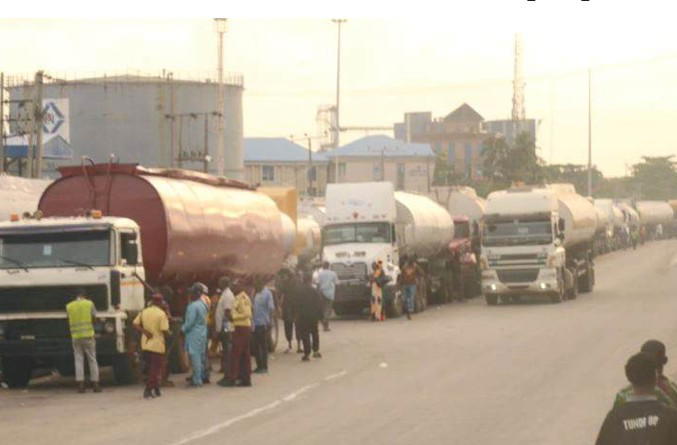
Lagos’ Apapa and Kirikiri industrial corridors continue to experience recurring traffic gridlock, with industry stakeholders attributing the problem to the indiscriminate parking of petroleum tankers waiting for loading opportunities and the inadequate parking facilities provided by many tank farms and depots.
Although government interventions and the electronic call-up system have significantly reduced the chaotic queues that once crippled Apapa, operators say the roads remain under pressure because hundreds of trucks still wait on major access roads instead of designated holding bays.
The situation is particularly evident along Kirikiri road, and other connecting roads leading to petroleum depots, where tankers often spend hours or even days waiting for loading instructions.
Industry operators explained that many tanker owners dispatch their trucks to Apapa and Kirikiri even before securing loading allocations from marketers or depot owners.
The expectation is that once petroleum products become available at any depot, trucks already positioned within the vicinity stand a better chance of securing business than those arriving from distant locations.
This practice results in hundreds of empty or partially loaded trucks occupying road shoulders, service lanes and access roads while waiting for possible loading opportunities.
Limited parking bays
Operators also blamed many tank farms for failing to provide adequate parking facilities capable of accommodating the volume of trucks they attract daily.
Many depots were established decades ago when truck traffic was significantly lower, while available land within Apapa has since become scarce and prohibitively expensive.
A depot operator explained that many facilities were constructed with only the minimum parking space required to obtain regulatory approvals.
He added that the available holding bays were designed mainly for company-owned trucks rather than the thousands of independent petroleum tankers that now serve the downstream petroleum industry.
Speaking with Vanguard, the Vice President of the Oil and Gas Services Providers Association of Nigeria (OGSPAN), Mr. Lawal Kamaldeen, said: “Most petroleum depots were originally built with limited parking space, providing only the minimum required to satisfy regulatory requirements. Developing a standard truck park in the Apapa area is highly capital-intensive because of the high cost of acquiring, reclaiming and concreting land.
“Consequently, the available parking facilities are often reserved for company-owned trucks or used as holding bays for tankers awaiting loading or preparing to depart after loading. As a result, many third-party trucks are forced to queue on public roads, contributing to the persistent traffic congestion in the Apapa and Kirikiri corridors.”
Impact on traffic and businesses
A transport expert, who pleaded not to be named, said the roads in Apapa were designed primarily for the movement of vehicles, not for long-term truck parking.
He said: “When heavy-duty tankers occupy traffic lanes, road capacity is significantly reduced, creating bottlenecks for other road users, including port trucks, container carriers, commercial buses and private vehicles. The situation becomes even more severe during peak loading periods when several depots operate simultaneously.
“Emergency response vehicles also face delays navigating the congested corridors. Businesses operating within Apapa and Kirikiri continue to complain about rising logistics costs, delayed deliveries and reduced productivity caused by prolonged travel times. Residents also face difficulties accessing their homes, schools and healthcare facilities whenever truck queues build up.”
Pressure on road infrastructure
The expert also noted that Nigeria’s petroleum distribution network remains heavily dependent on road transportation.
According to him: “With increasing supplies from domestic refineries and continued nationwide distribution of petroleum products, thousands of tankers converge on Lagos daily, making the state one of Nigeria’s largest fuel distribution hubs.
“Even with improved product availability from domestic refineries, particularly the Dangote Refinery and other local plants, the concentration of loading activities in Apapa and Kirikiri continues to attract huge volumes of trucks. Without corresponding investments in modern truck terminals, stakeholders fear the pressure on existing road infrastructure will persist.”
Way forward
Stakeholders believe the long-term solution lies in developing large off-site truck terminals linked digitally to depots through an efficient scheduling system.
Such facilities would enable tankers to remain outside Apapa until their loading slots become available, thereby reducing the unnecessary occupation of public roads.
Industry players also recommended stricter enforcement against roadside parking, the expansion of private holding bays by depot operators, and increased investment in logistics infrastructure.
Others advocated the decentralisation of petroleum loading operations by encouraging greater utilisation of depots in other parts of the country, thereby reducing the concentration of truck traffic in Lagos.
Stakeholders also urged regulators and traffic management agencies to ensure that every depot maintains adequate truck holding capacity relative to its daily loading volume.
However, in an interview with Vanguard, the Head of the Mile 2/Apapa Task Force, Mr. Shola Ojo, apologised to stakeholders affected by the recurring traffic congestion.
The post How idle tankers, inadequate parking bays keep Apapa, Kirikiri in constant gridlock appeared first on Vanguard News.

 Vanguard Nigeria
 This Day
 Daily Post
 Punch Nigeria
 Business Day
 identity-mag
 Channels TV