

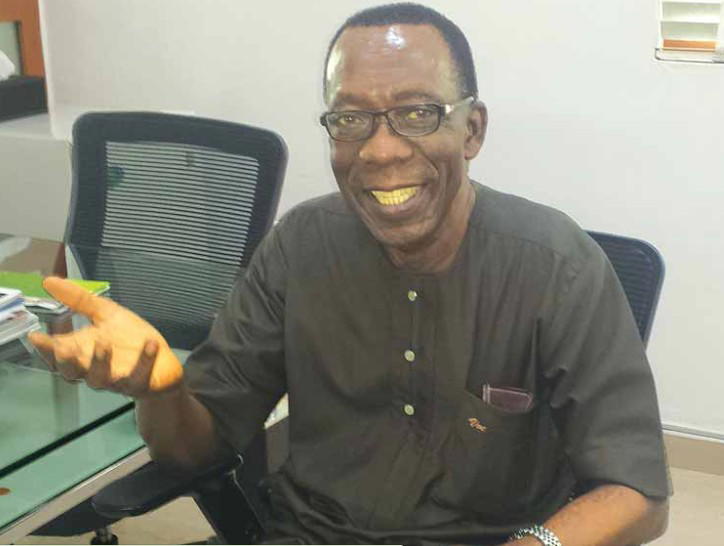
•Says they called me ‘The Spoiler’ because I refused to join corruption
•Laments Nigeria ignored warnings that destroyed manufacturing
•Believes Nigeria’s greatest problem is putting personal interest above national interest
•Insists Nigeria ‘ll rise again
•Adds at 80, my greatest achievement isn’t wealth, but my reputation
By Victor Ahiuma-Young & Adefolarin Adegboye
Few Nigerians have witnessed the country’s economic evolution as closely—or participated in it as actively—as Victor Eburajolo. For more than five decades, the industrial relations expert, corporate executive, manufacturing advocate and public servant occupied a front-row seat as Nigeria journeyed from an agrarian economy to industrial ambition, through the Structural Adjustment Programme, trade liberalisation, the decline of the textile industry and successive waves of economic reforms.
Along the way, he earned a reputation for something increasingly rare in both the corporate and public sectors: an unwavering commitment to integrity.
Now, as he marks his 80th birthday, Eburajolo reflects on a lifetime of leadership, service and conviction. Speaking with the candour of a man who has little left to prove, he recounts challenging the chairman of a multinational company over the meaning of loyalty, explains why he resigned from the Nigeria Social Insurance Trust Fund, NSITF, rather than compromise his principles, and revisits the warnings he issued decades ago that Nigeria’s embrace of structural adjustment and global trade liberalisation, without adequate preparation, would undermine local manufacturing.
In this wide-ranging interview with Vanguard, Eburajolo offers a candid assessment of Nigeria’s economic leadership, industrial policy, labour relations, entrepreneurship and governance.
He speaks passionately about the need to place national interest above personal gain, argues that integrity remains the foundation of effective leadership, and insists that despite decades of missed opportunities, Nigeria’s future remains bright.
More than an account of one man’s remarkable career, this is a conversation about the choices that have shaped Nigeria, the lessons history still offers, and the values that can guide the country towards a more prosperous future.
Throughout the interview, Eburajolo returns to the simple philosophy that has defined every major decision of his life: whatever your hand finds to do, do it as unto God.
As you mark your 80th birthday and look back on more than five decades in industry, corporate leadership, and public service, what moment do you consider the defining moment of your journey, and what values have guided your decisions throughout your career?
One experience captures the values that have guided me throughout my life.
One day after church, as I was walking to my car, eight young men from the congregation approached me. They said: “If you don’t mind, we would like to follow you home. We have some questions for you.” They came to my house, we sat down together, and they asked me a simple question: How did you become so successful in your career and in life?
I smiled and said, “Thank God we have just come from church.” I reminded them of what the Bible says: “Whatever your hand finds to do, do it as unto God.” If you live by that principle, God will direct your path.
That has been the foundation of my life. Everywhere I have worked, I have never looked at my boss as the person who would determine my success. My duty has always been to do my work with excellence and integrity, as though I were working for God. When you embrace that mindset, it gives you the courage to tell the truth, even when it is difficult.
I remember an incident about 12 years ago when I was a director at the Kewalram Chanrai Group. We had been invited to the chairman’s house. During the conversation, he said he expected every director to be loyal to him personally. I was the only Nigerian in the room. All the other directors agreed, but I remained silent.
He noticed my expression and asked:
“Victor, you haven’t said anything. What are you thinking?”
I replied respectfully, “Sir, with due respect, I don’t believe our loyalty should be to you personally. Our loyalty should be to the organisation. If we are all loyal only to you, and one day you make a decision that could ruin the company, no one will have the courage to challenge you. We would all go down together.”
He paused for a moment, reflected on what I had said, and then responded: “Thank you. You are right.”
Not everyone would have had the confidence to disagree with the owner of the company in that situation. The courage came from my conviction that I was speaking the truth and acting in the best interest of the organisation.
That is also the message I shared with those young men. I told them never to see success as a destination. Success is a continuous journey. The moment you think you have arrived, you begin to fall behind.
Many young people know the story of Kodak. It was once a global leader, but while it was enjoying its success, others were innovating and adapting. Eventually, they overtook Kodak, and the company never fully recovered. That is a reminder that success demands continuous learning, improvement, and the humility to keep growing.
Those principles—faith, integrity, courage, and a commitment to continuous improvement—have guided every important decision I have made throughout my career.
When you look at Nigeria today and compare it with the country in which you began your career, what emotions come to mind—pride, disappointment, hope, or something else?
Nigeria’s greatest challenge, in my view, is that too many people in positions of authority are more concerned with pleasing the Western world than advancing our own national interests. Without realising it, we sometimes end up selling ourselves short.
Take the events surrounding the June 12 election. Many people may not realise that Moshood Abiola spoke openly during his campaign about seeking reparations from countries he believed had historically exploited Africa. Whether one agrees with that position or not, it was a significant part of his message.
I remember reading an article in a British newspaper that focused not on his policies but on his personal life—his wives and children—and questioned whether he was fit to lead Nigeria. My reaction was simple: what relevance did that have to the issues Nigerians were trying to address? Too often, external narratives shape perceptions of our country, and we allow them to do so.
The same pattern has played out in sectors such as the textile industry, where we have too often failed to protect and develop our own economic strengths. In many cases, we know what needs to be done but lack the resolve to do it.
At the same time, I believe it is important to acknowledge progress where it exists. Whatever one’s political views, there are reforms in the financial sector under President Bola Tinubu that are intended to move the country forward. Nigerians have every right to criticise their leaders, but criticism should also be balanced and constructive. We should evaluate policies objectively, recognise what is working, point out what is not, and encourage improvements where they are needed.
That, to me, is the responsibility of responsible citizenship.
If you had to summarise your life’s work in one sentence, what would you want Nigeria to remember you for?
I would like to be remembered as someone who stood for the truth and always advocated for what I believed would help Nigeria become a better country.
Few people have witnessed Nigeria’s industrial evolution as closely as you have. Looking back, what do you consider the country’s greatest economic success and its greatest missed opportunity?
In the early years, Nigeria was primarily an agrarian economy, and things were relatively stable. Over time, we recognised that exporting only raw materials was not enough. We needed to add value before exporting, and that was the right direction for the country.
The challenge began when we entered value-added manufacturing because that meant competing directly with established industries abroad. Once you decide to process your cocoa into chocolate instead of exporting raw cocoa, for example, you are no longer simply a supplier—you become a competitor to international manufacturers.
In business, competitors naturally seek to protect their markets. If they can raise concerns about the quality of your products or create doubts in the minds of consumers, they will do so. That is the reality of global competition, and I don’t blame them for acting in their own interests. The real question is whether we are prepared to defend ours.
One of Nigeria’s greatest mistakes, in my view, was dismantling the institutions that protected the quality and competitiveness of our agricultural exports. We had commodity boards, including the Cocoa Board, that maintained quality standards and issued certifications for exported products. Those institutions gave international buyers confidence in Nigerian produce.
When those commodity boards were scrapped, we lost an important layer of quality assurance and coordination. Other countries did not make the same mistake. Benin, for example, retained its system, while we weakened ours.
There were also changes in production practices that affected quality. In the cocoa industry, for instance, the traditional use of jute bags was gradually replaced by synthetic polyethylene bags. In my experience, those synthetic materials created contamination problems that affected processing and the quality of the finished product. We raised these concerns at the time, particularly during my years in the textile industry, but they were not given the attention they deserved.
Looking back, I believe we underestimated the challenges of competing in global markets. We did not always anticipate how international competition would respond, nor did we consistently protect the institutions and standards that supported our industries.
Ultimately, however, I believe Nigeria’s biggest challenge has been putting individual interests ahead of the national interest. Too often, decisions have been driven by short-term personal considerations rather than what would strengthen the country over the long-term.
Until we consistently place Nigeria’s interests above individual interests, we will continue to struggle to realise our full economic potential.
At 80, what has experience taught you about leadership, integrity, and nation-building that you didn’t know when you began your career?
Looking back, I realise that integrity is not something you practise only when it is convenient. It has to shape every decision you make.
Throughout my career, I tried to ensure that everything I did was consistent with my faith and with the commitments I had made. In those days, I was often invited to deliver lectures and speak at conferences. My employment contract stated clearly that whatever I earned in the course of my work belonged to my employer because my time had been bought and paid for. So whenever I accepted speaking engagements during the working week, I asked the organisers to make the cheque payable to my company, not to me.
I did that for years.
After I left one of those companies, I approached them about supplying some of the materials I knew they required. The manager looked at me and said: “We thought you didn’t like money. So you want money now?”
I explained that while I was employed, I was simply honouring my contract. Once I had left, it was perfectly legitimate to build my own business. That distinction mattered to me.
In the end, integrity pays. The work I do today with Olam—managing and supplying labour services—came because someone who knew my reputation sought me out and persuaded me to take on the assignment.
Another experience reinforced that lesson.
When I served on the board of the Nigeria Social Insurance Trust Fund (NSITF), I carried out my responsibilities exactly as I believed they should be done. Before long, I discovered that people had given me a nickname: “the spoiler.”
I first heard it while travelling from Abuja to Lagos. A lady I knew boarded the aircraft, saw me in business class and smiled.
“Spoiler,” she said, “are you going to Lagos?” I looked at her, surprised.
She laughed and said: “Don’t you know that’s what people call you at NSITF? They say if anyone wants to do something that isn’t clean, and it gets to you, you’ll spoil it.”
To me, that was not an insult. It was confirmation that I was doing what I believed was right and acting according to my conscience.
Reputation has a way of extending beyond the individual. One day, someone visiting my son’s secondary school asked him his surname. When my son replied, “Eburajolo,” the man asked, “I hope Victor is your father.”
My son said yes.
The man responded: “Your father is a very straight man. You must learn to be straight too.”
For me, there could be no greater testimony than that. The values you live by become part of the legacy you pass on to the next generation.
That is why I have always believed that integrity is one of the greatest gifts a parent can leave behind.
You warned as far back as the mid-1980s that the Structural Adjustment Programme, SAP, would lead to Nigeria’s de-industrialisation. Looking back today, what do you believe policymakers misunderstood about the long-term consequences of those reforms?
Many of those reforms originated outside Nigeria. We must understand that countries promoting such policies are primarily pursuing their own interests. No nation designs economic policies to strengthen its competitors.
From my perspective in the textile industry, it was obvious that our manufacturing sector depended heavily on imported machinery, chemicals and dyes. Cotton was one of the few major local inputs. That made the industry particularly vulnerable to sudden policy changes.
The turning point, in my view, came when Nigeria joined the World Trade Organization (WTO). We were told that opening our borders would create opportunities for Nigerian manufacturers to sell freely across the world, including in markets such as the United States.
I decided to study the WTO agreement myself. I even attended the WTO conference in Seattle. As I read the agreement, I came across provisions that allowed countries whose industries faced serious threats a transition period to adjust before fully implementing certain commitments.
When I returned to Nigeria, we raised this issue through the textile industry and engaged government officials, including labour leaders such as Adams Oshiomhole. We believed Nigeria should take advantage of those adjustment provisions to prepare its industries for global competition.
We met officials in the Ministry of Finance and appealed for that transition period. Our argument was straightforward: give the industry time to modernise and adapt before exposing it fully to international competition.
Our appeal was unsuccessful.
At the time, the textile industry employed about 760,000 direct workers. We warned that opening the market without adequate preparation would have devastating consequences for those workers and for the wider economy.
Unfortunately, those concerns were not acted upon.
The challenges became evident. Nigerian textile manufacturers struggled to compete internationally, while imports increased significantly. In one case, a shipment of African prints exported to the United States was rejected because it failed to meet the required standards. Faced with the cost of returning the goods, the company simply abandoned the shipment. Incidents like that highlighted how difficult it was to compete in global markets without adequate preparation and institutional support.
I was also influenced by the writings of Professor Joseph Stiglitz, who argued that advanced economies often maintain significant protections for their own industries even while advocating trade liberalisation elsewhere. His observations reinforced my belief that countries must approach international trade with a clear understanding of their own strategic interests.
My advice to policymakers is simple. Ministers are not expected to know everything. Their responsibility is to seek out knowledgeable experts, listen carefully to informed advice, and make decisions that serve Nigeria’s long-term national interest.
Despite everything, I remain optimistic.
As a man of faith, I believe Nigeria’s best days are still ahead. When people hear the word “revolution,” they often imagine violence. But revolutions can also be peaceful. The Industrial Revolution transformed societies without being a political uprising.
I believe Nigeria will experience its own transformation. It may not happen in my lifetime, but I have confidence that the next generation will find new ways to solve the country’s challenges.
Nigeria is destined for greatness. I truly believe we will get there.
You have argued that Nigeria failed to take advantage of the WTO transition period for new members. If the country had used that window wisely, what concrete policies would you have recommended to prepare Nigerian industries for global competition?
The first step would have been to recognise that joining the WTO was not simply about opening our borders. It required a deliberate strategy to prepare Nigerian industries for international competition.
I would have encouraged the textile industry to establish a dedicated body to monitor global developments—studying emerging technologies, market trends, international standards and the strategies of competing countries. Without that kind of intelligence, you are always reacting rather than preparing.
Instead, what happened was abrupt. It was like switching off the lights without warning and expecting everyone to find their way in the dark. Industries were left to fend for themselves, and many simply could not survive.
One of the saddest consequences was what happened to our factories. When many textile companies collapsed, their machinery was dismantled and sold to buyers from countries such as India and other parts of Asia. I witnessed this myself. Machines that had powered Nigerian manufacturing were shipped overseas and put to use elsewhere.
Technology also transformed competition in ways we were not prepared for. Nigerian designers were exceptionally talented. A design created here could be transmitted electronically and, within a matter of weeks, copies produced abroad would be back on sale in Nigerian markets. That speed fundamentally changed the economics of the industry.
Today, countries such as China produce African prints for African consumers. That illustrates how global manufacturing has evolved. Once production can be done more cheaply and efficiently elsewhere, local industries must compete on innovation, quality and speed, not simply on location.
Nigeria’s textile industry once employed more than 750,000 people but has since declined dramatically. Beyond smuggling and dumping, what other factors do you think contributed to the industry’s decline? And what would it realistically take to revive it?
Reviving the textile industry today would be extremely difficult because many of the underlying economic conditions remain unfavourable.
I remember a study we carried out years ago. At the time, a metre of locally produced base cloth left our factory at about 80 kobo. Meanwhile, imported cloth from countries such as China and India could land in Lagos—including transportation costs—for about 20 kobo per metre.
No manufacturer can compete under those conditions. From a consumer’s perspective, the decision is obvious. If you can buy a comparable product for a quarter of the price, that is where your money will go. That is simply how markets work.
The industry also lost an important source of business as technology changed. Many Nigerian textile mills specialised in custom orders. Customers would visit a factory with a design, and the mill would produce fabric specifically for them.
Today, that process can be done online. A customer can send a design electronically to a manufacturer in India or China, choose the fabric from digital samples, approve production almost immediately, and receive the finished product within a few weeks. Advances in communication, logistics and manufacturing have made global sourcing faster and more efficient than ever before.
That is the reality of today’s economy. The world has become far more interconnected, and industries everywhere must adapt to that reality.
For Nigeria, the lesson is that we cannot rely solely on competing in areas where other countries already enjoy significant cost advantages. We must identify products, skills or technologies that are uniquely ours—areas where we have a genuine competitive advantage—and build industries around them.
That is where I believe Nigeria’s future opportunities lie.
You don’t believe that a policy encouraging Nigerians to wear made-in-Nigeria clothing would revive the textile sector?
On its own, I don’t think it would.
The real question is whether such a policy would be consistently observed. We often introduce policies, but enforcement is weak. We have a broader challenge with discipline.
Take something as simple as a “No Parking” sign. Many people, including influential individuals, will see it, realise there is no parking space available, and still park there because they believe the rule does not apply to them.
That attitude extends beyond traffic regulations.
If we want policies to succeed, we must first build a culture of discipline, accountability and respect for rules. Without that, simply asking people to wear made-in-Nigeria clothing is unlikely, by itself, to revive the industry.
Many African countries today are pursuing industrialisation under the African Continental Free Trade Area (AfCFTA). What lessons should Nigeria draw from its experience with the WTO to avoid repeating past mistakes?
The first question we should ask is whether the model we are trying to emulate has actually delivered the desired results elsewhere.
Many of the challenges Nigeria has experienced are not unique. Companies such as the Kewalram Chanrai Group established manufacturing operations across several West African countries, yet many of those industries have struggled with similar competitive pressures. Most of those countries have even fewer resources than Nigeria.
The reality is that global competition is intense. Every country seeks to protect its own interests. I don’t blame developed economies for doing that. International trade is competitive, just like sport. The responsibility is ours to prepare adequately and strengthen our own industries.
What gives me hope is the younger generation. I hope they will reject some of the practices that have held the country back, particularly corruption.
My son, who studied at the University of California, Berkeley, once shared with me conversations he had with friends after returning to Nigeria. He told me that some people believed jobs in certain public institutions could only be secured through unofficial payments. He even mentioned figures that people claimed were associated with recruitment into agencies such as the Federal Inland Revenue Service, the Nigeria Customs Service and, in one case, the Central Bank.
He also spoke about stories of politically connected individuals who were reportedly not held accountable in the workplace.
If such perceptions become normal, they undermine confidence in public institutions and discourage merit. That is a serious challenge for any country.
Despite all this, I remain optimistic.
History shows that many nations have gone through difficult periods before finding a better path. I believe Nigeria will do the same. A new generation will eventually decide that enough is enough and insist on higher standards of leadership and accountability.
One thing I have observed throughout my travels is that Nigeria is often held in very high regard across Africa.
I remember attending an International Labour Organization (ILO) meeting in Johannesburg. The meeting was scheduled to begin at 9:00 a.m., and I arrived on time, along with delegates from countries such as the United States and India.
After a couple of days, an American delegate sat beside me and asked, “Why aren’t you like your brothers?”
I asked him, “Who are my brothers?”
He replied, “Aren’t you South African?”
I smiled and said, “No, I’m Nigerian.”
He immediately apologised and then said something I have never forgotten. He told me that, in his experience, Nigerians were diligent and hardworking wherever he had encountered them.
That made me proud because it reflected the positive reputation many ordinary Nigerians have earned through their work and professionalism.
I have always believed that Nigerians are a remarkable people. The country’s difficulties are not a reflection of the character or ability of its citizens. Our challenge is to build stronger institutions and better leadership.
At the end of the day, political parties should be distinguished by clear ideas, philosophies and programmes. Too often, our politics revolves around personalities rather than competing visions for national development.
That is something we must change if Nigeria is to fulfil its enormous potential.
Successive governments have spoken about diversifying the economy beyond oil, yet manufacturing remains weak. In your view, what are the three most urgent policy actions needed to rebuild Nigeria’s industrial base?
First, government must recognise that manufacturing needs support if it is to become globally competitive. Where manufacturers depend on imported raw materials, there should be targeted subsidies to help them through the early stages. Such support should not continue indefinitely, but it should be available for a clearly defined period to enable new industries to establish themselves.
Second, manufacturers need access to affordable financing. Soft loans are essential, but they must be properly managed and monitored. Without transparency and accountability, such facilities can easily be diverted from their intended purpose, defeating the objective of supporting industrial growth.
Third, government should work much more closely with the Manufacturers Association of Nigeria (MAN) and other industry stakeholders to develop practical policies that address the challenges facing manufacturers. Those interventions should also be time-bound, with clear performance targets and exit plans. The objective should be to help industries become competitive, not permanently dependent on government support.
During your time at the Nigeria Social Insurance Trust Fund (NSITF), you were said to have threatened to rather resign than participate in practices you considered unethical. Looking at Nigeria today, has governance improved, or have these systemic problems become even more entrenched?
I wouldn’t say the problems are more entrenched, but they certainly persist.
I remember a journalist once making a remark that has stayed with me. He said Nigerians often criticise those in government, but once many of those critics get into government themselves, they become silent because, as the saying goes, when you are eating, you don’t talk. In other words, once people begin to benefit from the system, they stop speaking against it.
The truth is that many people in government know what needs to be done to move Nigeria forward. The real question is whether anyone is prepared to champion those reforms, especially when doing so comes at a personal cost.
My own experience at the NSITF illustrates that challenge.
I was nominated by the Organised Private Sector to represent it on the NSITF board. I regarded it as an opportunity to understand how the public sector operated because my entire career had been in private enterprise.
Before I accepted the appointment, Adams Oshiomhole met with me on two occasions and encouraged me to accept, regardless of the position I was eventually offered. At the time, I assumed he was simply acting in his capacity as chairman.
When I met the Minister of Labour, he spoke to me with remarkable openness. He explained that different stakeholders each had their preferred candidates for key positions within the organisation. He said that if I insisted, I could be appointed Managing Director.
I told him that, in my opinion, if government wanted to strengthen the institution, the position of Managing Director should ideally go to someone already within the organisation who understood its systems and operations. Bringing in an outsider, I argued, would make it much harder for the person to succeed.
The minister looked at me and asked whether I would be willing to step aside.
I said I had no objection. My main interest was not the title but the opportunity to contribute meaningfully.
He then suggested another role. I told him I wanted responsibility for operations because that was where I believed I could make the greatest impact—ensuring that contributions collected from employers were properly managed and that benefits reached workers.
The minister seemed visibly relieved. He left his office briefly, returned, placed his hand on my shoulder and said, “You are God-sent. You have solved a problem that has been giving me sleepless nights.”
That was how the matter was resolved.
Later, after another senior official left the organisation, I was promoted to Managing Director.
Nothing about my approach changed.
One day, some officials came into my office to “brief” me on how things worked. Towards the end of the discussion, they handed me a schedule showing how funds were expected to be distributed every month.
As I looked through the document, I saw allocations listed for various institutions and offices.
I immediately said, “I cannot do this.”
They laughed.
They told me, “You will do it. Everyone before you has done it.”
The outgoing Managing Director quietly leaned over and whispered to me, “Now you know why I am leaving. I am tired of this.”
I asked what would happen if I refused.
I was warned that I could face investigations, fabricated allegations and sustained public attacks. I was told that my reputation could be destroyed and that I might even be detained on false charges. Someone even reminded me of the dangers faced by public officials who challenged powerful interests.
Those conversations forced me to think deeply about my options.
A few weeks later, I came to a simple conclusion: if remaining in office meant compromising my principles, then the only honourable option was to leave.
I submitted my resignation.
There was no acknowledgement from either the Presidency or the Ministry of Labour. After serving my notice period, I wrote again to say that if I received no response within two weeks, I would consider my resignation effective.
When no reply came, I packed my belongings and left Abuja.
To this day, I have never received an official response to that resignation.
I often remember a remark by former President Olusegun Obasanjo: “If you want to fight corruption, corruption will fight you back.”
My experience taught me exactly what he meant.
Looking back today, I have no regrets. I left with my integrity intact, and I continue to enjoy the peace of mind that comes from acting according to one’s conscience.
You have served in leadership positions across manufacturing, labour relations, human resources and corporate governance. How would you assess the quality of economic leadership in Nigeria today compared with the 1980s and 1990s?
The biggest challenge is not that we lack capable people. It is that too often, political leaders fail to draw on the expertise that is available to them.
Politicians are elected to lead, but they cannot be experts in every field. Good leadership requires the humility to seek advice from people who understand the technical issues, to listen to them and to use that knowledge in making policy.
Instead, what we often see is political appointments being filled by other politicians rather than by professionals with the relevant expertise. That approach has to change.
If I do not understand a subject, I should bring in people who do, interact with them, challenge their thinking and use their advice to arrive at the best decisions. That is how institutions become stronger.
Despite the challenges, I remain optimistic. When I listen to many young Nigerians—particularly those who have studied abroad and returned home—I hear fresh ideas, energy and a genuine desire to build a better country. My concern is that some young people who grow up within political families are exposed to practices that can discourage that idealism.
Nigeria has endured many difficulties, yet the country has remained remarkably resilient. Sometimes I reflect on how vulnerable we would be if, on top of all our existing challenges, we faced a major natural disaster. That thought reminds me that we cannot continue to take stability for granted. We need stronger institutions and more responsible leadership.
Nigeria has one of the youngest populations in the world, yet youth unemployment remains a major challenge. If you were advising the President today, what industrial strategy would you recommend to create millions of sustainable jobs?
One thing I would encourage is a change in mindset.
Too many young people leave school believing that success depends on writing job applications and waiting to be employed. Employment is important, but entrepreneurship should receive far greater attention.
I remember asking my son what he intended to do after completing his master’s degree in the United Kingdom and finishing the National Youth Service. He replied, “Dad, I don’t want to work for someone. I want to build my own business.”
He believed there were opportunities in Nigeria for those prepared to identify problems and create solutions. Together with two friends, he started a business. Like every new venture, they encountered challenges, and I encouraged them not to give up. Today, the business is doing well.
Government should continue strengthening support for small and medium-sized enterprises through access to finance, infrastructure and policies that encourage innovation. Those are encouraging developments, and they should be expanded.
At the same time, we should not assume that everyone must spend a lifetime working for someone else. Entrepreneurship creates jobs as well as wealth.
My own experience reinforces that lesson. Had I not established my own business alongside my career, I would have struggled after retirement. The pension I eventually received from public service was nowhere near enough to sustain the standard of living I had become accustomed to.
I also see this entrepreneurial spirit in my daughter. After graduating from the University of London, she attended an interview with KPMG in Nigeria. During the interview, one of the interviewers questioned why she had completed her master’s degree before the age of 21, asking why she had been in such a hurry.
She found the reaction surprising. Instead of being encouraged for her achievement, she felt she was being criticised.
Although she was offered the job, she chose a different path. Today, she works with a company in Scotland while building her own business, designing and selling bags online. She is also introducing a photo booth business to Nigeria because, as she puts it, Nigerians enjoy celebrations and photography, and she sees an opportunity in that market.
That is the kind of thinking we should encourage. Our young people are intelligent and innovative. Given the right environment, they will create opportunities rather than wait for them.
I believe Nigeria’s future lies in unlocking that entrepreneurial energy.
In a recent interview, you said that something unexpected would happen in Nigeria—that there would be a revolution. Could you explain what you mean by that? Do you envision a political, economic, technological or social transformation? And what gives you that optimism?
When I speak of a revolution, I am not referring to violence or political upheaval. I am talking about a revolution in mindset.
The Industrial Revolution transformed societies without being a violent movement. In the same way, I believe Nigeria’s transformation will begin with a change in how people think, work and create opportunities.
I see evidence of that already in many young Nigerians.
My son, for example, received an attractive job offer from Toyota in the United Kingdom, but he chose to return home instead. His reasoning was simple. He told me that while life in the UK offers stability, it also has limits. He wanted the opportunity to build something of his own rather than spend his life paying for everything through loans and living within a fixed system.
Whether one agrees with his decision or not, what impressed me was that he had thought carefully about the future he wanted to create.
Today, he is registering a company in California because he sees opportunities to build a business with an international footprint while creating opportunities for Nigerians. That is a different way of thinking from previous generations.
Our young people are globally connected. They understand technology, entrepreneurship and international markets. They are looking beyond traditional career paths.
By contrast, I sometimes feel our politics has not evolved at the same pace. Too often, politicians move from one party to another without any clear ideological differences or long-term vision for national development.
I believe that will eventually change because the next generation is thinking differently. They are more interested in creating value than in preserving old political structures.
Someone once remarked that my generation was a “wasted generation” because we spent our lives caring first for our parents and then, later, for our children. I remember praying for my son one day and asking that, just as he had tested our patience as parents, he too would one day understand the responsibilities of raising children.
When I finished the prayer, I noticed he had not said “Amen.” I asked him why.
He smiled and replied, “I can’t say amen to that.” We both laughed.
For me, that conversation symbolises something important. Every generation wants a better future than the one before it. I believe today’s young Nigerians will build that future. It may not happen overnight, but I am convinced that the transformation has already begun—in the way they think, the way they innovate and the way they see the possibilities for this country.
That is why I remain hopeful. Nigeria is destined for greater things.
At 80, after more than five decades in business, public service and industrial advocacy, what legacy do you hope to leave, and what message would you like young Nigerian entrepreneurs, policymakers and professionals to take from your life’s work?
The legacy I hope to leave is a simple one: live truthfully, live ethically and live by faith.
Whatever you do, do it to the glory of God. If you live by that principle, you will rarely go wrong. It has made life much easier for me because it gives you a clear standard for making decisions.
People often tell me, “You’ve worked for so many years. It’s time to rest.”
I always smile and ask them, “What do people write on a tombstone?” The answer is, Rest in Peace. My response is simple: I still have strength. Why should I begin resting now?
I still work every day. I have an office in my home, and I even have a workspace in my bedroom. The only difference now is that if I become tired while working, I simply close my laptop, lie down for a while, and when I wake up, I continue where I stopped.
To me, that is not work; it is a fulfilling way of life.
Real happiness comes from within. You have to make a conscious decision to be happy. It is not determined by circumstances alone.
Above all, surrender your life to God. I believe that when your life is guided by faith and integrity, those values will also be reflected in your children and in the legacy you leave behind.
I consider myself fortunate. I live a peaceful life. Even today, old friends still call me, not just to reminisce but sometimes to ask for help. Recently, a classmate from secondary school called to say his daughter was getting married and that he needed financial assistance. I told him I would help.
To me, that is what life is about—living in a way that enables you to be a blessing to others.
As an industrial relations expert, what is your solution to the frequent labour disputes and industrial actions in both the private and public sectors?
Many years ago, I shared a principle with some labour leaders that I still believe is true today.
There is a saying that if employers in earlier times had always been fair, there might never have been a need for trade unions.
Whether or not one agrees with that completely, the point is clear: many workplace conflicts begin when employees feel they are being treated unfairly.
Some employers expect workers to keep the business running while denying them fair treatment or a sense of belonging. Eventually, people become frustrated. If they have no other way of making their voices heard, they withdraw their labour.
The solution begins with fairness.
Employers should be open with their workforce. Explain the true financial position of the company. Let employees understand the challenges the business faces and make them feel that they have a genuine stake in its success.
I learnt this lesson in my own consulting firm.
At one point, I discovered that clients owed the company about N280 million. When I investigated, I realised that some invoices had not been processed on time and others had simply been overlooked. It was a costly administrative failure.
That experience reinforced my belief that employees perform differently when they understand that the organisation’s success is also their success.
One experience involving my managing director illustrates what I mean.
I walked into his office one day and found his daughter in tears. She had secured admission for a master’s degree in the United Kingdom but had deferred it for three consecutive years because the family could not raise the money. She had just been informed that if she did not resume that year, the admission would be withdrawn.
I asked my managing director how much he had been able to raise and how much was still outstanding. He told me he needed about N3.2 million more.
I said, “Prepare the documents and bring them to me. I will approve the money so your daughter can go to school.”
He immediately asked how he would repay it.
I replied, “Did you hear me mention repayment? I simply want your daughter to take up her admission.”
That was the end of the conversation. I often ask people: after an employer shows that level of concern for an employee, do you think that employee will deliberately undermine the organisation?
On another occasion, the same managing director complained that his neighbourhood had a water problem. I told him to engage the same company that had drilled the borehole at my house and have one installed at his own home.
These gestures were not extraordinary. They reflected a simple belief: if employers genuinely care about the welfare of their employees, loyalty and commitment will naturally follow.
Of course, there will always be a few difficult employees. That is inevitable. But in my experience, most workers respond positively when they feel respected, valued and treated fairly.
That is why I believe lasting industrial peace cannot be achieved through rules alone. It begins with trust, fairness and a genuine commitment to treating employees not merely as workers, but as partners in the success of the organisation.
The national minimum wage will soon be reviewed by the tripartite committee comprising organised labour, the private sector and government. What principles should guide those negotiations?
The starting point should be the realities of the economy.
We have data on inflation, the cost of living and the purchasing power of workers’ incomes. Those facts should guide the discussions, not politics or sentiment.
As Adams Oshiomhole often used to ask, “Can a take-home pay of a Nigerian worker even take the take-home pay home?” In other words, wages should be sufficient to meet the basic cost of living.
The objective should be to arrive at a realistic minimum wage—one that enables workers to live with dignity while taking into account the capacity of the economy and employers to sustain it.
Government also has a responsibility to cushion the effects of economic hardship. While improving wages is important, it must be accompanied by policies that reduce the cost of living and strengthen the economy. If the economy grows and productivity improves, future wage reviews can deliver even greater gains for workers.
I have seen firsthand why this matters.
At one point, I discovered that many security guards in my neighbourhood were earning about N30,000 a month. My own security personnel were earning N90,000, even before the current national minimum wage of N70,000 was announced.
Because their salaries elsewhere were so low, many guards had to work multiple jobs just to survive. Some would work three days at one location and then spend the next three days working somewhere else. In Abuja, some even used their days off to work on farms in order to supplement their income.
That tells you that, for many workers, one job is no longer enough to support a family.
Beyond wages, employers also have a moral responsibility to care for the people who work for them. It is not just about paying salaries. It is about recognising their humanity.
In my own home, for example, my security personnel are provided with meals. I remember one of them telling my cook after a few days that he had stopped eating because same food had been served to him. That struck me deeply.
If someone is entrusted with protecting your home and your family, the least you can do is ensure that the person is treated with dignity.
Fair wages, humane treatment and a stronger economy must go hand in hand. That is the only sustainable path to industrial harmony and national development.
From your experience, when should a worker start preparing for retirement?
I’ll tell you: from the very day you start working.
As I joked with you earlier, I don’t know how 70 years crept up on me. I just woke up one day and realized I was 70. Now I’m 80.
So, the day you start working is the day you should begin preparing for retirement. However, don’t get involved in anything that creates a conflict with your employment. Plan ahead, but do it wisely.
Let me repeat: the time to prepare for retirement is the day you start work. If you relax, time will pass before you know it.
I’m also a strong advocate of having a second stream of income. But again, I emphasize that it should never conflict with your primary job.
Ideally, is there ever a time when someone can say, “I’m done. I’ve stopped working completely”?
That would be a very foolish decision.
Even if you have a hundred million today and decide to sit back and enjoy life, you are not adding to your wealth—you are only withdrawing from it. Before long, what you have will be depleted.
I always advise people to keep doing something productive.
Just recently, I was speaking with the Director General of an association here in Nigeria . I asked him, “do you have your own house?” He was quiet for a moment and then said, “No, sir. I have a place in Abuja.”
I asked him, “Do you intend to retire to Abuja? We are from this part of the country. Get a place back home and start building.”
I advised him to leverage influential people to help him obtain land from the government if possible, and then begin building gradually.
A house is a huge project when you don’t even have land. But once you have land, progress becomes easier. At first, you may simply fence it. Later, you may build a boys’ quarters. Before long, the main house begins to take shape. God provides along the way.
If you don’t have a roof over your head by the time you retire, retirement can become extremely difficult.
Now that your workload has reduced, what other activities keep you active?
First of all, exercise. If you don’t exercise, it will take its toll on you.
Few days ago, I was with my wife and my son when something dropped on the floor. I simply bent down and picked it up. My son looked at me and said, “Dad, you can still bend down like that?”
I was surprised by his reaction. But the truth is, some people in their 60s or 65s can’t bend down comfortably anymore.
You must stay physically fit. Otherwise, you’ll spend all your money on doctors.
I’ll tell you a joke. I visited my doctor some time ago, and he said, “Victor, it’s been a long time since I saw you.”
I replied, “Glory be to God.”
He asked, “Why do you say that?”
I said, “Would you rather I came here every day? Do you want me to be perpetually sick?”
What about your eating habits?
At this age, most of what you eat is determined by your doctor.
I’ve been told to cut out sugar and reduce carbohydrates. Even ordinary rice is no longer for me—I can only eat Basmati rice. As for bread, it has to be brown bread.
When we were children, our food was restricted by our parents. Now, in what Shakespeare called our “second childhood,” our food is once again restricted—this time by our doctors.
The post I walked away from power rather than compromise my integrity —Octogenarian Eburajolo appeared first on Vanguard News.