

***Mourns Gen Abubakar, others, demands tech-driven security overhaul
***Army detains 2 surrendering terrorist commanders in Borno
By Henry Umoru & Ndahi Marama
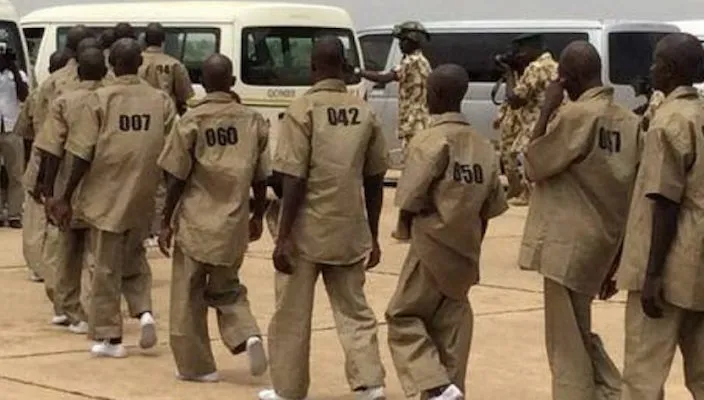
ABUJA — The Senate has urged the Federal Government to halt the policy of rehabilitating and reintegrating former Boko Haram members into society, and ensure that perpetrators of terrorism and banditry are, instead, arrested and made to face the full wrath of the law.
The resolutions followed a motion of urgent national importance on escalating attacks, abductions and killings of serving and retired military personnel, sponsored by the Chairman, Senate Committee on Army, Senator Abdulaziz Yar’Adua, during plenary, yesterday.
The Senate condemned, in strong terms, the worsening insecurity in Nigeria, describing it as increasingly complex, persistent and alarming, manifesting through terrorism, insurgency, banditry, kidnapping, attacks on communities and continued loss of innocent lives across the country.
Debate on the issue drew contributions from senators across party lines, reflecting deep concerns within the National Assembly over a security crisis that has, in recent years, expanded beyond its traditional North-East epicentre to touch virtually every zone of the country.
This happened as the Nigerian Army announced the surrender of two senior terrorist commanders to troops of Operation Hadin Kai in Borno State, saying the detained suspects have provided valuable intelligence expected to aid ongoing operations against insurgents in the North-East.
Senate mourns Gen Abubakar, others
The Senate observed a minute of silence in honour of late Major-General Rabe Abubakar, former Director of Defence Information, and all Nigerians who lost their lives to terrorism, insurgency, banditry and kidnapping across the federation.
It resolved that the Senate leadership will immediately constitute a delegation of senators to visit the family of the late General, the Katsina State government and the Nigerian Army to convey its condolences.
Moving the motion, Senator Yar’Adua said the killing of General Abubakar and other retired officers “represents not only personal tragedy but also a painful national loss demanding urgent action.”
He said retired officers remained attractive targets for terrorists and kidnappers because of their previous operational, intelligence and command responsibilities, warning that persistent attacks on security personnel undermines troop morale and emboldens criminal groups challenging authority of the state.
Attacks on
retired officers
Sen. Yar’Adua listed a string of attacks on retired senior officers across Zamfara, Imo, Abuja, Katsina, Kogi and Plateau states since 2023:
lJanuary 1, 2023 — Colonel Rabiu Garba Yandoto (retd) and his two children were abducted by bandits along the Gusau–Tsafe Road, Zamfara State, and later released after negotiations.
lSeptember 27, 2023 — Major General Richard Chukwudi Duru was kidnapped in Owerri, Imo State, and killed by his abductors despite his family paying a $50,000 ransom.
lJune 22, 2024 — Brigadier-General Uwem Harold Udokwere (retd) was murdered by intruders who invaded his residence in Lokogoma, Abuja.
lFebruary 5, 2025 — Brigadier-General Maharazu Tsiga (retd), former Director-General of the National Youth Service Corps, NYSC, was abducted at his residence in Katsina State and regained freedom after 56 days in captivity.
lMay 21, 2025 — Retired Major Joe Ajayi was abducted from his residence in Kogi State and died in captivity.
lJanuary 2026 — Colonel Joseph Ajanaku (retd) was abducted in Plateau State and later rescued by security forces in a special operation.
lMay 30, 2026 — Retired Major-General Rabe Abubakar was abducted alongside his wife by suspected terrorists in Katsina State and subsequently died in captivity.
The Senate said the pattern undermines morale within the armed forces, weakens public confidence in the state’s capacity to provide security, and emboldens criminal elements who perceive the state as incapable of protecting even those who once defended it.
Ikpea, Oshiomhole lead call against rehabilitation
The de-radicalisation and reintegration programme targeted by the Senate has, for years, formed a central plank of the Federal Government’s non-kinetic approach to ending the North-East insurgency, with repentant fighters screened and resettled in host communities after rehabilitation.
That rationale came under direct fire on the Senate floor, yesterday, with lawmakers arguing that the policy had, in practice, come to be seen by ordinary Nigerians as rewarding violence rather than deterring it.
The call to halt the rehabilitation of former insurgents was raised as an additional prayer by Senator Joseph Ikpea who argued that the policy had become a source of growing public concern deserving urgent legislative attention.
“Mr. President, my additional prayer is that the issue of insecurity has become something Nigerians are deeply concerned about. One of the issues we need to look at is the rehabilitation of Boko Haram members. My additional prayer is to stop the rehabilitation of Boko Haram,” he said.
The proposal was seconded by Senator Adams Oshiomhole, who said the policy of rehabilitating and reintegrating former insurgents defies logic at a time victims of terrorism and families of fallen security personnel are still grappling with the consequences of insurgent attacks.
“It does not make even common sense to grant pardon, rehabilitate and reintegrate criminals into society,” Oshiomhole said, urging government to place greater emphasis on justice for victims, accountability for perpetrators and support for security personnel. “Therefore, I support it in total,” he added.
Tech-driven security overhaul
Beyond the rehabilitation policy, the Senate urged security and intelligence agencies to significantly strengthen intelligence gathering, intelligence sharing, surveillance operations, threat assessment mechanisms and early warning systems to prevent attacks and improve response effectiveness nationwide.
It also called for deeper collaboration with local communities, traditional institutions and religious leaders to build community-based intelligence and trust-driven security partnerships, and urged the federal government to accelerate deployment of modern security technologies, including unmanned aerial systems, geo-spatial intelligence, integrated command and control platforms and advanced communications systems, to combat terrorism, banditry and kidnapping.
The Senate commended the Armed Forces, the Police, the Department of State Services, the Nigeria Security and Civil Defence Corps and other agencies for their sacrifices, even as it insisted that legislative oversight of the sector must be intensified.
Stronger oversight of security sgencies
Senator Abdul Ningi, who called for greater legislative oversight of Nigeria’s security institutions, urged the National Assembly to intensify oversight of security agencies by reviewing casualty records, operational responses and the level of support extended to families of fallen security personnel.
Contributing on the same note, Senator Osita Izunaso, who seconded the main motion, described the recurring attacks on serving and retired military personnel as disturbing and unacceptable, saying the catalogue of abducted and murdered officers reflects a worsening national security situation that demands stronger measures against perpetrators.
“This motion has come at the right time when Nigerians expect the nation’s defence and security architecture to decisively confront growing insecurity,” Izunaso said.
Troops doing their best — Barau
Presiding over the session, Deputy President of the Senate, Jibrin Barau, said concerns raised by lawmakers are justified but urged a balanced assessment of ongoing security operations.
Barau noted that terrorism remains a global challenge affecting several countries, particularly within the West African sub-region, and requires collective regional responses.
“Our men and women in uniform are doing their best. They have been successful in decimating many criminal elements and deserve our continued support,” Barau said.
Army detains 2 senior terrorist commanders after surrender in Borno
The development was disclosed in a statement by the Acting Media Information Officer, Headquarters Joint Task Force (North East) Operation Hadin Kai, Capt. Mohammed Goni.
According to the Army, the two commanders surrendered to troops of Sector 2 in Geidam on July 4, 2026, before arriving in Maiduguri at about 7:30 p.m. on July 5, where they are now in military custody undergoing “detailed profiling, debriefing and intelligence exploitation.”
Geidam, in northern Borno close to the Yobe State border, has long served as a corridor through which fleeing terrorist elements pass either to surrender to troops or to relocate to other enclaves within the Lake Chad Basin.
Suspects held key positions – Army
The statement identified the suspects as Munzirs within the terrorist leadership structure, adding that preliminary interrogation showed the pair “occupied influential positions and possess extensive knowledge of the group’s operational activities, command arrangements and logistics architecture.”
The Army said initial intelligence from the debriefing had “provided valuable insights into the terrorists’ operational methods, sustaining mechanisms and support networks,” noting that the information will significantly enhance ongoing intelligence-led operations aimed at locating, disrupting and dismantling remaining terrorist enclaves across the North-East theatre.
Setback for insurgents – Military
Describing the surrender as another blow to the insurgents, the military said the development “represents another major setback for the terrorist faction and further validates the effectiveness of sustained offensive operations being conducted by troops of Operation Hadin Kai.”
The Army said sustained land and air offensives, backed by enhanced intelligence operations, had continued to restrict the terrorists’ movement, weaken their fighting capability and disrupt their command structures, adding that “terrorist leaders and fighters are finding continued resistance untenable, compelling them to abandon the insurgency and surrender to troops.”
Operation Hadin Kai reiterated its commitment to sustaining the offensive, saying troops would continue to exploit actionable intelligence, intensify offensive operations and work in close collaboration with relevant stakeholders to eliminate the terrorist threat and restore enduring peace, security and stability across the North-East.
Fresh questions
The timing of the latest surrender places fresh scrutiny on how the federal government intends to handle the two commanders, coming just as the Senate has called for an end to the rehabilitation and reintegration of repentant insurgents and demanded that captured terrorists be prosecuted, rather than resettled.
Military authorities have consistently maintained that surrendered fighters in leadership positions, given their detailed knowledge of terrorist networks, are of significant intelligence value and are processed through debriefing before any decision on their disposition is taken.
The Army did not indicate in its statement whether the two commanders would eventually be prosecuted or passed through the rehabilitation pipeline, saying only that the debriefing process was ongoing.
The post Insecurity: Halt rehabilitations, try B-Haram members, Senate tells FG appeared first on Vanguard News.

 Punch Nigeria
 Modern Ghana
 Daily Post
 This Day
 Business Day
 The Standard Kenyan
 Watchdog Uganda
 Vanguard Nigeria