

By Steve Oko
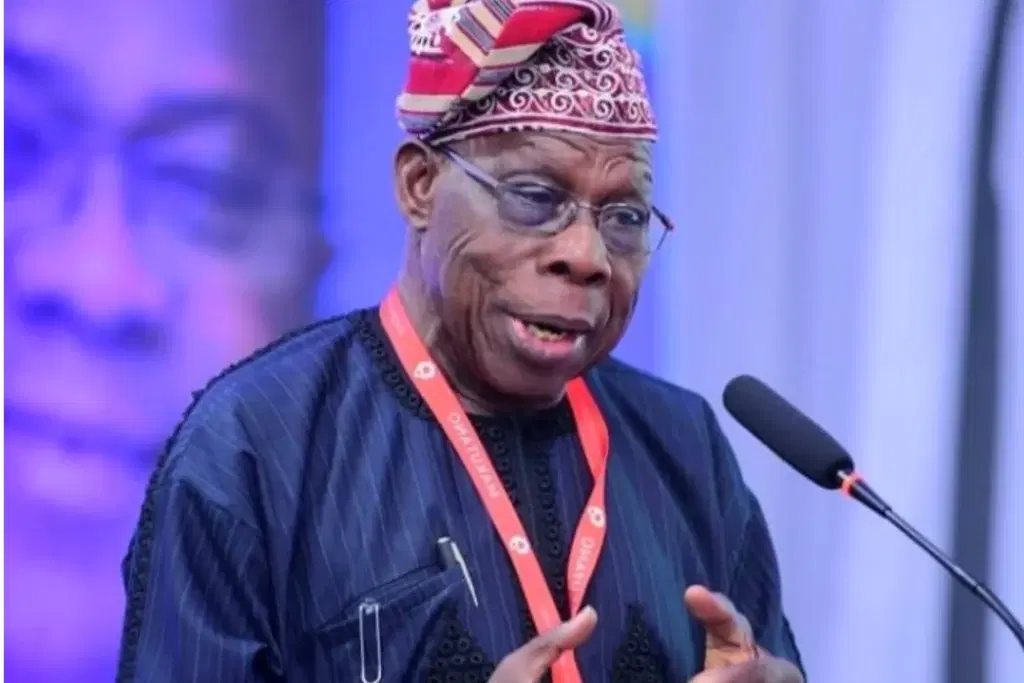
UMUAHIA — Former President Olusegun Obasanjo has urged Nigerians to confront the nation’s painful historical experiences and draw lessons that will promote unity, inclusion and national development.
Obasanjo spoke on Wednesday in Umuahia during the 60th memorial service held in honour of Nigeria’s first military Head of State, General Johnson Thomas Umunnakwe Aguiyi-Ironsi, who was assassinated on July 29, 1966.
The former President also expressed concern over the removal of History from Nigeria’s school curriculum, warning that a nation that forgets its past risks repeating the mistakes of previous generations.
“Nigeria has many black days, and because of these black days, we must remember history to learn the right lessons,” Obasanjo said.
He described the January 15, 1966 coup, the July 29, 1966 counter-coup, and the annulment of the June 12, 1993 presidential election as some of the country’s darkest moments.
“July 29 is one black day in the history of Nigeria. January 15 is another black day. The annulment of June 12 was also a black day. But the question is: what lessons do we learn from them?” he asked.
According to him, many of Nigeria’s historic tragedies were marked by exclusion, destruction and division, stressing that the country must instead embrace inclusion, cooperation and national integration.
“Most of these black days excluded, destroyed and separated us. But we can learn the right lessons and draw inspiration for inclusion, construction, cooperation and bringing our people together,” he said.
Obasanjo recalled his relationship with Aguiyi-Ironsi, describing the late military leader as a father figure who treated younger officers with care and respect.
He said Aguiyi-Ironsi demonstrated outstanding leadership during his military career, including his service during the United Nations peacekeeping mission in Congo.
The former President also highlighted Aguiyi-Ironsi’s historic rise as Nigeria’s first indigenous Captain, Major, Lieutenant-Colonel, Brigadier and Major-General, urging Nigerians to preserve the memories of leaders who sacrificed for the country.
Tinubu: Ironsi remained symbol of national unity
President Bola Tinubu described Aguiyi-Ironsi as a patriot whose commitment to national unity helped preserve Nigeria during a turbulent period.
Represented by the Minister of Defence, Gen. Christopher Musa, the President said the late military leader remained a symbol of patriotism, discipline and selfless service.
Tinubu described Aguiyi-Ironsi as Nigeria’s “unifier-in-chief,” “martyr of national unity,” and a pioneer of indigenous military leadership.
“Today we gather not merely to remember a man, but to reflect on a significant chapter in our nation’s history and honour a patriot whose life was dedicated to the service of Nigeria,” he said.
The President noted that although Aguiyi-Ironsi’s tenure was brief, he demonstrated commitment to preserving national unity, restoring stability and protecting the integrity of the Nigerian state.
He reaffirmed the Federal Government’s commitment to strengthening institutions that promote democracy, security and development, urging Nigerians to embrace the values of patriotism, discipline and national integration.
“Our diversity remains one of our greatest strengths,” Tinubu said.
He also paid tribute to members of the Armed Forces who lost their lives in defence of Nigeria’s sovereignty.
Musa urges Otti to honour Ironsi, Fajuyi
The Defence Minister, Gen. Christopher Musa, commended Abia State Governor Alex Otti for his developmental efforts, describing him as a leader who had “set the standard of governance.”
Musa urged the governor to immortalise Aguiyi-Ironsi and Lt.-Col. Adekunle Fajuyi by establishing a Unity Square in Abia State to symbolise their sacrifices and promote national cohesion.
Otti: Nigeria stronger together
Governor Alex Otti described Aguiyi-Ironsi as a symbol of national unity whose legacy remains relevant to Nigeria’s quest for peace and cohesion.
Otti said the late military leader’s greatest contribution was his commitment to keeping Nigeria united, urging citizens to place national interest above ethnic and sectional considerations.
“We are better together than apart. Those trying to cause confusion will fail. We must continue to build a country founded on unity, inclusion and shared prosperity,” he said.
The governor stressed that Nigerians must learn from history rather than remain trapped by past mistakes.
“People made mistakes. Even today, we still make mistakes. The day you stop learning is the day you are dead. We must continue to learn from history,” he said.
Otti also criticised self-centred leadership, saying public office should be about sacrifice and service to the people rather than personal enrichment.
He reaffirmed his administration’s commitment to inclusive development in Abia State, including improved healthcare, infrastructure and other essential services.
Family honours Ironsi’s legacy
Speaking on behalf of the family, Engr. Imo Onyegbule Aguiyi-Ironsi described the late Head of State as a “de-tribalised Nigerian” who dedicated his life to national unity.
He said the memorial was not only to mourn Aguiyi-Ironsi but also to remind Nigerians of the importance of unity and patriotism.
The event was attended by former First Lady, Dame Patience Jonathan; former Chief of Army Staff, Lt.-Gen. Azubuike Ihejirika; President-General of Ohanaeze Ndigbo, Sen. John Azuta Mbata; former Nigerian Consul to South Africa, Ambassador Okey Emuchay, among other dignitaries.
The post Ironsi @60: Obasanjo urges Nigerians to learn from history, restore teaching of History in schools appeared first on Vanguard News.