

By Edwin Phillip, Lafia
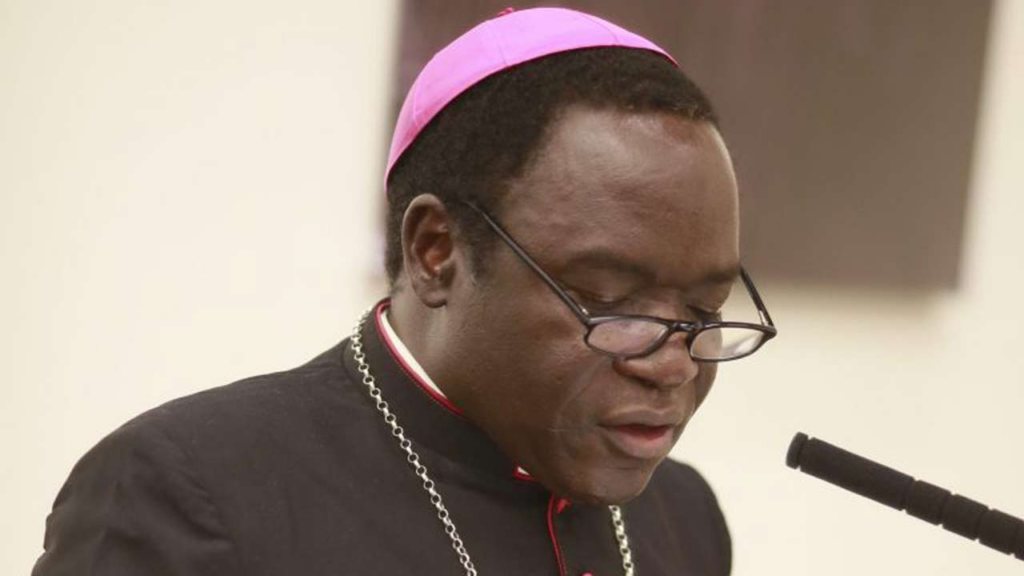
LAFIA — Catholic Bishop of Sokoto Diocese, Most Rev. Matthew Kukah, has identified uneven development as one of the factors fuelling regional and ethnic agitations for political positions and greater political inclusion in Nigeria.
Kukah said citizens were increasingly concerned about equitable distribution of development projects and opportunities that had a direct impact on their communities, rather than where political leaders came from.
He spoke on Wednesday at a colloquium marking the 30th anniversary of Nasarawa State in Lafia, the state capital, with the theme, “Unity in Diversity: Three Decades of Building a Cohesive Nasarawa State — Issues, Challenges and Prospects.”
According to him, Nigeria’s leaders had not managed the country’s diversity effectively, contributing to persistent poverty and disunity.
Kukah said the country had sufficient resources to meet the needs of its citizens but not enough to satisfy what he described as the greed of some leaders.
He said the manner in which diversity was managed could determine whether a society developed peacefully or remained trapped in conflict.
“Nasarawa State is a miniature Nigeria with over 30 diverse ethnic groups scattered across 13 Local Government Areas,” he said.
“The challenge is how to ensure that in the distribution of opportunities, your eyes are all-encompassing enough to sense the cry of those who cannot access the capital.”
Kukah described Nasarawa as strategically located, saying the state could serve as a major economic link between different parts of the country.
He also highlighted the state’s tourism and economic potentials, including the Farin Ruwa Waterfalls in Wamba, Peperuwa Lake in Doma, solid mineral deposits and the presence of major industrial investments such as Dangote.
He said Nasarawa’s future remained promising if its resources were deliberately harnessed for the benefit of its people.
Kukah urged governments to provide infrastructure and institutions equitably rather than waiting for citizens to demand them.
He warned that concentrating institutions and development projects in the home communities of political leaders could fuel agitation for the creation of new states.
“The demand for new states continues because people don’t feel a sense of belonging. When we create belonging, the demand becomes redundant,” he said.
The cleric also paid tribute to the late former military Head of State, Gen. Sani Abacha, who created Nasarawa State in 1996, urging Nigerians to build on the work of previous administrations rather than continually starting afresh.
He said that despite the challenges faced by Nigeria in 66 years of independence, citizens had remained committed to the country and were primarily demanding justice and fairness.
Jega: Nasarawa moves from foundation to transformation
Also speaking, former Chairman of the Independent National Electoral Commission, INEC, Prof. Attahiru Jega, said Nasarawa State had moved from its foundational years to a period of transformation in its 30 years of existence.
Jega, in his presentation titled, “From Foundation to Transformation,” said the state started with limited infrastructure, including one tarred road, no water board and no secretariat.
He said the state’s internally generated revenue accounted for only 3.7 per cent in 1997 but had since improved to about 11 per cent.
Jega traced the state’s history from Nasarawa Province in 1902 to Plateau Province in 1926, Benue-Plateau in 1967, and eventually its creation on October 1, 1996, alongside Bayelsa, Ebonyi, Ekiti, Gombe and Zamfara states.
He commended the administration of Governor Abdullahi Sule for what he described as transformational developments in urban renewal, healthcare, agriculture, education, industrialisation and mining.
“I can say without fear of contradiction that Governor Abdullahi Sule’s record in seven years is transformational — from urban renewal to health, agriculture, education and most importantly industrialisation and mining,” Jega said.
He urged future leaders to prioritise inclusive governance, balanced development, infrastructure, digital expansion, healthcare, mining and skills acquisition for women and youths.
Sule: Diversity remains Nasarawa’s strength
Governor Abdullahi Sule appreciated Jega and Kukah for their presentations, saying their contributions offered opportunities for reflection on the state’s development and unity.
He said diversity remained one of Nasarawa’s greatest strengths, adding that the 30th anniversary provided an opportunity to reflect on the challenges and achievements of the state with humility and gratitude.
Sule recalled the difficulties involved in building a common identity among the diverse groups that make up the state.
Former Military Governor, Lt. Col. Bala Mande, said he met Lafia as a largely rural capital in 1998 and was impressed by the development he observed, including the introduction of street lights.
Mande attributed the containment of insecurity in the state partly to discipline and respect for traditional institutions.
Also, the first civilian governor of Nasarawa State, Senator Abdullahi Adamu, recalled that the state began with limited infrastructure, including the Keffi-Akwanga road, and monthly revenue of between N500,000 and N1 million.
He urged citizens to contribute to the development of the state, stressing that government alone could not provide every service required by the people.
The post Kukah: Uneven development fuels political agitations appeared first on Vanguard News.