

By Evelyn Usman
Lagos’ rapid expansion as Nigeria’s economic nerve centre is placing unprecedented pressure on its environment, with rising population, increasing waste generation, flooding, pollution and other ecological challenges threatening the sustainability of the megacity.
From the thousands of tonnes of waste generated daily to flooding, pollution, blocked drainage channels, deteriorating waterways and the loss of green spaces, the state is confronting environmental challenges that come with managing a rapidly growing megacity.
But beyond the familiar images of refuse-laden streets and flooded roads, the Lagos State Government seems to be strengthening a network of agencies, private operators, technology-driven initiatives and enforcement measures aimed at managing the environmental consequences of urban growth.
At the centre of the waste-management effort is the Lagos Waste Management Authority, LAWMA, which says it is expanding its operations from conventional waste collection to recycling, marine-waste management, resource recovery and technology-assisted monitoring.
Across other areas, government agencies are dealing with wastewater, drainage, pollution, wetlands, biodiversity and urban greening.
The interventions are unfolding against the reality that Lagos’ environmental problems are interconnected. Waste can obstruct drainage; blocked drains can worsen flooding; polluted waterways can threaten aquatic ecosystems, while unregulated urban development can put additional pressure on wetlands and green spaces.
For a state with millions of residents and an economy that attracts people and businesses from across Nigeria and beyond, the management of these pressures has become an important part of keeping the metropolis functional.
Environmental battle
The scale of the challenge is most apparent in waste management.
Lagos generates an estimated 13,000 tonnes of waste daily, according to LAWMA. The volume is driven by population growth, urbanisation, industrialisation, commercial activities and changing consumption patterns.
Every household, market, restaurant, office, school and construction site contributes to this stream.
For LAWMA, therefore, the responsibility extends beyond removing refuse from the streets. It involves ensuring that waste is properly stored, collected, transported, processed, recycled or disposed of.
The authority which operates within a Public-Private Partnership, PPP, arrangement under which private-sector operators collect waste while LAWMA regulates and monitors the system.
The Public Sector Participation, PSP, scheme has become a major component of domestic waste collection across Lagos.But the system has faced challenges.
LAWMA identifies residents’ attitudes to waste handling, difficulties in collecting service charges, inadequate waste-compactor capacity and poor road infrastructure among issues affecting waste collection.
These challenges become more pronounced in a city where waste generation continues to increase.
From disposal to recycling
The response has increasingly shifted from simply collecting and disposing of waste to recovering materials that can be reused.
LAWMA said it had introduced recycling bins in markets, schools, malls and other public places to encourage residents to separate recyclable materials at source.
The initiative covers materials including PET bottles, aluminium cans, plastics and other recyclable items.
The idea is to reduce the quantity of waste requiring final disposal while creating a supply chain for recycling companies and other businesses involved in waste recovery.
LAWMA stated that the number of recycling operators in the state has increased significantly, creating employment opportunities in the sector.
The authority has also continued to register recyclers operating in different parts of Lagos.
For the state, recycling provides an opportunity to address two problems simultaneously : reducing environmental pollution and creating economic value from materials previously regarded as waste.
The landfill pressure
The increasing volume of waste has also placed pressure on Lagos’ landfill infrastructure.
Land remains a major constraint in the state, where urban development is competing for limited space.Landfills therefore cannot remain the only long-term destination for the increasing volume of waste.
LAWMA has embarked on rehabilitation and other interventions at landfill sites, including Olushosun, Solous, Epe, Ikorodu and Badagry.
The authority says the interventions are aimed at improving operations and reducing environmental risks associated with landfill sites, including leachate and other forms of pollution.
But the longer-term strategy is increasingly focused on reducing the volume of waste reaching landfills through recycling, composting and waste-to-energy initiatives.
Waste-to-energy initiative
In 2025, the Lagos State Government announced plans to deploy waste-to-energy facilities as part of its strategy for managing the state’s growing waste burden.
The proposed approach is to convert municipal solid waste into energy while reducing the quantity of waste sent to landfill.Government said the initiative could generate clean energy for up to two million Lagos residents.
The development reflects the changing approach to waste management in Lagos, where the focus is moving towards a circular economy in which waste is recovered and reused rather than simply buried.
The state has also entered partnerships aimed at processing large quantities of municipal waste into recyclable materials and compost.
Waste as flooding issue
In Lagos, waste management is closely linked to flooding.The relationship is particularly important because of the state’s geography.
Lagos has an extensive network of lagoons, creeks, rivers and waterways, while a significant portion of its territory is aquatic.
When waste is indiscriminately dumped into drains, canals and waterways, it can obstruct the free flow of water.
During heavy rainfall, blocked channels can contribute to the accumulation of storm water, with consequences for roads, homes, businesses and transportation.
This has made marine-waste management an important part of LAWMA’s operations.
The authority says its marine-waste programme covers the removal of floating waste from waterways and coastal areas, including PET bottles and other plastic materials.
The programme also involves clearing water hyacinth and other obstructions.
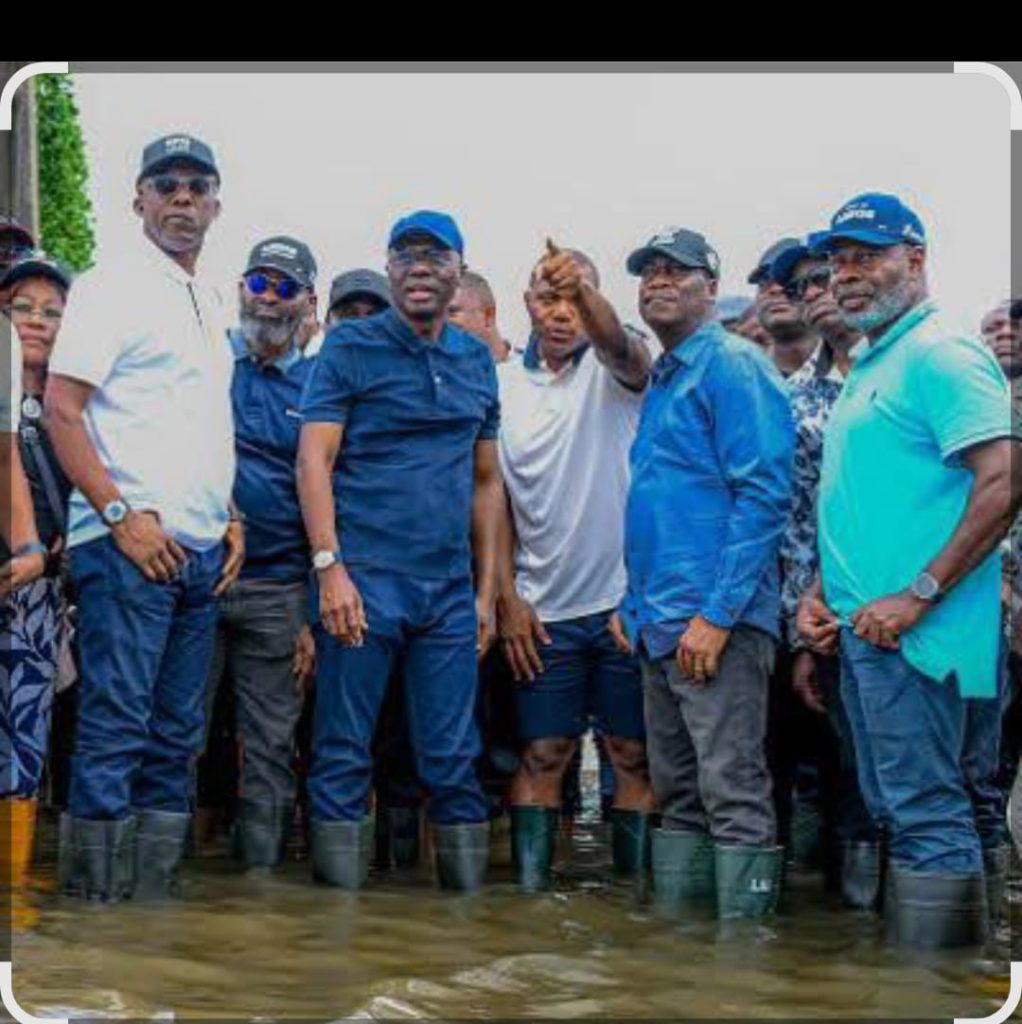
In March 2025, LAWMA reported intensified marine-waste operations along the coastline and drainage channels, including Five Cowries Creek and other locations identified as vulnerable to flooding.
The operation illustrates the connection between waste management and flood prevention in Lagos. But clearing a waterway, however, only addresses part of the problem.
The continued dumping of waste means that the waterways have to be monitored and cleaned regularly, while enforcement is required to discourage indiscriminate disposal.
Wastewater problem
Beyond solid waste is another environmental challenge that is less visible but potentially more serious : wastewater.
Untreated sewage discharged into public drains can eventually enter the wider water system, affecting roads, drainage channels, lagoons and other receiving environments. This is why wastewater management is handled separately from solid waste collection.
The Lagos State Wastewater Management Office is responsible for regulating wastewater and monitoring compliance with relevant standards.
The agency has carried out enforcement operations against facilities accused of discharging untreated sewage into public drains.
In August 2025, the agency sealed a facility in Lekki over alleged discharge of untreated sewage into public drains, warning of the potential consequences for the environment and public health.
The enforcement illustrates the broader environmental regulatory structure in Lagos, where different agencies have responsibilities covering different aspects of the environment.
Protecting wetlands
The pressure on Lagos’ environment is not limited to waste and wastewater.Rapid urban development has also increased pressure on wetlands, waterways and other environmentally sensitive areas.
With land required for housing, roads, industries and commercial developments, wetlands can come under pressure from reclamation and other forms of development.
The state announced in February 2025 that it was developing an environmental policy on wetlands and biodiversity.
The policy is expected to provide a framework for managing wetlands and ensuring that developments in environmentally sensitive areas are subjected to appropriate Environmental Impact Assessments.
The state has also taken enforcement action against illegal dredging.
Officials have linked unregulated dredging to environmental degradation, erosion, flooding and threats to wetlands and infrastructure.
For Lagos, the issue is particularly relevant because wetlands and waterways form part of the natural landscape through which rainwater moves and is retained.Their degradation therefore has implications beyond biodiversity.
Building a greener Lagos
While some aspects of environmental management focus on what needs to be removed, another component focuses on what needs to be preserved and planted.This is where urban greening comes in.
The Lagos State Parks and Gardens Agency, LASPARK, reported in July 2026 that 13,401 trees had been planted across the state’s five administrative divisions as of June 30, against a target of 20,000 trees for the year.
The agency has also introduced geo-tagging of planted trees to facilitate monitoring and assessment of their survival.
The development is part of a broader attempt to increase green spaces in a city experiencing rapid urban development, as trees provide shade and contribute to urban cooling, while green spaces also provide recreational and ecological benefits.
But the survival of the trees remains as important as the planting itself. Consequently, monitoring has become part of the programme.
Technology and waste management
Technology is also being incorporated into the state’s waste-management system, as indication emerged that LAWMA currently operates digital platforms including PAKAM, a smart waste-management platform, its PSP locator, recycling-related platforms and other tools designed to improve waste monitoring and service delivery.
This is in addition to the introduction of smart bins equipped with RFID technology to improve monitoring of waste evacuation.
For an urban system involving thousands of waste generators and numerous private operators, technology provides a means of tracking operations and identifying areas where services may be inadequate.
The objective is to make waste collection more data-driven and improve accountability among operators.
Enforcement strategy
Despite the increasing emphasis on recycling, technology and resource recovery, enforcement remains a significant part of environmental management in Lagos.
LAWMA has continued to work with the Lagos State Environmental Sanitation Corps, LAGESC, against illegal waste disposal.
In April 2025, LAWMA reported the apprehension of more than 300 people during an enforcement operation targeting illegal waste disposal.
The state has also continued enforcement against other environmental infractions, including illegal dredging and unlawful wastewater discharge.
Such enforcement is aimed at ensuring that individuals and businesses comply with environmental regulations.
But enforcement alone cannot address the volume and complexity of environmental challenges in a city as large as Lagos.
The human factor
One of the continuing issues in Lagos’ environmental management is public behaviour.
Waste collection infrastructure may be available, but residents still have to use the system. Recycling initiatives may be introduced, but households and businesses have to separate recyclable materials.
Drainage channels may be cleared, but they can become blocked again when refuse is dumped into them.
Environmental regulations may exist, but industries and businesses must comply with them.
LAWMA and the Lagos State Government have therefore continued to combine infrastructure development with public enlightenment and enforcement.
The state’s environmental strategy increasingly recognises that government cannot manage the entire environmental burden without the cooperation of residents and businesses.
A sustainable solution therefore requires a coordinated system in which infrastructure, regulation, technology, private operators and responsible citizen behaviour work together. For Lagos, the environmental challenge cannot be addressed through a single project or isolated intervention; it requires the continuous management of interconnected systems, from waste collection and recycling to drainage, waterways, wastewater control and urban greening.
Much of this work may take place beyond public attention, within waste collection systems, recycling plants, drainage channels, waterways, regulatory offices and green spaces. Yet these are the systems that must continue to function effectively if Lagos is to manage the environmental pressures associated with being one of Africa’s largest and most densely populated urban areas
The post Lagos: Battling the environmental cost of a growing mega city appeared first on Vanguard News.