

By Luminous Jannamike, ABUJA
When operatives of the Economic and Financial Crimes Commission, EFCC, moved against the Director-General of the Energy Commission of Nigeria, Mustapha Abdullahi, earlier this week, many initially assumed it was another major corruption investigation involving a senior government official and an enormous amount of money.
Read Also: APC Tickets: Govs, aspirants at war over alleged imposition
Some reports put the figure at N500 billion. Others said N701 billion. But within political circles in Abuja, attention quickly shifted from the numbers themselves to a far more sensitive question: how close was the EFCC getting to the financing structure quietly taking shape ahead of the 2027 elections?
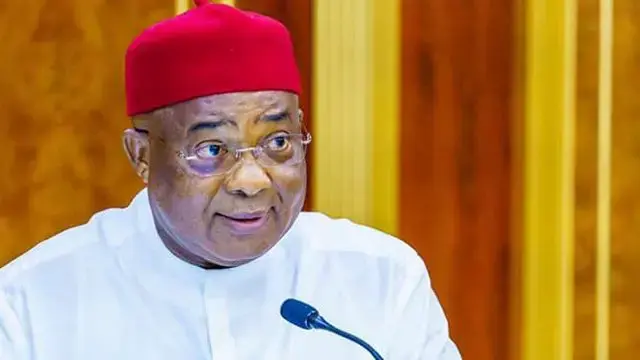
That question gained traction because the investigation has now become linked to allegations surrounding the Progressive Governors’ Forum, PGF, the influential body of APC governors chaired by Senator Hope Uzodimma.
Within days, what first appeared to be a routine anti-corruption investigation had evolved into something far more dangerous for the ruling establishment; a controversy touching on campaign financing, elite power arrangements, internal distrust among governors and the increasingly blurred boundary between governance and partisan mobilisation ahead of the next presidential cycle.
The issue first gained major public attention after online news outlet, The Will, published a report alleging that more than N800 billion had been pooled through platforms associated with ‘Renewed Hope Ambassadors’ and later ‘Renewed Hope Network’, structures reportedly linked to mobilisation for President Bola Tinubu’s expected re-election effort.
The report alleged that governors elected on the platform of the APC made coordinated contributions from their states’ Federation Account Allocation Committee, FAAC, revenues.
That immediately transformed what could have remained an internal arrangement into a constitutional, financial and highly sensitive national controversy.
FAAC allocations are public revenues distributed monthly among federal, state and local governments under Section 162 of the Constitution. Once allegations emerged that portions of those funds may have found their way into partisan structures outside formal public scrutiny, anxiety reportedly spread quietly across sections of the ruling party.
Governors who had once moved in careful alignment were suddenly said to be asking difficult questions privately. How much was contributed? Who controlled the accounts? Who approved the transfers? Who benefited? And perhaps most dangerously in Nigerian politics: who knew what?
Following the Money
Although the EFCC has not publicly released detailed court filings or formal charges, investigators are tracing financial transactions allegedly linked to the movement of hundreds of billions of naira through different entities and accounts.
One source familiar with the probe described the investigation as part of a broader effort to establish how the money moved, who authorised the transactions and where the funds eventually ended up.
“We are treating this as a serious money laundering case involving substantial movements of funds estimated around N500 to N701 billion. The Energy Commission DG was invited multiple times before we brought him in. Our focus is tracing the flow of these resources, which appear linked to the pooled contributions from some states,” the source told Saturday Vanguard.
The source added that investigators were attempting to determine whether “public-derived funds were diverted or laundered”.
Inside the APC, however, the investigation is already generating another kind of tension.
Several sources familiar with internal discussions said concern deepened once the controversy stopped being treated as gossip and began attracting forensic scrutiny from the EFCC.
The fear in some quarters was no longer merely about headlines. It was about exposure. Not necessarily exposure to criminal liability alone, but also exposure to vulnerability at a delicate moment when alignments ahead of 2027 are quietly taking shape.
One senior source said the investigation unsettled parts of the ruling party because financial arrangements that normally remain protected by internal trust had suddenly become subjects of public controversy and possible forensic examination.
In elite Nigerian politics, money is rarely just money. It is influence, access, leverage and insurance. Once questions begin emerging publicly around who controlled what, who authorised what and who benefited from what, relationships can become strained very quickly.
Still, another source within the governors’ forum defended the arrangement, insisting that the contributions were voluntary support efforts among governors.
“Look, the governors made voluntary contributions to support the Renewed Hope agenda ahead of 2027, this is normal political mobilisation, not a crime. The figure being quoted is exaggerated and taken out of context,” the source said.
The source also acknowledged that some governors later demanded explanations over the handling of the funds, leading to disagreements within the forum.
That detail may explain why the controversy quickly evolved into an internal problem for the ruling party itself.
Vote of Confidence on Uzodimma
As chairman of the PGF, Uzodimma now finds himself dealing with one of the most sensitive controversies confronting the ruling party. Reports of tension within the forum emerged after claims that some governors questioned how the pooled money was managed and whether proper accountability existed around the contributions.
There were also reports that a few governors quietly considered moves to challenge Uzodimma’s leadership before interventions eventually restored public calm within the forum.
Within APC circles, however, the episode appears to triggered some questions. Several sources said the real concern inside the party was containment. That was achieved.
The APC could survive opposition criticism, they argued. What worried many more was the possibility of internal financial disagreements escalating into a prolonged public scandal ahead of 2027.
That concern reportedly triggered consultations, interventions and reassurance efforts aimed at preventing deeper fractures within the governors’ bloc.
Governor Uba Sani, who serves as deputy chairman of the PGF, publicly dismissed reports of serious division.
“At the moment, there’s no problem. All the governors are together. There was misunderstanding in the APC governors’ forum, but Uzodimma remains chairman,” he said. Similarly, Kebbi governor, Nasir Idris, moved the motion endorsing a vote of confidence in the PGF leadership.
Publicly, the governors projected unity. Privately, however, the controversy appeared to expose deeper anxieties about trust, control and accountability within the ruling elite.
That is partly because financing arrangements that usually remain hidden from public view suddenly became matters of national discussion. And once the financial structure inside a major power bloc becomes publicly contested, loyalty itself can become uncertain.
The Legal and Constitutional Grey Zone
The controversy has reopened debate about where political discretion ends and misuse of public trust begins.
The PGF itself is not a constitutional body. It is a caucus of APC governors. Yet the allegations suggest that funds tied to public revenues may have been coordinated for mobilisation ahead of 2027.
Supporters of the governors argue that elected officials are partisan actors who naturally fund party structures and campaign activity. They also point out that Nigerian politics has long operated through informal elite arrangements that are rarely discussed openly until alliances weaken or rivalries emerge. To many within elite circles, what is happening now is less about whether such financing exists and more about what happens when internal consensus around it begins to fracture.
Critics, however, insist that if public revenues allegedly derived from FAAC allocations were redirected into partisan activities, then serious constitutional and ethical questions arise.
The debate is complicated further by the absence of clear public disclosure around campaign financing in Nigeria. Formal regulations exist, but much of the real money behind mobilisation often moves through informal networks, elite alliances and opaque arrangements that remain difficult to track publicly. That grey area is part of what makes the controversy dangerous. It also explains why some opposition figures believe the investigation could evolve into one of the defining accountability battles ahead of 2027.
At the same time, APC figures quietly argue that anti-corruption investigations in Nigeria are rarely insulated from power struggles, especially once succession calculations and internal negotiations begin intensifying.
Hardship, Public Anger and the Optics Problem
The timing of the allegations has added another layer of risk. Nigeria is still dealing with the effects of petrol subsidy removal, inflation and rising living costs.
The Tinubu administration has repeatedly defended its economic reforms as painful but necessary steps intended to stabilise public finances and reposition the economy.
But allegations involving hundreds of billions of naira linked to 2027 mobilisation efforts have inevitably deepened public scepticism. Even without definitive court findings, many Nigerians already view the controversy through the wider lens of economic hardship and growing distrust of political elites.
Opposition figures have also moved quickly to frame the issue within broader concerns about transparency and public finance management.
For critics of the administration, the symbolism is damaging: a government defending painful economic reforms while allegations swirl around massive financing structures linked to the ruling elite.
Yet supporters of the ruling party insist that some of the outrage surrounding the controversy may itself be driven by calculations ahead of 2027.
For them, the investigation reflects not only anti-corruption scrutiny but also an emerging struggle over influence, succession and positioning inside and outside the ruling party.
The Shadow of Mambilla
The controversy has also revived familiar questions about opacity and accountability within Nigeria’s energy sector, where huge public promises and huge public spending have repeatedly collided with allegations of mismanagement, abandoned projects and missing funds.
Only days before the ECN controversy escalated, former Minister of Power, Saleh Mamman, was sentenced in absentia to 75 years imprisonment over N33.8 billion fraud linked to the Mambilla and Zungeru hydroelectric projects.
For years, the Mambilla Hydroelectric Power Project symbolised the promise of major improvement in Nigeria’s electricity supply and industrial growth.
Instead, the project became associated with delays, legal disputes, funding controversies and corruption allegations across multiple administrations.
The timing of both controversies has reinforced public concern about accountability within the energy sector itself.
Despite repeated promises of reform and major financial commitments over the years, Nigeria’s electricity challenges remain unresolved, leaving households, manufacturers and small businesses to continue bearing the economic cost of unstable power supply.
That reality partly explains why the ECN investigation resonates beyond ordinary partisan conflict.
For many Nigerians, it reflects a broader concern about whether governance itself has become too closely tied to opaque financing systems that operate far from public scrutiny.
What the Probe Has Already Exposed
For now, several key questions remain unanswered. No independent forensic audit of the alleged PGF funds has been released publicly. The EFCC has not formally accused the PGF itself of criminal wrongdoing. No court has established that governors illegally diverted public funds.
And Abdullahi, through his aides, insists that he voluntarily honoured EFCC invitations and remains entitled to the presumption of innocence.
Still, the controversy has already exposed something the Nigerian system rarely allows citizens to see clearly: how power is financed long before campaigns officially begin.
For now, the money trail remains incomplete, the allegations contested and the investigations unfinished.
Yet the controversy has already pierced one of the quietest traditions in Nigerian politics, the unspoken understanding that the financial machinery behind power works best when it remains invisible.
What the EFCC probe has done, intentionally or otherwise, is drag parts of that machinery into public view.
And with 2027 already casting its shadow across the national landscape, many within the establishment may now fear that the greater danger is no longer the allegation itself, but how much more the public could eventually discover.
The post N701bn Probe: How money, power sparked quiet tensions among APC governors ahead of 2027 appeared first on Vanguard News.

 This Day
 Punch Nigeria
 Daily Post