

By Davies Iheamnachor
PORT HARCOURT — Environmental rights activist, Celestine AkpoBari, has called for the extension of the ongoing Ogoni environmental cleanup to other polluted communities across the Niger Delta, warning that Ogoniland could be re-polluted if neighbouring impacted areas are left unattended.
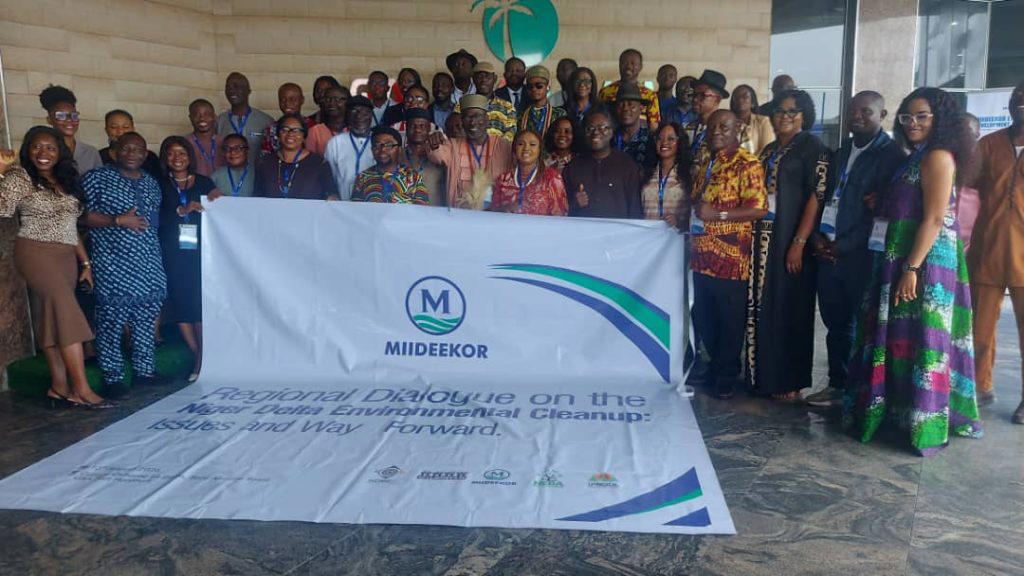
AkpoBari, Team Lead of Miideekor Environmental Development Initiative, MEDI, made the call during a one-day regional dialogue on Niger Delta environmental cleanup issues and the way forward, organised by MEDI in Port Harcourt on Thursday.
He argued that the remediation of Ogoniland could not be sustained in isolation, given the interconnected nature of the region’s coastal communities and waterways.
According to him, the government should urgently extend environmental remediation efforts to other communities affected by decades of oil exploration and production.
AkpoBari also expressed concern over the divestment of some oil companies operating in the region, alleging that companies responsible for environmental degradation had not been adequately held accountable for the pollution left behind.
He said the environmental consequences of oil exploration had contributed to decades of agitation in the Niger Delta, citing the activism of Isaac Adaka Boro and Ken Saro-Wiwa as part of the region’s history of resistance.
“A great thing has happened to us as people of Niger Delta. This is what brought our people into agitation. This brought our people to Isaac Adaka Boro. It took Ken Saro-Wiwa and others to their early grave.
“Today, Nnimmo Bassey is leading dialogues in this area. Emem Okon and others are doing the same. We are worried that people who spoiled our environment have all run away. They claim it is divestment,” he said.
The activist also accused oil companies of misleading communities by presenting oil exploration as a better alternative to traditional livelihoods such as farming and fishing.
He said the activities had subsequently degraded the environment and disrupted the livelihoods of many residents.
“They lied to our people who are farmers and fishermen that when they start exploration, the people will make more money.
“They polluted our environments and have run away. Their activities have chased our people out of farming and fishing. They have changed their names to still operate. Changing names cannot clean our environment,” he said.
AkpoBari maintained that the ongoing cleanup of Ogoniland was the result of sustained agitation by affected communities and environmental activists rather than a government concession.
“The cleanup going on in Ogoni today was not dashed. We did not get it for free. We took it by force,” he said.
He warned that the cleanup would not achieve its full objective if other polluted communities in the region were excluded from remediation.
“Ogoniland cannot be clean until other areas of the region are clean. Ogoni is not an island. It is connected to other coastal communities. When those communities are not cleaned, Ogoni would be re-polluted,” he said.
AkpoBari therefore called for a coordinated regional approach to environmental remediation, saying the government should address pollution across affected communities rather than concentrate efforts in one area.
‘Remediation must include people’
Also speaking, Executive Director of KEBETKACHE Women Development Resource Centre, Dr Emem Okon, called for a broader approach to the environmental cleanup programme to include the health and wellbeing of residents exposed to pollution.
Okon said remediation should go beyond contaminated land and waterways to address the effects of pollution on people living in affected communities.
“We don’t need to just clean the land and water. We need to clean the men and women. We have hydrocarbons in our bloodstreams,” she said.
The dialogue brought together stakeholders to examine environmental challenges in the Niger Delta and discuss measures for improving the ongoing cleanup and remediation efforts in the region.
The post Ogoni cleanup won’t be complete without remediating other Niger Delta communities — Activist appeared first on Vanguard News.