

By Ike Uchechukwu
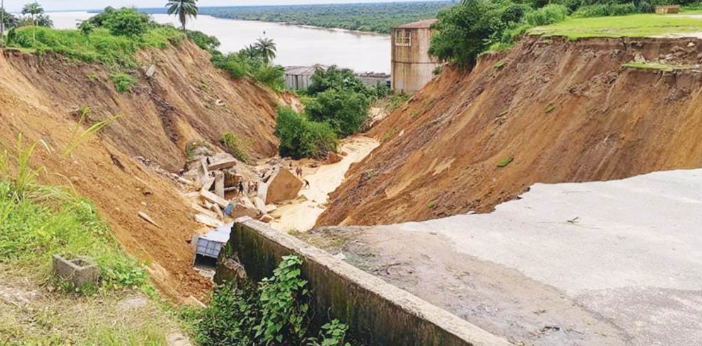
OBUTONG — The tarred federal highway that once knit this historic community in Calabar Municipality together has been erased. In its place yawns a crevice, a raw, widening gash that has swallowed a hospital, car parks, offices, and homes nurtured for decades.
Truckloads of boulders hammer into the abyss daily, while engineers hover at the edge with clipboards and worry. But for the residents, the science of soil and rain tells only half the story.
Beneath the mud, they whisper, moves Anansa, the old river goddess, offended and stirring. To them, the July landslide is not a geological event; it is a spiritual accounting. Whether Calabar’s leaders treat it as an engineering failure or a summons from the deep, one brutal truth remains: the ground has broken faith, and it is taking everything in its path.
A community heartbroken
Emmanuel Okon, the Youth Leader of Obutong, has become the reluctant voice of a community in mourning. He speaks with the measured pace of a man who has watched his people’s life work crumble into a pit of mud.
“The scale of destruction is unprecedented,” Okon told NDV, his voice carrying the weight of a community that no longer recognises its own streets. Businesses, properties, livelihoods, all destroyed within a matter of days. “Nothing in living memory compares to this.”
The community has dealt with minor erosion during past rainy seasons, the kind their forebears would attribute to “the water being angry,” appeased with small rites. But this, Okon insisted, is different in scale, in speed, and, cruelly, in location. It sits directly on a federal road that Calabar depends on.
Anansa: more than a legend
In Obutong’s worldview, nothing happens in isolation. When land and sea move against each other, it is read as a message from Anansa, custodian of the waters, a signal that a covenant between the people and nature has been broken.
“For us, the response cannot be engineering alone,” Okon said carefully. “Cleansing rites must accompany technical work to restore peace and stop further destruction.”
Long before this disaster, Anansa held a formal place in Efik cosmology, not as a vague folk figure, but as a named, localised deity. Historical accounts identify her specifically as Anansa Ikañ ObutÍñ, the deity of Obutong itself, said to have originated with the Enwang clan and to reside at the head of a spring or river near the old site of Obutong, close to the historic Hope Waddell Training Institute.
She was once honoured with a naval base renamed in her memory. Processions of worshippers drew through the streets of Calabar in her honour.
That history matters now, because the epicentre of the current disaster carries her name in the landscape itself. The affected corridor runs through what residents call the Anansa Junction axis, between WAPI Junction and the Nigerian Navy Ship (NNS) Victory base, ground long associated with the goddess, long before a single container yard or hospital wing was built upon it.
A government caught between mud and myth
While Obutong pleads for cleansing rites, government officials are racing against the physics of collapsing soil.
Cross River’s Commissioner for Environment, Bassey Mensah, has classified the landslide as a natural occurrence requiring urgent technical response, not superstition. Erosion experts working with the state have recommended diverting water from one drainage channel into another to relieve pressure on the collapsing corridor and slow the landslide’s advance.
Mensah admits this will require substantial funding, even as emergency floodwater redirection continues.
The National Emergency Management Agency and the Cross River State Emergency Management Agency have dispatched teams to the site for an on-the-spot damage assessment, an acknowledgment, at the federal and state levels, that this is no longer a local inconvenience but a full-blown disaster zone.
Mensah has also issued a direct warning to residents desperate to salvage what they can: stay away from stranded containers and scavenge within the disaster zone. Such activity could trigger fresh collapses and cost lives.
The Engineer who saw it coming
Not everyone in Calabar is comfortable pinning the disaster on the supernatural.
One engineer, who pleaded anonymity, offered a far more constant monitoring; small warning signs addressed long before they become catastrophes.
“The trouble was flagged earlier in the year,” the engineer said in frustration. “Nothing was done. When the rains returned, the crisis simply exploded.”
He did not dismiss Obutong’s spiritual framing out rightly, only offered it as one lens among several. “The community may attribute it to one goddess or another,” he said, “but the underlying truth is a maintenance failure compounded by a punishing rainy season.”
Billions Lost, A Cement Giant Silent
Among the casualties is a large facility now under the ownership of HBM (formerly Lafarge), which housed a car park, a hospital, and logistics offices, all now partially consumed by the expanding gully.
Losses across Obutong are already estimated in the billions of naira, with the disaster still spreading and no final damage assessment yet possible. The gully continues to grow, even as the government works to arrest its advance.
Our efforts to obtain an official statement from HBM were met with an acknowledgment that a public statement would follow. As of filing, none had been issued.
A Community’s Plea
What Obutong wants, ultimately, is an emergency access road around the collapsed federal corridor, urgent engineering intervention from Abuja and Calabar alike, and space to grieve and atone in the ways their tradition demands.
Okon has called on the custodians of the community’s tradition to act quickly; urging residents to search their own conduct for whatever might have provoked the calamity.
Whether Anansa’s anger is metaphor for ecological neglect or something residents believe more literally, the message from the ground is the same one the government has heard before and too often ignored: infrastructure built on fragile earth cannot be forgotten once the ribbon is cut.
For now, the boulders keep coming. The gully keeps widening.
The post Residents count losses as river ravages C’River community appeared first on Vanguard News.