

By Evelyn Usman
When an insurgent lays down his weapon, does the threat truly end or simply change form? That question has moved from theoretical debate to urgent national concern, as fresh battlefield gains by Operation HADIN KAI collide with rising anxiety over the reintegration of surrendered fighters into society.
Read Also: We can fight terrorists with ‘juju’ – Yoruba monarchs agree with Ooni of Ife
The recent surrender of two high-profile Islamic State West Africa Province (ISWAP) commanders : Ismail Mohammed and Abu Umar , has been described by the military as evidence that sustained pressure is breaking insurgent ranks.
But outside the battlefield, it has reopened an old, unresolved fear: what if yesterday’s enemy returns tomorrow in a different guise?
Surrender under fire
Troops of Operation HADIN KAI confirmed that the two commanders surrendered on June 8, 2026, following sustained military operations across the Lake Chad axis.
According to military intelligence, Ismail Mohammed was a close associate of ISWAP leader Baa Shuwa and deeply embedded in the group’s command structure, while Abu Umar was described as a skilled explosives expert involved in the production and maintenance of vehicle-borne improvised explosive devices.
Reintegration debate
But even as guns fall silent for some fighters, with a possible reintegration process, a fierce argument continues across Nigeria’s public space.
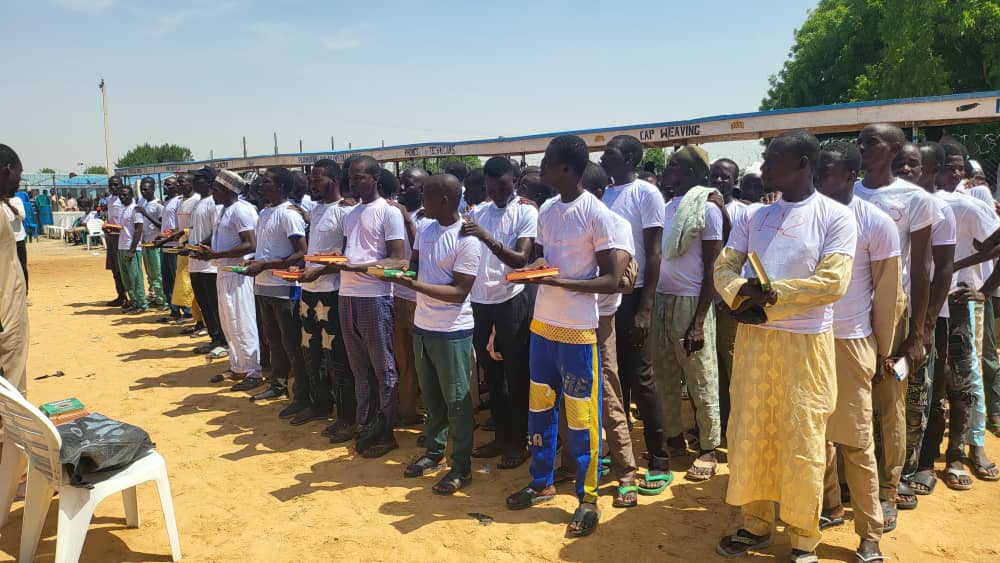
That debate was reignited on April 16, 2026, when the Federal Government announced that 744 former insurgents had completed rehabilitation under the Operation Safe Corridor initiative and would be reintegrated into society.
The beneficiaries, drawn mainly from the North-East, including 597 from Borno State, also included nationals from Niger, Chad, Cameroon and Burkina Faso.
They were said to have undergone psychosocial therapy, vocational training, civic education, and religious reorientation.
Disengagement
or deradicalisation?
The government called it transformation.
But across Nigeria, many called it something else: a gamble.
For Rear Admiral Dickson Olisemelogor (rtd) , he argued that the reintegration policy carries a fundamental misunderstanding of extremist transformation.
He explained that: “The idea of reintegrating de-radicalised deviants into society is good. However, what I see in our own case is disengagement rather than deradicalisation.”
“Deradicalisation entails changing the person’s ideology and must be seen over a period of time that the person has actually changed. As far as I am concerned, most of the so-called repentant Boko Haram boys are not de-radicalised because they come out when military pressure or hunger knocks hard on them.”
“Some are purposely sent to gather intelligence and infiltrate security agencies. This is the reason they return to their old group or even form a new terror group once they have the opportunity.”
“Surrender must not be a loophole” — Retired Brig. Gen.
A retired Brigadier General of the Nigerian Army, who gave his identity simply as Makinde, commended troops of Operation HADIN KAI for what he described as “a professionally executed pressure campaign,” but cautioned that the development must be treated with “structured suspicion and disciplined monitoring.”
According to him: “I have confidence in the Nigerian military’s procedures, especially under a joint task framework. These are structured processes: debriefing, intelligence exploitation, and behavioural assessment are standard practice.”
“But confidence does not remove caution. In fact, it should increase vigilance. We must also not be naïve. In insurgency warfare, surrender is sometimes tactical. Some individuals surrender not because they are defeated ideologically, but because they are seeking survival, access, or operational advantage.
“The danger is not just in what they do immediately after surrender, but in how they reconnect over time. That is why community intelligence, local leadership structures, and security networks must remain alert.
“We are fighting an adaptive enemy. So our systems, whether kinetic or non-kinetic, must be adaptive too. But adaptation must never compromise security,” he cautioned.
“We will pay the price if things go wrong” — Serving Maj. Gen.
A serving Major General, who spoke anonymously due to lack of authorisation to address the media, echoed concerns from within the system.
He said: “I was among those who criticised the so-called ‘safe corridor.’ I couldn’t really understand it.”
“How would they integrate? Take Jilli market, where the Air Force bombed recently , it was a Boko Haram supply hub. After all that, you want to reintegrate them into a society where their former members still operate?”
“To be candid, we even have senior officers who sympathise with them. They have infiltrated the system.”
“I have served as defence attaché in many countries, and I have come back to realise that Nigeria is not a nation. We are just a group of people thrown together, coexisting.”
“Victims forgotten” — Kano businesswoman
For Aminat Saudi, a Kano-based businesswoman who lost six relatives in Borno attacks, the debate is deeply personal.
“Aside from fears that this repentant approach could be part of the terrorists’ strategy to infiltrate sectors of the economy, no one is talking about the victims of their wicked act,” she said.
Her position captures a growing emotional fault line in the debate: justice versus forgiveness, policy versus personal pain.
Military response
Defending the programme, Coordinator of Operation Safe Corridor, Brigadier General Yusuf Ali, insisted there was no evidence that rehabilitated insurgents have returned to terrorism.
Speaking on Arise Television recently, he asserted that: “The reality on the ground does not support that assertion. Operation Safe Corridor is structured and a well-developed system of screening clients and providing psychosocial and other forms of support.”
“At the end of their training at the DDR camp, we don’t just insert them into society like that. Their integration is even done by the various state governments.”
“From there, the state governments, traditional rulers, and other key leaders, including security agencies at the local level, continue the monitoring of the clients.”
“Terrorism has been a global phenomenon, and the causes are broad and many. Relatively put together, what we are currently enjoying is the net product of the combination of kinetic and non-kinetic operations. Terrorism thrives where there are various factors, and it takes the whole nation to defeat terrorism.”
The debate circles back to where it began , not on the battlefield, but in the minds of Nigerians still weighing risk against hope.
When an insurgent lays down his weapon, does the threat truly end or simply change form? In that question lies Nigeria’s most difficult security dilemma and, for policymakers, perhaps its most consequential answer.
The post ‘They disengage but never deradicalise’; fresh fears over ISWAP commanders who surrendered appeared first on Vanguard News.

 This Day
 Punch Nigeria
 Business Day
 Daily Post
 Channels TV
 Pulse Ghana
 Modern Ghana
 Vanguard Nigeria