

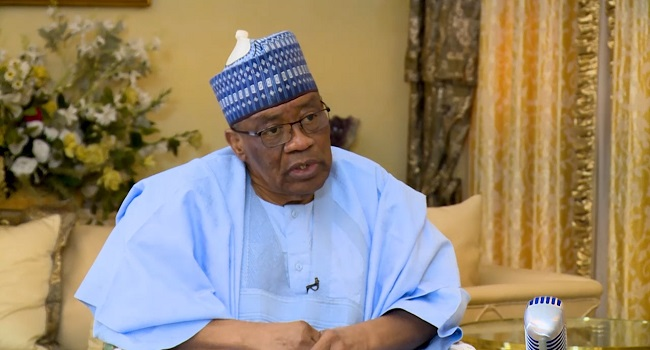
By Efe Onodjae
Former military Head of State, General Ibrahim Badamasi Babangida (retd.), has revealed that national pride was the driving force behind his administration’s decision to complete the Third Mainland Bridge in Lagos.
Babangida disclosed this in an interview monitored by Vanguard on CBS News, and posted on X where he recalled how an American television programme depicting Nigeria as a country that embarked on ambitious projects without completing them angered him and influenced his administration’s decision to complete the bridge.
According to him, the programme featured Nigerian broadcaster and entertainer, Onyeka Onwenu, and highlighted the then-incomplete Third Mainland Bridge as an example of an abandoned “elephant project” in Africa.
He said the programme left him deeply concerned about the image being projected about Nigeria to the international community.
Babangida said: “National pride was what pushed us to do the Third Mainland Bridge.
“You had a programme, I think on one of the television stations, ‘Nigeria: A Squandering of Riches’ or something like that. I saw that programme before the takeover. There was a programme called 60 Minutes on CBS News.
“I saw it and I was mad after watching the television programme. There was a Nigerian on the programme, I think Onyeka Onwenu.
“She was on that programme and I think the compere was an American. He’s dead now, I think. He went on the bridge when it was not completed.”
The former Head of State recalled that the American broadcaster used the stalled bridge as an example of how African countries conceive major projects but often fail to complete them.
He said: “He gave it as an example of how African countries conceive programmes, elephant projects. He said, ‘Look at this bridge. It stopped here. Who knows, maybe it will end up in oblivion.’
“That word pained me a lot. On the CBS show? Yeah, on the CBS show.
“The whole world is going to see Nigeria with that impression.”
Babangida said the situation became a matter of national pride for him when his administration came into office, prompting him to challenge his colleagues to ensure the bridge was completed.
“When God brought us into office, the first decision we made was that we are going to prove that American broadcaster wrong,” he said.
“I talked to my colleagues. Some were not concerned about it. I said, no, this is on our country. It’s about national pride.
“Let’s put it to them that we can do it. That’s the first inspiration, that we have to do that. After that, all we need to do is to ask people, how are we going to do it?”
According to him, his administration subsequently assembled a small committee involving relevant stakeholders, including Julius Berger and the Lagos State Government, to work out how the project could be completed.
“We sat down, we set a small committee. We sat down together. By then, my late colleague, Bolaji Anthony, his company, Julius Berger, Lagos State Government, and so on.
“We put them together and said, ‘I want a solution to this.’ They came out with a blueprint that, yes, this is doable, but this is the way to do it.
“I said, well, you guys have to do it. I will provide the support. I will provide the money for the job. And they did, quite easily.”
Babangida also recalled setting a personal deadline for the completion of the bridge, asking the contractors to present it to him as a birthday gift.
He said: “When we initially put it on, it happened to be in August, on my birthday. I said, ‘Give me a birthday present. I will come back to commission this bridge on my next birthday.’
“And behold, thank be to God, they met our obligations. We met their obligations. So we have a Third Mainland Bridge.”
Asked whether he anticipated the enormous impact the bridge would have on Lagos, Babangida said he did not envisage that it would become as important as it is today.
“Not as much as it is now,” he said.
“But people talked to me about the impact it was going to make, especially the construction engineers and so on and so forth.”
The Third Mainland Bridge later became one of Lagos’ most important transport routes, connecting the mainland to Lagos Island and easing movement across the metropolis.
For Babangida, however, the project represented more than infrastructure. It was a response to an international narrative about Nigeria and a demonstration that the country could complete major development projects.
“It’s about national pride,” the former Head of State said.
The post Third Mainland Bridge: National pride drove us to build it — IBB appeared first on Vanguard News.