

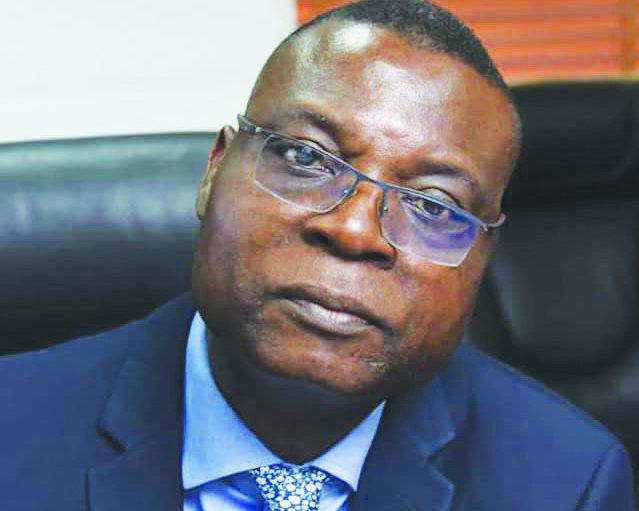
Sometimes truth can be too acerbic to be accommodated by reality. It hits hard in the face to the point of irritation while others can simply sneer at a point of profundity which, of course, doesn’t look very popular. Listening to the MTN Nigeria boss, Karl Toriola, speak recently about his organisation and the entire telecommunications industry may fit the foregoing, superficially. You may also come to the easy conclusion that he is the chief executive officer of his organisation, the first-line marketing officer of MTN, so what were you expecting him to say? My point of intervention here is that Toriola deserves a listening, and doing so says so much about all of us, about an important industry, and about our nation where we seem to normalise even the absolutely bizarre.
But let me start with one issue that proved so exigent that he couldn’t have avoided speaking about it. MTN Nigeria has suddenly found itself in the eye of a wave of xenophobia; others say Afrophobia is a more appropriate word—sweeping across South Africa, a country that has failed its largely uneducated youths who still carry the vestiges of the apartheid era, and has become a serious concern to its corporate exports. The misdirected youths and a government with very low capacity are pursuing the immigrants from countries that helped them defeat apartheid. Some have been unalived in the most horrible way.
What an unfortunate irony! And I understand that country well enough to state here that quite a number of those people with bare protruding stomachs, carrying weapons or sticks in their hands, will hardly understand the meaning of the word irony. There is the fear of reprisals swirling in some of the affected countries, including Nigeria, which may have pressured Toriola to speak about it. Addressing the issue squarely, Toriola declared that MTN hates xenophobia in all ramifications. MTN may have originated from South Africa, he explained, but MTN Nigeria is a Nigerian publicly quoted company, managed by Nigerians and with a Nigerian board. It has 201,000 retail investors and another 11 million Nigerians as shareholders through the pension fund. Although the parent company is headquartered in South Africa, MTN remains a multinational corporation and only 50 percent of its shares are held by Africans while the remaining 50 percent belong to investors outside Africa, including the United Kingdom and North America.
But he also addressed a number of other issues because there is always something to talk about in the country’s telecommunications sector. There are always concerns about quality of service, about data depletion, and about cost-reflective tariffs or charges, among others. Quite a lot on the plate to deal with at any particular time. However, responding to the omnibus challenge of quality of service, Toriola said, “We are dealing with the nature of the operating environment. There are some things that, with all the money in the world, you can’t do.” He explained that to tackle the intractable industry challenge, the operator needs to invest massively in network expansion to accommodate rising service demands and data consumption. He further revealed that the tariff increase granted in January 2025 by the regulator has strengthened the expansion and network upscaling capacity of the operators. For instance, while MTN had a capital expenditure of N250bn in 2024, by 2025 the amount had jumped to a staggering N1trn. Before the increase, he recalled, the operators were on their knees and could hardly fund essential needs with the funds they were generating. In the first quarter of this year alone, the organisation invested N390bn as capital expenditure, which outstrips its N359bn profit after tax within the same period. “Since the tariff increase, we are investing at four times the pace we did previously,” he explained.
However, the phrase “We are dealing with the nature of the operating environment” is a euphemism that covers so many things. And Toriola removed the layers one by one without apportioning blame to anybody for the challenges facing an industry where his company is an obvious leader. Indiscriminate road construction, network vandalisation, security challenges and even miscreant issues pose serious challenges to telecom operations in the country. About three weeks ago, a highly placed industry source told this writer that every hour there is vandalism taking place on the telecommunications networks. Toriola corroborated this when he stated that “We have very frequent fibre cuts. We have more fibre cuts in a day than the whole Kingdom of Saudi Arabia had in a year in MTN.” He noted that sometimes when things happen we can’t go to certain locations and this obviously will affect service output in those locations. Dealing with security challenges has become a daily nightmare confronting the nation; however, there is an elevated—or for choice of a more appropriate word, a demonic—version, where some individuals, for whatever reason, would pour petrol into a manhole hosting telecom cables and set it on fire. One such action, Toriola explained, could take out between two and three million subscribers at once.
While the unstable power infrastructure has long been complicit in degrading telecoms network quality, Toriola informed that having to address the problem frontally by fueling generators in 18,000 sites across the country comes at a huge cost. “The cost of operation in Nigeria is significantly more,” he stated. I can almost hear the hackneyed refrain of people saying, you knew the nature of the environment before you agreed to come in; why have you not resolved the challenges in over two and a half decades that you have operated in the country? Such fossilised rationalisation of serious issues has become adversarial to our capacity to resolve them. In an ecosystem like telecommunications, everybody has a role to play. The failure of one inexorably affects the other. Nobody expected that in over two decades the power sector would remain staunted, if not diminishing; that insecurity would escalate so much that swathes of land would remain in the hands of bandits; that wilful vandalisation of telecommunications facilities would still feature in 2026; and that nobody would even want to contemplate that right of way (RoW) would still be an issue. But they pile up, creating confusion and hopelessness for all the stakeholders because each has not done what should have been done.
It is encouraging that the stakeholders are not on each other’s necks with blame games but remain in a collaborative mood to change the fortunes of the industry and provide good services. While the regulator, Nigerian Communications Commission (NCC), can apply some pressure and at some point consider cost-reflective tariffs for the operators as it did last year, more collaboration to the understanding of the various stakeholders—government, operators and subscribers—should be encouraged. Concerning data depletion, which Toriola also spoke about, let me share a personal experience. Penultimate weekend I expended over 35GB of data in just over 48 hours. Feeling really miffed by such development, I went to the service centre belonging to the network not too far from my abode. We went through my phone carefully. Behold, the phone was backing up my material on iCloud that very weekend! I speak for no network because they can’t be totally insulated from every blame awash in their industry. But here is my observation: if you are watching the World Cup 2026 on your phone on the go; if you like to enjoy the beauty of some goals or the daredevil saves by some goalkeepers; if you are into streaming services or you are hooked on WhatsApp like iced tea, dear friend, you will need to pay for data. But you have the right to complain because you are the customer.
Is the network quality the best? Not at all. But I also know that although I am assigned to Band A by the power service provider in the place I live, sometimes I go for days on generator because the service provider has abandoned its customers, and the cost is crippling. In the end, however, there is something to be happy about. And I totally agree with Toriola when he enthused that “After 25 years, we are just incredibly overwhelmed with what we have been able to do together with all Nigerians to move this country forward in terms of digital infrastructure. We are very proud of that.” Nobody can contest this with him. The gains are there to be counted one by one, as they say in my part of the world.
The post Toriola’s take on MTN and the telco ecosystem, by Okoh Aihe appeared first on Vanguard News.

 Punch Nigeria
 This Day
 Business Day
 Channels TV
 Daily Post
 Capital Ethopia
 Vanguard Nigeria