

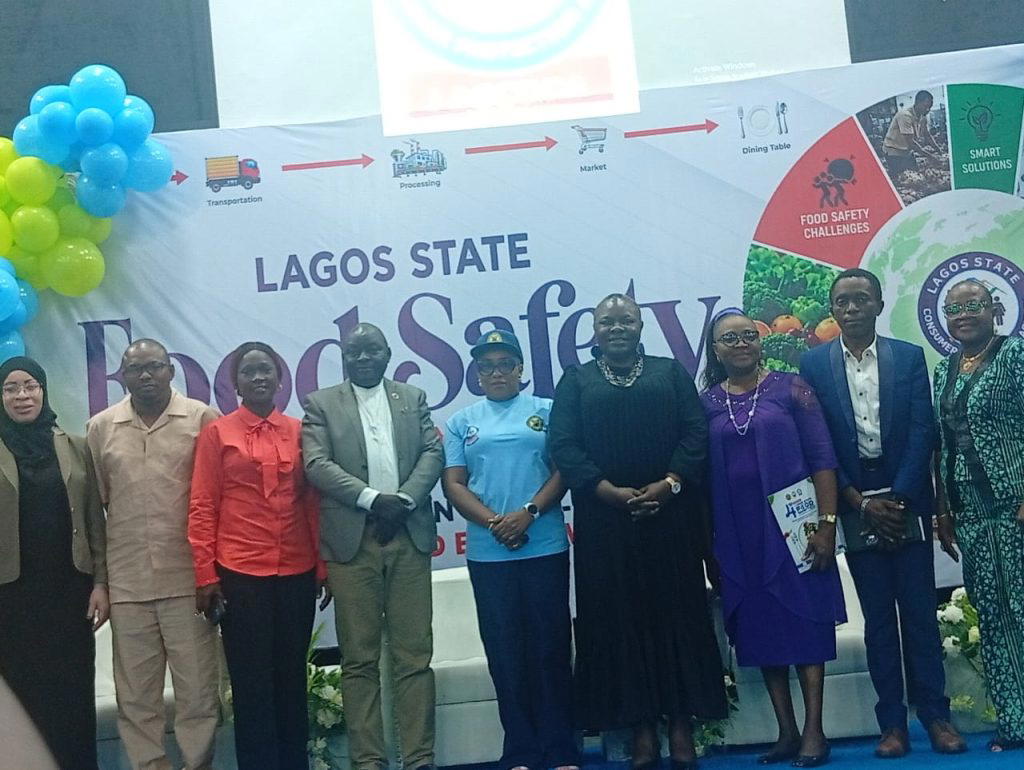
— Experts raise alarm at Lagos food safety conference
By Olasunkanmi Akoni and Shekinah Ijile
LAGOS — At least 53,000 deaths associated with unsafe food are recorded annually in Nigeria, a food safety expert, Dr Adeniyi Odugbemi, has said.
Odugbemi, who attributed the figure to recent studies, urged stakeholders to move beyond identifying food safety challenges and adopt science-based solutions to prevent avoidable deaths.
The expert, Global Director of Quality and Food Safety at Archer Daniels Midland, ADM, stated this yesterday at the fourth Lagos State Food Safety Conference and Exhibition organised by the Lagos State Consumer Protection Agency, LASCOPA, at NECA House, Alausa, Lagos.
The one-day conference was themed, “From Burden to Solution: Safe Food Everywhere.”
Delivering the keynote address, Odugbemi described unsafe food as a major public health and economic challenge, saying Nigeria could no longer rely on faith alone to address foodborne illnesses.
He said, “We’ve sat too long on the problem. We’ve sat too long on the burden. We need to start working together, look at the complexity of this burden and begin to offer solutions.
“Food safety challenges, including biological, chemical and physical contamination, food fraud, adulteration, ineffective packaging, food loss and waste, require interventions based on science, empirical evidence and research.”
Odugbemi stressed the importance of food safety, saying, “If it is not safe, it is not food.”
He identified food security, food sustainability and food safety as major challenges across the food value chain, stressing that access to food should not expose consumers to illness or injury.
The expert also called for greater attention to Nigeria’s informal food sector, where many Nigerians obtain meals outside the home.
He urged stakeholders to support informal food vendors with the knowledge and resources required to maintain safe food-handling practices rather than simply criticising them.
Odugbemi further warned that food safety had economic implications for Nigeria, particularly as food exports could face rejection in international markets over safety concerns.
He said strengthening the country’s food safety system was essential to maximising the economic potential of its agricultural and food sectors.
Odugbemi called on government, industry, academia and consumers to take clearly defined responsibilities in ensuring food safety.
He urged government to develop science-based policies and regulations, industries to treat food safety as a competitive advantage, and academic institutions to focus research on practical challenges rather than solely on academic requirements.
For consumers, he advised vigilance, stressing that individuals had the right to reject food they considered unsafe.
Earlier, the General Manager of LASCOPA, Afolabi Solebo, said the agency was committed to strengthening food safety practices and protecting consumers from unsafe products.
Solebo said food safety was a shared responsibility involving farmers, processors, distributors, retailers and consumers, and not solely that of regulatory agencies.
He said LASCOPA had strengthened its enforcement mechanisms, expanded consumer education and deepened collaboration with the Lagos State Ministry of Health, Ministry of Agriculture, National Agency for Food and Drug Administration and Control, NAFDAC, and Standards Organisation of Nigeria, SON.
Also speaking, a representative of the Federal Competition and Consumer Protection Commission, FCCPC, Mrs Odubunmi Olutoyin, described food safety as a consumer protection, public health, economic and trust issue.
She urged businesses to comply with food safety requirements and advised consumers to read product labels, check expiry dates, buy from reputable vendors and report unsafe practices.
NAFDAC, represented by Olubunmi Olugbenga, reaffirmed the agency’s commitment to strengthening regulatory oversight, promoting good manufacturing practices and collaborating with stakeholders to reduce food safety risks.
At the conference, Dr Nora Oseni, a food and cosmetic scientist and lecturer at Auchi Polytechnic, raised concerns over palm oil adulteration.
Speaking on “Palm Oil Adulteration: Emerging Risks, Detective Strategies and Regulatory Control,” Oseni warned that consumers’ reliance on the colour of palm oil, particularly the belief that “the redder, the better,” could contribute to adulteration.
She said some traders add oil-soluble dyes to palm oil to improve its appearance, while cheaper oils and recovered frying oils could also be used as substitutes or adulterants.
Oseni advised consumers to pay attention to the visual and organoleptic characteristics of palm oil, including its colour, layers and characteristic smell, and avoid oil that appears degraded or smells rancid.
She called for improved training of palm oil processors, stronger traceability and closer collaboration between researchers and industry.
During a panel session, industry representatives also highlighted the importance of traceability in protecting consumers.
Mrs Muyiwa-Salami Olanike of Chivita Limited said the company’s food safety management system enabled it to trace products from raw materials through production and distribution.
The panel also identified poor waste management as a major food safety concern in Lagos.
The conference called for a shift from merely discussing the burden of unsafe food to developing measurable and sustainable solutions capable of ensuring safe food for Nigerians.
The post Unsafe food kills 53,000 Nigerians yearly — Expert appeared first on Vanguard News.