

By Luminous Jannamike
Across the world, governments are cushioning motorists and businesses from a fresh oil shock. Nigeria’s 2027 debate is shifting from whether subsidy should exist to what form it should take, what it will cost and who will carry the bill.
The latest petrol-price shock has produced an awkward reality for governments that spent years trying to reduce fuel subsidies: when energy prices surge, the pressure to intervene returns.
More than 90 countries provide some form of fuel-price support, according to international policy tracking. The International Energy Agency has recorded at least 94 governments using measures such as direct subsidies, price caps or tax cuts during periods of severe energy-price pressure. The World Bank has also found that 132 of 154 economies studied used a subsidy, price freeze or tax reduction to lower fuel costs.
Different countries, different tools
But the direction is similar: governments are trying to prevent the full force of an external energy shock from landing on households and businesses.
France has offered targeted fuel support to vulnerable workers and energy vouchers to households. Germany has cut petrol and diesel taxes. Spain has used tax relief to reduce the burden on motorists, while Japan has subsidised refiners to limit the increase reaching consumers. Malaysia has increased support for its widely used RON95 petrol.
Yet there is a crucial distinction. Most of these measures are temporary, targeted or capped. They are not necessarily a return to unlimited, blanket pump-price subsidies.
That distinction is becoming important in Nigeria as the 2027 presidential contest brings petrol pricing back to the centre of economic politics.
The question is no longer simply whether subsidy should be removed or restored. It is what form intervention should take, what it will cost and, most importantly, whether the benefit will actually reach the person buying petrol.
Atiku changes the subsidy argument
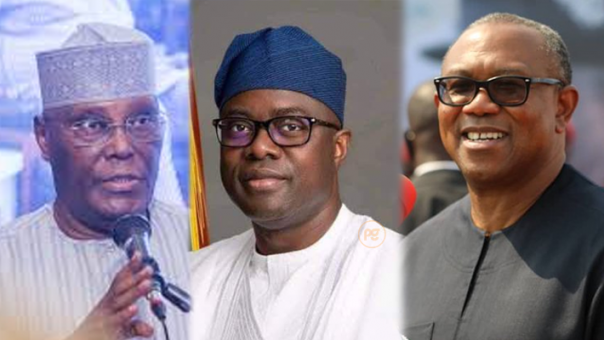
Atiku Abubakar’s ADC proposal takes the subsidy debate into the refinery.
The former vice-president has repeatedly said he would restore subsidy if elected, but his campaign has subsequently defined the proposed intervention around domestic production rather than imported petrol.
The idea is to supply crude to qualifying Nigerian refineries at a preferential price, provided the crude is refined in Nigeria and the resulting products are supplied to the domestic market.
“Import subsidy spends public money supporting petrol refined abroad and brought into Nigeria. Production subsidy supports crude refined here in Nigeria so that Nigerian refineries can produce fuel more cheaply and Nigerians can pay less,” Atiku said.
He has proposed excluding imported fuel, foreign refineries and middlemen, while putting spending limits, verification and independent audits around the scheme.
“If you do not refine in Nigeria, you do not qualify. This is not a subsidy for foreign refineries. It is not a subsidy for importers. It is not a subsidy for middlemen. It is a subsidy for Nigerian production,” he said.
That is a materially different proposition from the old import-based arrangement. But it raises the question that any production subsidy must answer: who pays for the cheaper crude?
If crude is supplied to domestic refiners below the price that could otherwise be obtained, there is a fiscal cost somewhere. The question is whether that cost appears as lower Federation revenue, direct budgetary expenditure or another form of government support.
The APC Presidential Campaign Council has challenged Atiku to explain the legal, fiscal and operational basis of his proposal, including how it would operate under the Petroleum Industry Act and how it would be funded. Those are political criticisms, but the fiscal question they raise is fundamental. (Premium Times Nigeria)
A subsidy can move from imports to production. It cannot make its underlying cost disappear.
Makinde wants cheaper crude, not the old subsidy
Seyi Makinde, the APM presidential candidate, approaches the same problem without calling for a return to the old pump-price subsidy.
His proposal is to price crude supplied to Nigerian refineries differently from crude sold internationally.
The argument is straightforward: Nigeria produces crude, so Nigerians should not necessarily bear the same crude-cost burden as a country that has to import its raw material.
“If a community grows food, the people of that community should not have to buy that food as though it travelled halfway around the world before reaching them,” Makinde said.
“So, why should crude oil supplied to Nigerian refineries be priced as though Nigeria does not produce crude oil?”
Makinde wants the benefit built into the system from the beginning through the price of crude supplied for domestic refining, rather than through what he describes as an opaque intervention at the petrol pump. He has also called for transparency across crude allocation, refining, transportation, distribution, taxation and retail margins.
There is an obvious overlap with Atiku’s proposal: both seek to reduce the cost of crude available to domestic refiners.
The distinction is the policy architecture. Atiku calls his proposal a production subsidy. Makinde describes his as domestic crude-pricing reform.
But both eventually face the same practical test: if the crude becomes cheaper, how does government ensure the saving becomes cheaper petrol?
That requires more than an announcement of a new crude price. It requires a transparent formula linking crude cost to refinery costs, margins and the final pump price.
Obi’s position raises another question
Peter Obi’s position has also evolved. Earlier, he defended the removal of subsidy, arguing that the old system was riddled with corruption and that mismanagement of subsidy proceeds was not a reason to retain it.
“I subscribe and maintain that you need to remove subsidy. Mismanagement of the proceeds shouldn’t be the reason for not removing it,” Obi said in August.
He argued instead that savings from removal should have been invested in healthcare, education, agriculture, poverty reduction and security.
But in September, Obi said a future administration could restore subsidy after tackling corruption.
“People are talking about subsidy but what is all about it is corruption. By removing the corruption, I assure you that we will bring back subsidy,” he said.
His running mate, Rabiu Kwankwaso, had earlier described the proposed approach as bringing subsidy back ‘in our own way’.
Obi has subsequently clarified that there was no disagreement between them, while reports of his current position describe a transparent subsidy regime intended to prevent the corruption associated with the previous system.
The important point is what remains undefined. Obi’s statements establish the principle of restoring some form of subsidy after addressing corruption, but they do not yet spell out whether that would be a pump-price subsidy, producer support, cheaper domestic crude or targeted assistance.
That leaves a different policy question for the NDC camp: what exactly would the new subsidy subsidise?
The arithmetic
candidates
must show
This is where the 2027 debate needs to move. How much would each proposal cost annually? How much Federation revenue would be forgone if domestic crude were supplied below an international-equivalent price? Would Dangote Refinery, NNPC refineries and other private refiners qualify? Would they receive the same treatment? How would government calculate the benefit and verify the quantity of crude supplied? Most importantly, how would a lower crude price become a lower petrol price?
Atiku has proposed spending limits, audits and verification. Makinde has emphasised transparency across the petroleum value chain. Obi has placed the removal of corruption and transparent tracking of oil transactions at the centre of his approach.
But the electorate still needs the arithmetic. A government can announce a cheaper input. It must also explain who absorbs the cost of that discount.
The issue becomes even more important because oil revenue is not simply federal money. Changes in what the Federation earns can affect the resources available to the three tiers of government.
Then comes the question of duration. Would the intervention run indefinitely? Would it be triggered only when international crude prices cross a particular threshold? Would there be a spending ceiling? What happens when that ceiling is reached? And what safeguards would prevent subsidised crude or refined products from being diverted? These are not technical details to be left until after an election. They are the policy.
Cheaper petrol has
a bill attached
Every intervention has a cost, even when the consumer does not see it. A tax cut means less government revenue. A crude discount may reduce what the Federation earns from its oil. A direct subsidy requires budgetary spending. A price cap can shift pressure onto refiners. Targeted cash support requires a credible system for identifying beneficiaries and delivering assistance.
But refusing to intervene also carries a cost. When petrol prices rise, the effect does not stop at the filling station. Transport becomes more expensive. Food distribution costs rise. Farmers, manufacturers and small businesses absorb higher operating costs. Eventually, households feel the pressure through prices across the economy.
That is why the emerging Nigerian debate deserves more than the familiar argument over whether subsidy is good or bad.
The international response shows that governments facing exceptional fuel shocks can intervene in different ways without necessarily returning to an unlimited subsidy regime. The number of countries using some form of support also shows that subsidy is not uniquely Nigerian. What differs is the design, transparency, duration and fiscal discipline.
For Nigeria, the harder question is where that intervention should sit. At the tax point? At the refinery? At the crude allocation stage? Through targeted support? Or at the pump? And after choosing the mechanism, who pays?
The 2027 petrol debate should therefore be less about the political label attached to subsidy and more about the machinery underneath it.
Who benefits? How much does it cost? How long will it last? How is the saving passed through? Who audits it? What happens when the money runs out?
Until those questions are answered with numbers, a promise of cheaper petrol remains only a promise.
Nigeria has already learnt that the price of subsidy is not simply what motorists see at the filling station. The next debate must establish the full bill, and who is expected to pay it.
The post VERBATIM: What Atiku, Obi, Makinde really want as 90+ countries subsidise fuel to ease hardship appeared first on Vanguard News.