

By Dickson Omobola
Nigerian Society of Engineers, NSE, has urged stakeholders in the infrastructure industry to look beyond 2026 in their planning, saying urbanisation and infrastructure deficits would continue to drive demand in the coming years.
Deputy President of NSE, Valerie Agberagba, said energy demand and industrial expansion would create opportunities for the construction industry, adding that energy was essential to industrialisation.
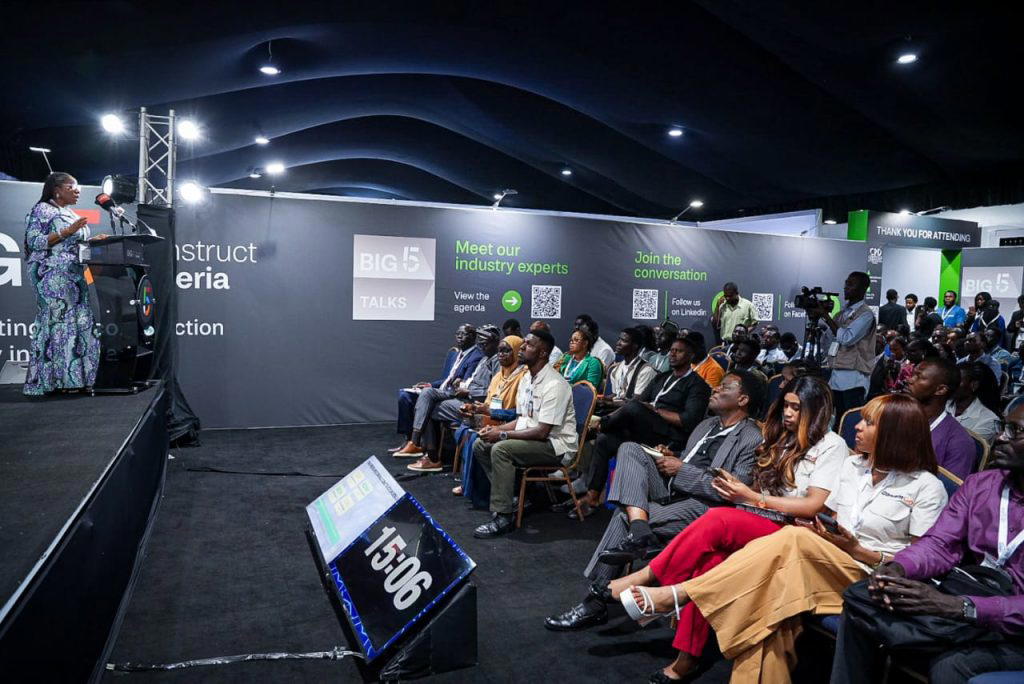
Agberagba spoke on the topic, ‘Nigeria’s Construction Outlook 2026: Market Realities and Delivery Priorities,’ at the sixth edition of Big 5 Construct Nigeria in Lagos.
She said: “If you look at the industry we have today, we are not short of projects. What we are short of, however, is completed projects. You can even go a little further to say that we are not short of completed projects; we are short of well-maintained projects. Some projects are completed and have a beautiful outlook at the time of commissioning, but after a few years, they begin to look like abandoned projects. The Nigerian construction market does not suffer from a lack of demand.
“Our population is growing and increasing by the day, while our cities are expanding. There is a need for housing, more power, proper transportation, water and industrial infrastructure. As the population grows, these things also need to expand. So, we are not short of projects. We have project pipelines, but the challenge is converting this list of projects into financed, executed and sustained projects. When we consider what we expect in Nigeria, the people we need to look out for are those who will ensure that there is a proper structure for the construction industry and that financing is available for these projects to be delivered.
“Those are the kinds of people we are looking out for. Those are the people we are going to applaud in Nigeria and say: ‘Yes, you have come to lead us, and you have properly planned how to secure financing to deliver these projects to everyone.’ But, of course, there are barriers.
“As I said, the population is growing. I think we have about 232 million people in Nigeria. I believe the census being planned will give us the exact population we have at the moment. Then we have urbanisation. Everybody is moving. There is continuous movement towards urban areas. This is also a barrier. Then we look at the Federal Government’s capital expenditure. As of 2025, our budget had N23.9 trillion for capital expenditure, focusing on power, transportation and, I think, water.
“Where has that taken us? If you look at our monetary policy, which the private sector considers when deciding whether to invest, the rate stood at 25.7 per cent as of 2025. As I said, demand is not the question. The scale of demand is increasing, but we are looking at affordability, financing conditions and delivery discipline. These are the real constraints preventing us from having a proper outlook for our construction industry.
“Looking beyond 2026, there are several forces that will shape the industry. There are several factors that we must consider. Urbanisation and infrastructure deficits will continue to drive our needs. Energy demand and industrial expansion will create opportunities for us. If we do not have energy, we cannot talk about industrialisation.
“So, energy is an enabler. Then, if you look at selected capital costs, volatility and rising expectations, these will separate serious players from the rest. We also have to consider energy demand and industrial expansion, which, as I said, present new opportunities for us. They unlock wider economic development. Alongside transportation and logistics, these are very relevant opportunities that we cannot afford to overlook. If Nigeria must grow, if our economy must improve, if job opportunities are to be created and if projects are to be delivered on time, then we must focus on energy and power delivery, as well as transportation.”
Meanwhile, Senior Vice President at DMG Events, Josine Heijmans, said population growth, urbanisation and economic diversification were increasing the need for infrastructure development in Nigeria.
Also speaking on the sidelines of the event, she said bringing stakeholders involved in project delivery together was important to addressing the country’s infrastructure needs.
She said: “Nigeria, driven by population growth, urbanisation and economic diversification, needs strong development in infrastructure, transport and social infrastructure. To deliver these projects, it is really important to bring stakeholders involved in delivering them together, and that is what platforms like Big 5 Construct Nigeria do.
“The stakeholders come every year to explore the latest products that are maybe not yet in the market. There are a lot of opportunities for knowledge exchange and discussion, and sometimes discussions around the challenges that the Nigerian market is facing.”
Likewise, speaking on behalf of Bosch, an exhibitor at the event, Managing Director of Robert Bosch Nigeria, Dr Samson Ajayi, said the company’s continued participation was driven by the opportunity to engage key stakeholders in the construction industry.
Ajayi said: “This is our third time exhibiting here, and over the years, we have felt it makes sense to be here because this is where key stakeholders in the construction industry actually converge. Conversations here are top-level, and the quality of the audience is top-notch. Based on the success that we have experienced in previous years, this year it makes us strongly participate as a sponsor because we want to scale up the conversations that we had in the past.”
The post Why energy, infrastructure deficits’ll shape construction beyond 2026 – NSE appeared first on Vanguard News.