

… Experts add: Register them where they are born
By Chioma Obinna
The first cry came, then the rush of hands. A newborn baby girl had just entered the world. While nurses attended to the mother and cleaned the baby, Emmanuel Joseph was already thinking beyond the excitement of fatherhood.
He wanted his daughter to exist not only in his family, but also in the records of the country.
Within minutes of his wife’s delivery, Joseph walked out of the labour area in search of the nurse in charge.
“I asked if they had a desk where I could register the birth of my child,” he told Good health weekly.
The nurse was surprised.
“She asked if I really had a name for my child because the child would not be registered if I did not have a name. I told her yes.”
Joseph was directed to a National Population Commission, NPC, registration unit within the hospital.
There, another surprise awaited the registrar.
“They were also surprised that I came for a child that the nurses were still busy cleaning up,” he said.
But the registrar quickly got to work. A chair was provided, a form brought out and Joseph completed the necessary details.
His daughter was registered. Free of charge.
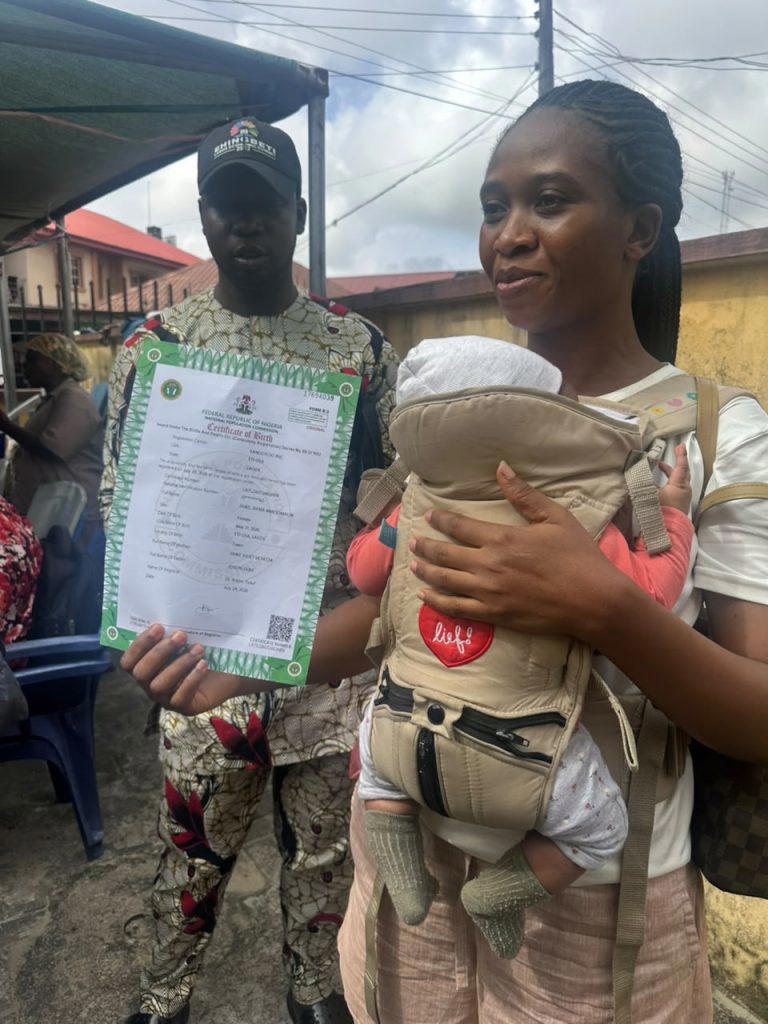
Before the family left the hospital, Joseph had in his hands what could become one of the most important documents in his daughter’s life — her birth certificate.
“I know the importance of birth registration and what it means for a child. It shows that the child is a Nigerian and can be budgeted for and counted. She will need it all through her life,” he said.
For Joseph, the experience was simple. For millions of Nigerian children, however, getting that first legal identity remains anything but simple.
Across Lagos, Ogun, Oyo, Osun, Ondo, Ekiti and Edo states, an estimated 3.5 million children are without birth certificates, according to officials reports. These children are not missing and not necessarily abandoned.
But they are living in homes, going to hospitals, attending clinics and growing up within communities but whose births may never have been entered into the official records of the country.
In the words of Chief of UNICEF Lagos Field Office, Celine Lafoucriere: “They are children who are alive, at home, loved by their families, but completely invisible to their state and the country.
“Some are in cities. Some are in villages. Some were born in hospitals and still never got registered. The gap is everywhere.”
The contradiction is stark.
A child may be born inside a health facility, surrounded by doctors, nurses, midwives and health workers, yet leave that same facility without a legal identity. That is the gap health facilities could help close.
The delivery room as the first registration point. Hospitals, maternity centres and primary healthcare facilities occupy a unique position in the life of a newborn.
They know when a baby is born. They know where the child was born. They have access to the mother, father or caregiver at one of the few moments when the entire family is physically present. They are therefore potentially the most strategic entry points for universal birth registration.
According to experts, there was need to make birth registration part of routine maternal and newborn care, just as immunisation, weighing, postnatal checks and other essential services are integrated into the continuum of care.
The civil registration system itself recognises this opportunity.
One of the key accelerators identified for scaling up legal identity services is the integration of birth registration with primary healthcare services, alongside decentralisation, digitalisation, data interoperability and social mobilisation. The strategy envisages birth registration becoming an integral component of PHC services and expanding registration points to wards and health facilities.
The logic is compelling.
Instead of asking a mother who has just delivered a baby to make another journey to a distant registration centre, the registration service comes to the place where the birth has already been recorded.
Instead of relying on parents to know that registration is free, health workers can tell them.
Instead of waiting weeks or months, registration can begin before the mother leaves the facility.
And instead of treating birth registration as a bureaucratic afterthought, it becomes part of protecting the child from the moment of birth.
A mother’s experience
Duke Juliet, a mother of two, understands the value of that document. “I just wanted to do a birth certificate for my child. Because I know that it’s very important,” she said.
Her experience was largely seamless.
She filled the form, submitted it and received the certificate without paying.
When she later returned for immunisation, she was informed that the document was ready.
Her experience with her first child was less straightforward. At one point, she had to redo the registration because the handwritten document was not ready for printing.
The newer process, she said, was faster.
“This one didn’t take up to a month. This one came out. There was no money,” she said.
For Juliet, the lesson for other mothers is clear: information must follow women into the health system.
“For other women, I think that once they go for immunization and all, they will be informed.”
For Juliet, every antenatal clinic, every delivery room, every postnatal clinic, every immunisation session and every PHC visit could become an opportunity to ask one simple question: “Has this child been registered?”
Where the system works, and where it breaks
At on of the Primary Healthcare in Sangotedo, area of Lagos, the transition from paper to digital birth registration is already exposing both the promise and the weaknesses of the new system.
According to Mr. Gabriel Aboton-Philip, NPC Registrar-in-Charge of Sangotedo, paper registration was officially discontinued from July 1, 2026, with registration moving online.
The digital system, he said, has been welcomed by more educated parents.
But for families in surrounding communities, the transition has exposed another layer of exclusion.
The first obstacle is the National Identification Number, NIN.
“Many of the mothers or the fathers don’t have NIN,” Aboton-Philip said.
He recalled spending four days at the registration point for a free online registration exercise for children aged zero to five.
Seventy-six people submitted their details.
Only 46 were successfully registered.
In some cases, parents provided NINs but their information could not be retrieved on the system.
Then comes another familiar problem, connectivity.
“When we register sometimes, when it gets to the point of submitting, sometimes it delays,” he said.
The problem, he explained, is internet connectivity.
The registrar therefore developed a workaround. Instead of keeping mothers waiting indefinitely, his team collects their details on a form and contacts them when necessary.
“With good network, within five minutes, you are done with your registration. But if there are network challenges, sometimes it takes as long as 10 to 15 minutes, dealing with one person,” he said.
The lesson is uncomfortable but important.
Digitalisation can make birth registration faster, cheaper and more accessible.
But digitalisation without reliable connectivity, functioning identity databases and trained personnel can simply move the barriers from a paper desk to a computer screen.
Invisible barriers
For families who fail to register their children, the reasons are not always neglect. Sometimes it is distance. Sometimes money. Sometimes language. Sometimes ignorance. Sometimes a lack of registration centres. Sometimes a parent does not understand why the document matters until the child urgently needs it.
Speaking at a birth registration media dialogue in Lagos, the UNICEF Child Protection Specialist, Mr. Denise Onoise, identified limited accessibility, inadequate registration centres, long distances, language barriers, inefficient registration processes and insufficient financial, human and material resources as major obstacles.
He noted that the burden is not only the official cost of registration.
Families may also spend money travelling to registration points, lose income by taking time away from work, make repeated journeys and endure poor-quality services.
“The problem is compounded in hard-to-reach areas and among disadvantaged population groups,” he said.
This is why the hospital could be more than a place where a child is delivered.
It could be the first gateway to citizenship. The price of being invisible. A birth certificate is often dismissed as a piece of paper that can be obtained later. But that paper represents much more. It establishes a child’s legal identity, name, gender, place and date of birth and provides information governments need for planning health, education, housing and social protection programmes.
For UNICEF’s Lafoucriere: “A birth certificate is not a piece of paper. It is a child’s ticket into school. It is what allows a doctor to put a name on a patient file. It is how a family proves their child is theirs.”
Without it, she warned, a child may face difficulties proving identity later in life, including accessing passports, voting and inheritance.
The consequences can become even more dangerous for vulnerable children.
Further, Onoise in his presentation, further identified risks ranging from exclusion from education, healthcare, social protection and justice systems to child marriage, child labour, trafficking, abuse, exploitation and family separation.
Children in marginalised, underserved and hard-to-reach communities are particularly exposed.
In other words, failure to register a birth does not merely create an administrative inconvenience.
It can create a lifetime of vulnerability.
NIN hurdle
Nigeria’s move towards digital birth registration is also bringing the country’s identity systems face-to-face with one another.
The current system requires parents to provide NIN details, while the birth registration process is designed to link the child to the national identity framework.
Registrars told parents that registration for children aged zero to five is free and that parents should ensure their NIN information is correct before registration.
The registrar also explained that the child must be physically present for capturing and that the system generates a NIN for the child.
That integration could eventually create a seamless identity chain from birth to adulthood.
But the Sangotedo experience shows why the chain must be as strong as its weakest link.
If a mother does not have a NIN, the child’s registration may stall.
If the NIN database does not return the parent’s details, registration may stall. If the internet fails, registration may stall. If there are too few registrars, registration may stall.
And if the family lives far from a registration point, they may never start.
The answer, therefore, is not simply to digitise. It is to bring the entire system closer to families.
Experts say a registration desk beside the weighing scale would bridge gaps and ensures infants are given immediate legal identity.
The case for integration with healthcare is already contained in the reform agenda.
The proposed approach includes decentralising services to local governments and establishing more registration points at ward and health-facility levels. It also calls for stronger interoperability between civil registration, health and identity management systems.
Imagine a mother arriving at a PHC for her baby’s immunisation.
The nurse checks the child’s vaccination card. The health worker asks whether the birth has been registered.
If not, the mother is immediately referred to an NPC registrar stationed within the facility or connected digitally to the registration system.
The registrar verifies the parents’ details. The baby is captured.
The birth is registered.
The NIN is generated.
The certificate is issued.
One visit. One integrated system.
One less child invisible to government. That is the promise.
But the reality remains unfinished.
However, according to Onoise on lessons learned from civil registration efforts showed that community-based registration expanded coverage and helped identify previously unregistered children. Digital registration improved efficiency and data quality, while interoperability strengthened coordination.
He further revealed major weaknesses such as health-facility interoperability had stalled at the profiling stage, with none of 371 targeted facilities live despite completed training. The birth notification pipeline had recorded zero notifications in the reporting year, while certificate issuance lagged behind registration — 120,469 certificates issued against 443,162 registrations.
That is the unfinished business.
The delivery room is ready.
The technology is emerging.
The parents are already there.
What is missing is a system capable of connecting all three.
From paper to a national identity
Nigeria’s civil registration architecture remains fragmented, with different agencies collecting identity-related information for different purposes.
The National Identity Management Commission manages NIN; NPC handles population and civil registration data; immigration manages passports; the Federal Road Safety Corps manages driver’s licences; the Central Bank of Nigeria manages BVN, while INEC handles voter registration, among others.
The fragmentation means critical child-related services such as school enrolment, immunisation and child justice do not yet operate through one unified identity system linked to birth registration.
The Partnership Compact involving NPC, the Association of Local Governments of Nigeria, NIMC, UNICEF and Barnksforte Technologies Limited is designed to tackle some of these weaknesses through harmonisation, decentralisation, stronger infrastructure and universal access.
Under the proposed arrangement, NPC would manage the national birth and death registration system and work with local governments; ALGON would support implementation at local level and establish additional registration centres; NIMC would ensure identity-system integration and prompt NIN assignment; while UNICEF would provide technical, financial and technological support.
The ambition is bigger than issuing certificates.
It is about building a child-centred identity system that follows a Nigerian from birth through the services and opportunities that define life.
A child born today should not have to become an adult before the country can prove that the child exists.
The health system can change that.
The first opportunity may come within minutes of birth.
Joseph’s daughter is proof that when the system is available, when the parent understands its value and when the registrar is within reach, registration can happen before the family even leaves the hospital.
His story should not be an exception.
It should be the standard.
Because every newborn arrives with more than a name chosen by parents.
Every child arrives with a right to identity. And perhaps the most powerful place to begin protecting that right is where life itself begins — in the delivery room.
The challenge now is to ensure that no mother walks out of a Nigerian hospital holding her newborn, while the country has yet to record that the child was ever born.
Explaining how the e- birth registration works, the Lagos State Director of the National Population Commission, Sherifdeen Kekere-Ekun Mr Kekere-Ekun emphasized that birth registration is now fully free for children between 0 to 5 years.
“We are no longer doing that handwritten registration. It has been phased out. We are now using digitalized one. This is digitalized birth certificate for your child.
0 to 5 years old is free. When you want to register your child, you must come with your NIN.
Your NIN or your husband’s NIN. And make sure that the name is correct. The name on the NIN and the name that is going to be on the child’s birth certificate is correct.
All the information, you have to give it to the registrar in charge to register your child. You are not paying 0 to 5 years. So once your child is above 5 years and you didn’t register, it’s called late registration.
That is when you have to make payment. And the payment is N5,000. And you must provide an email to be able to log in.
The old one is still valid. If you have registered the old one before 1st July, 2026, it’s still valid. You can still make use of it. But that’s not what we call it. We issue that manual only.”
“For mothers, if you don’t want to change your name for your parents’ name and you want to still maintain your father’s name, it’s still okay. So whatever name that you have on your NIN is what is going to be applicable, to be applied on this birth certificate.
So once there is a mistake on your NIN, you have to correct it before coming to the birth registration office. But if you want to change your husband’s name, there’s no problem. You have to make that correction before coming to the birth certificate office. Normally it takes 3 days. That is 72 hours. So that the NIN of your child will be applied.”
“It also has a tracking eye that you can see here. You have to bring your baby when coming to register. You must come with your baby for capturing. Pictures are not acceptable when you are coming to register the baby.”
Explaining some of the hitches, he said the NIN could not be confirmed or unable to submit, it may delay registration.
He charged the media to move beyond reporting statistics and government activities by taking the birth registration message directly to parents and caregivers in communities.
He stressed that accurate registration of births was also essential for effective governance, as reliable demographic data would enable government to determine the number and distribution of children and plan adequately for education, healthcare, social protection and other services.
The post 3.5m missing births:: How hospitals can close Nigeria’s registration gap appeared first on Vanguard News.