

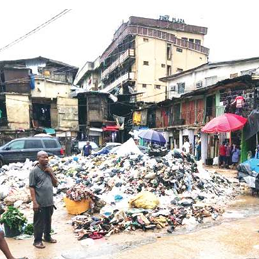
…Some spaces for demolished shops now serve as car parks, refuse dump site
By Chimaobi Nwaiwu
FEW months ago, precisely on March 1, 2026, the Anambra State Government moved in with bulldozers to demolish some shops at the popular Onitsha Main Market.
The government claimed the shops were illegal, that they were not authorised to be erected in those places. But the occupying traders countered the position, insisting that they have receipts and allocation papers given to them after buying the shops from the government through the Onitsha North Local Government Council.
Their arguments did not change anything as the shops were reduced to rubbles. Over ten thousand shops were said to have been pulled down, with the fate of the owners now hanging in the balance.
About the popular Market
The Premier of the defunct Eastern Region, the late Dr Michael I. Okpara, was said to be instrumental in the building of the market with structures that were destroyed and burnt during the civil war.
After the war, it was rebuilt into a morden one, and officially named Onitsha Main Market, which turned out to be the biggest market in West Africa, attracting traders from within and beyond Nigeria, including Ghana, Cameroon,Togo, Benin Republic, among others.
Interestingly, over the years, many other markets had sprung up in and around Onitsha, all having roots in the Main Market.
The President of Onitsha Chamber of Commerce, Industry, Mines and Agriculture, ONCCIMA, Sir Chinedu Nwonu, told SEV that there are over 15 big markets that sprang up from the Onitsha Main Market.
And the interesting aspect of the movement of such markets is that the Onitsha Main Market keeps regenerating and keeps expanding, so that the whole of those areas are assumed to be part of the Onitsha Main Market.
“The economic significance of the Onitsha Main Market, no doubt, makes it the largest open market in the whole of West Africa. It is usually regarded as the largest, as a matter of fact, in Africa, and not just in West Africa, in terms of geographical spread or size, and the volume of goods traded on a daily basis.
“In fact, in terms of business volume, it is estimated that over $5billion to $10 billion worth of goods are traded in the Onitsha Main Market on an annual basis, with daily transactions hovering around $10 to $15 million dollars; this is humongous, and it surpasses what is witnessed in most markets as far as West Africa is concerned.
“Onitsha Main Market is a critical hub, because if you are coming in from Delta State, you have to come into Onitsha, where the market is located, before you start going to Imo or Enugu states, and then to Abia, Cross River, Rivers , and the rest. So you have different items being traded in the market, and people come from Lagos and other parts of the country on a daily basis to the market to buy fashion and fashion accessories.
“As a matter of fact, it is being said that most of these containers that are cleared in Lagos come into Onitsha Main Market before going back to Lagos, Abuja or even the North So it is a market of significance, it is a market that is critical to the nation, it is a market that is significant as far as trade is concerned in Africa and West Africa.”
Before the government bulldozers moved in for the demolition, many groups, including the Onitsha Chamber of Commerce, Industry Mines and Agriculture, ONCCIMA, United Igbo Elders Council, UNIEC, Igboezue International Association Nigeria and the Diaspora, IIAND, the Ohanaeze Ndigbo, pleaded with the state government to have a rethink, pointing out the economic implications to the traders, but the Governor Charles Soludo-led government ignored the appeals and went ahead with its decision.
A recent visit to the market revealed that many of the traders who were displaced by the demolition exercise are finding it very difficult to cope and readjust, as securing new shops is not easy in the market.
To feed their families, some of them have resorted to a daily display of wares in the open spaces, using big umbrellas and taking the goods home at the end of the day, using commercial tricycles, Chinese motorcycles that are now in vogue in Onitsha, while warehousing them in the shops of friends not affected by the demolition. Also, some have relocated to other places within and outside the state.
Some affected traders, SEV further observed, have also resorted to operating a Point Of Sale, POS, business to survive.
What currently obtains in the open spaces is stand-up business transactions, as most traders hang their goods on mobile hangers, while others carry their goods in wheel barrows and other constructed mobile metal carts they push home after the day’s trading activities.
Four months after the hurried demolition, no reconstruction is ongoing as promised by the government. Residents now question why the shops were demolished if there were no plans to build better structures or site something else in those places, why allow the place to lie waste while former owners suffer?
Meanwhile, some parts of the demolished shops have been turned into car parks and dustbins by the residents and traders.
An affected trader who gave his name as Joseph Eze said that they have gone through all sorts of challenges since the demolition of their shops, adding that the rainy season is aggravating their suffering as sudden rains keep destroying the displayed goods.
According to another affected trader, Mr Magnus Okoro: “What I lost in the demolition cannot be quantified, and it will take another 10 years before I will get to the level I was before the demolition exercise.
“It is unfortunate that the Anambra State Government decided to set us back, and nothing in terms of what they said they want to do with the spaces for the demolished shops has started, and we are sure nothing will happen there.
“Meanwhile, we have been rendered homeless, our shops have been destroyed, and the space turned to an open field where cars are parked, where nothing is happening except the collection of tolls for cars parked by traders not affected by the demolition.
“You can see that the space is also gradually turning into a dump site and car park. You destroyed thousands of shops, displaced millions of traders, and turned the space into a car park and dump site, while thousands of families cannot feed because their source of livelihood has been taken away without any replacement.
“It is unfortunate that this is happening; it has become a practice in Anambra State, particularly in Onitsha, where the government destroys shops, displaces thousands of people, and the reason for such demolitions is abandoned, while the spaces are turned into motor parks where one or two people collect daily tolls.
“This is the situation we have found ourselves in, and it is not funny; we are suffering, and many are dying due to suffering.”
The post Lamentations of displaced Onitsha Main Market traders appeared first on Vanguard News.

 Vanguard Nigeria
 Capital Ethopia
 Business Day
 Modern Ghana
 Daily Post
 Premium TImes
 Channels TV
 Punch Nigeria
 Complete Sports